
The Best Routine for Hyperpigmentation and Post-Acne Dark Spots
How to identify PIH, PIE, melasma and acne scars, then choose one active azelaic acid, vitamin C or a retinoid you can tolerate long enough to work.
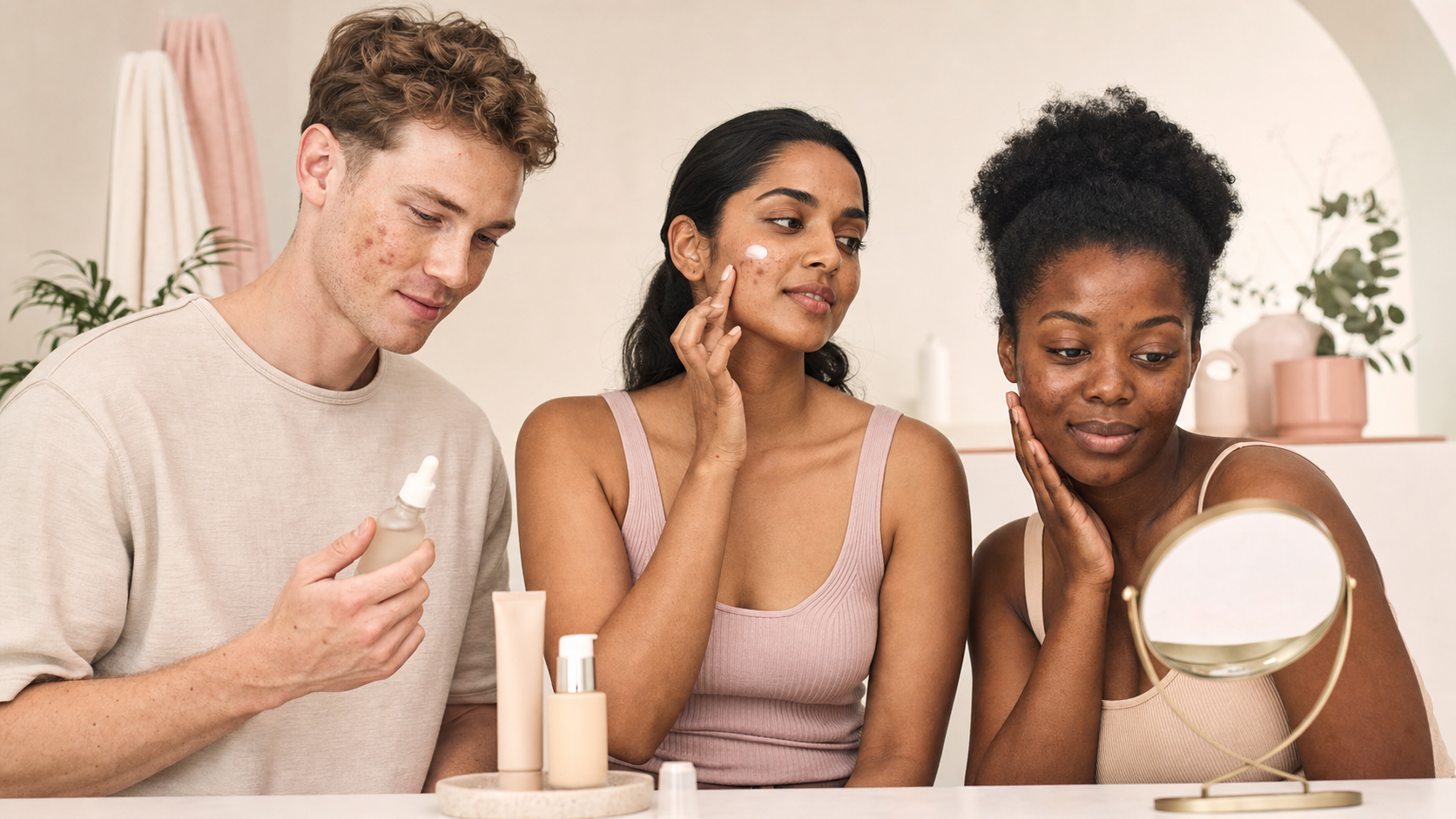
A calm, evidence-based routine for post-acne dark spots and hyperpigmentation: how to tell PIH, PIE, melasma and acne scars apart, and how to build a simple AM/PM routine around one active.
Dark spots rarely need the longest or strongest routine. They need the right diagnosis, consistent protection from light and one treatment your skin can tolerate long enough to work. That distinction matters because "hyperpigmentation" is an umbrella term, not one condition. A flat brown mark left after a spot is not the same as melasma, a red post-acne mark or an indented acne scar. The products that help one may have little effect on another.
For most post-acne hyperpigmentation, the foundation is simple:
- Control new acne and irritation.
- Protect the skin from ultraviolet and visible light every morning.
- Choose one main pigment treatment.
- Support the skin barrier with gentle cleansing and moisturiser.
- Review the routine after several consistent weeks, not several days.
This guide compares azelaic acid, vitamin C, retinoids and exfoliating acids, then shows you how to turn one of them into a routine without over-treating your skin.
Want a routine matched to your skin? Take the Radiant Eden Skin Routine Quiz to match your skin type, sensitivity and main concern with a simple routine.
First, identify the kind of mark you have
Before buying a "dark-spot corrector", look at the colour, shape, location and history of the mark.
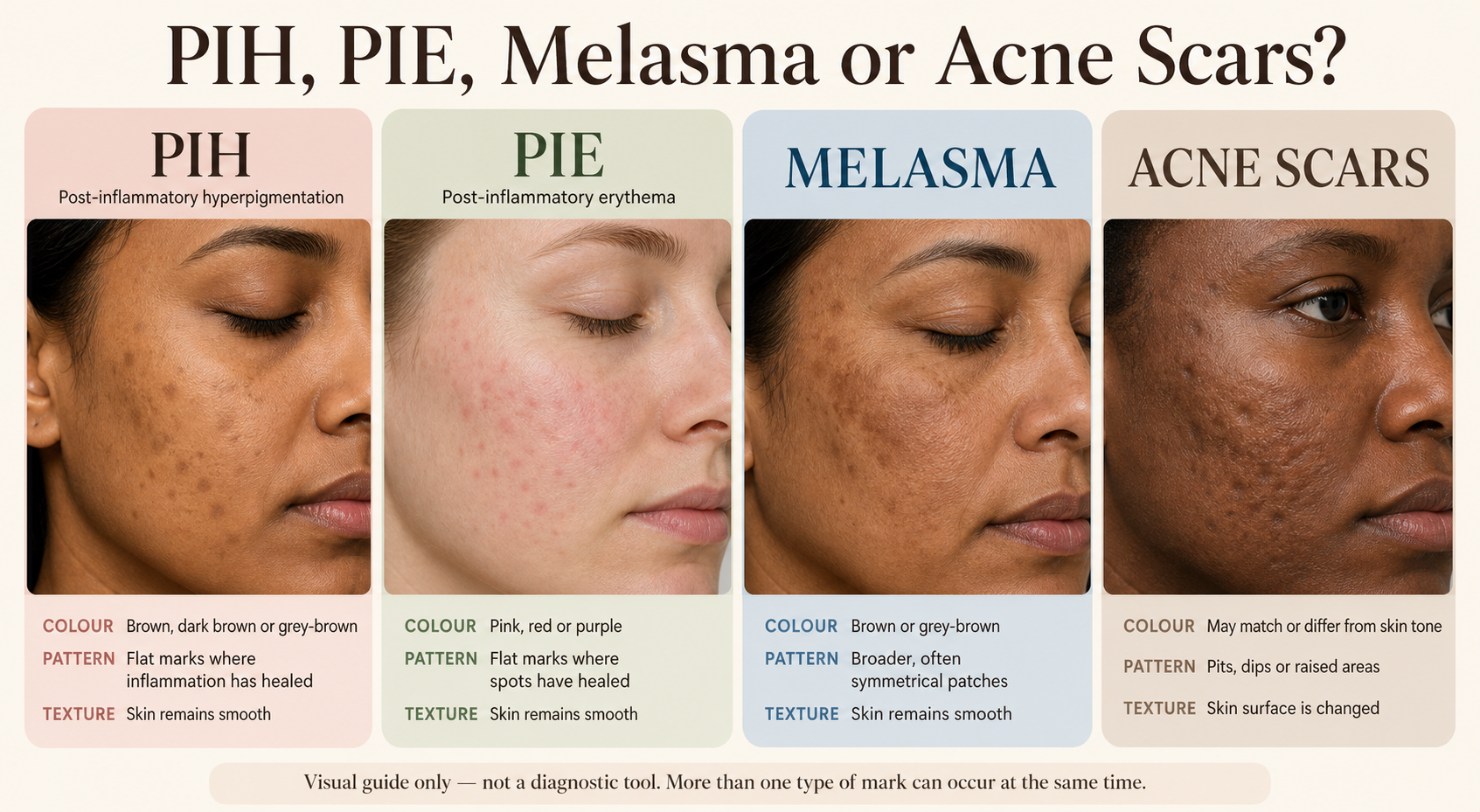
Hyperpigmentation is the broad category
Hyperpigmentation means an area of skin has become darker because of increased pigment. It can have many causes, including inflammation, sun exposure, hormonal influences, medication and certain skin conditions. Post-inflammatory hyperpigmentation and melasma are both forms of hyperpigmentation, but they behave differently and may need different treatment plans.
Post-inflammatory hyperpigmentation follows inflammation or injury
Post-inflammatory hyperpigmentation, usually shortened to PIH, appears after the skin has been inflamed or injured. Acne is a common trigger, but eczema, insect bites, burns, picking, friction and irritating skincare can also leave marks.
PIH is usually flat rather than raised or indented. On lighter skin it may look tan or brown. On deeper skin tones it may appear dark brown, grey-brown, blue-grey or almost black, depending on how deeply the pigment sits.
The first treatment is to stop the source of inflammation. If new acne continues to appear, a fading product may improve old marks while new ones replace them. The American Academy of Dermatology recommends treating the underlying skin condition as part of treating the pigmentation.
Red or purple post-acne marks may not be hyperpigmentation
Flat pink, red or purplish marks can be post-inflammatory erythema, or PIE. These marks are linked more closely to changes in small blood vessels than to excess melanin.
PIE and PIH can exist at the same time, particularly in medium and deeper skin tones where colour can be harder to judge. Pigment-fading ingredients may not fully resolve a vascular red mark. Persistent redness, flushing or uncertainty is a good reason to ask a dermatologist for a diagnosis.
Melasma usually forms broader, recurring patches
Melasma commonly appears as symmetrical, blotchy brown or grey-brown patches, often on the cheeks, forehead, upper lip or jawline. Light exposure, hormonal influences and genetic tendency can all contribute. It may begin or worsen during pregnancy or while using hormonal contraception, although not every case has an obvious trigger.
Unlike a single post-acne mark, melasma often returns and is easily aggravated by sunlight, visible light, heat or irritation. The American Academy of Dermatology advises broad-spectrum SPF 30 or higher and highlights tinted sunscreen containing iron oxide because visible light can worsen melasma, particularly in darker skin tones.
If the patches are symmetrical, expanding or unrelated to a recent spot, treat "melasma" as a possibility, not a self-diagnosis. A dermatologist can distinguish it from other causes of facial pigmentation and discuss prescription options.
Dark marks are not the same as acne scars
A flat change in colour is a mark. A change in skin texture is a scar.
- Flat brown, grey, red or purple area: more likely to be a post-inflammatory mark.
- Indentation, pit or rolling depression: an atrophic acne scar.
- Raised, firm area: a hypertrophic scar or keloid.
Skincare may fade pigment, but it cannot rebuild a deep indentation or flatten every raised scar. Textural scarring usually needs professional assessment and may require procedures.
Why dark spots become stubborn
Pigmentation often lasts because the skin is receiving repeated signals to produce or retain pigment. Common reasons include:
- New acne or inflammation: every new breakout can create another mark.
- Sun and visible light: light can darken existing pigment and make melasma more persistent.
- Picking or squeezing: physical injury increases inflammation and the chance of a lasting mark.
- An irritated skin barrier: burning, peeling and dermatitis can create more inflammation instead of faster fading.
- Too many actives: stacking a retinoid, strong acid toner, exfoliating mask and brightening serum can turn treatment into injury.
- Pigment sitting deeper in the skin: deeper grey-brown or blue-grey pigmentation usually fades more slowly than a light surface mark.
The AAD notes that a spot only a few shades darker than the surrounding skin may take 6 to 12 months to fade naturally, while deeper pigmentation can take considerably longer. Treatment can help, but it cannot make skin biology instantaneous.
The best morning and evening routine for dark spots
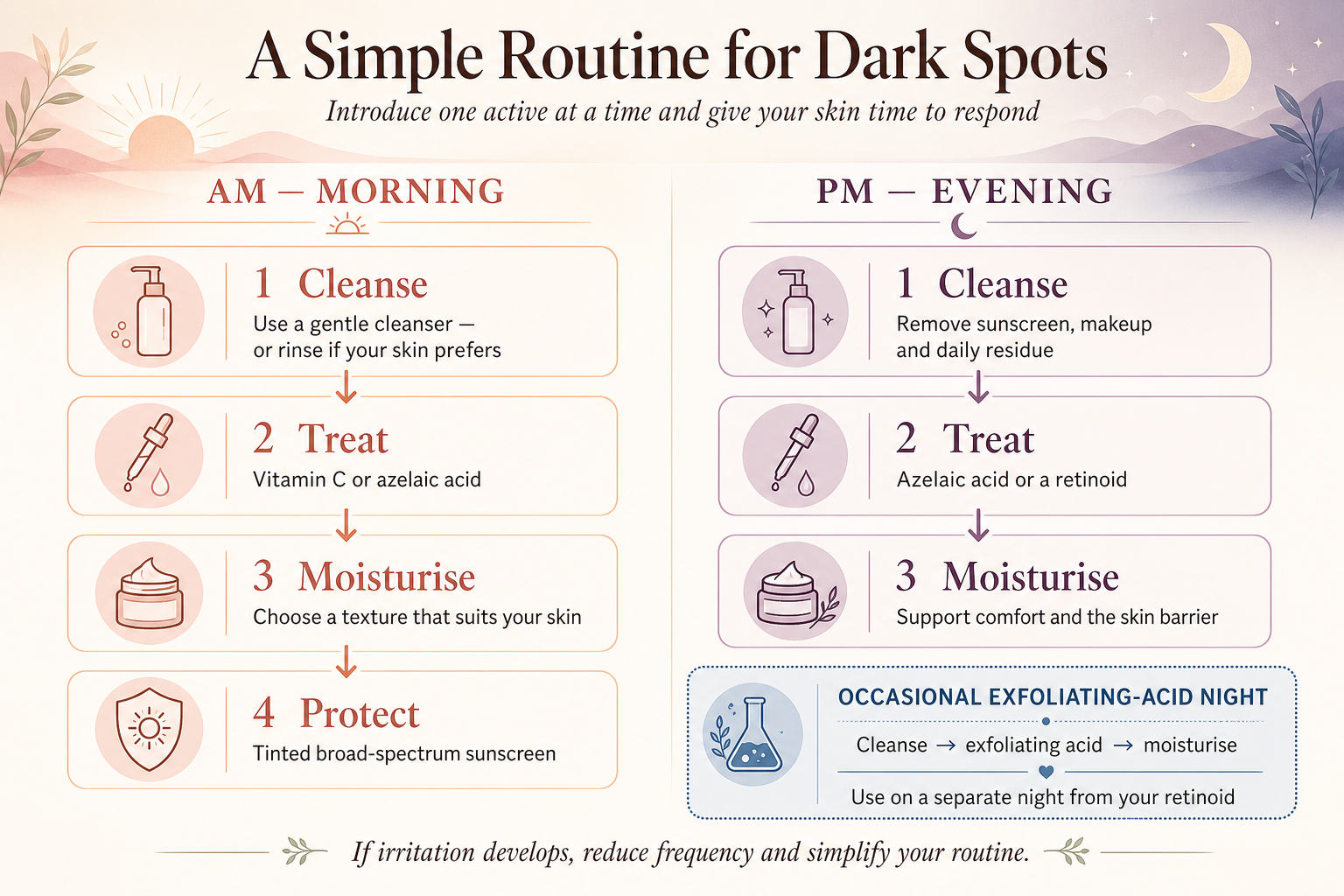
The best morning routine for dark spots
Morning care should limit new pigment and protect the progress made by your treatment.
Step 1: Cleanse gently or simply rinse. Use a mild cleanser if you wake with oil, sweat or product residue. If your skin is dry or easily irritated, rinsing with lukewarm water may be enough. Avoid scrubs, cleansing brushes and very hot water. A cleanser does not need to make the skin feel tight to work.
Step 2: Apply one optional treatment. Choose vitamin C or azelaic acid if it suits your skin. You do not need both.
- Choose vitamin C if you want antioxidant support and a morning product for general uneven tone.
- Choose azelaic acid if you have both acne and brown post-acne marks, or if you prefer one ingredient that targets inflammation as well as pigment.
- Skip a morning active if the skin is stinging, peeling or recovering from irritation.
Step 3: Use moisturiser where needed. A moisturiser helps the skin tolerate treatment and reduces the temptation to compensate for dryness with more products.
- Oily skin may prefer a light lotion or gel-cream.
- Dry or sensitive skin may need a cream with glycerin, ceramides or other barrier-supporting ingredients.
Step 4: Finish with sunscreen. Sunscreen is not an optional "prevention" step added after the real treatment. It is part of the treatment. Choose a sunscreen that is:
- broad-spectrum;
- SPF 30 or higher;
- comfortable enough to apply generously every day; and
- non-comedogenic if you are acne-prone.
For persistent PIH or melasma, a tinted sunscreen containing iron oxides adds protection against visible light. Reapply when spending time outdoors, after sweating or swimming, and at least every two hours during sustained exposure, as advised by the AAD. Makeup with SPF is not usually applied in a thick or even enough layer to replace a dedicated sunscreen.
The best evening routine for dark spots
Evening is the simplest place to use your main treatment active.
Step 1: Remove sunscreen and makeup. Use one gentle cleanser that removes the day comfortably. A separate first cleanse can help with water-resistant sunscreen or heavy makeup, but double cleansing is not compulsory if one cleanser works.
Step 2: Choose one main treatment pathway. Start with one of the following:
- Azelaic-acid pathway: useful for acne, PIH and sensitive or redness-prone skin.
- Retinoid pathway: useful when ongoing acne, clogged pores, texture and pigmentation need to be addressed together.
- Exfoliating-acid pathway: an optional route for surface dullness and congestion when retinoids are not used or tolerated.
Vitamin C is usually easiest to place in the morning, although a stable formula can also be used at night.
Step 3: Moisturise. Apply moisturiser after the active, or before and after a retinoid if the "sandwich" method makes it more tolerable. Applying moisturiser first may buffer the product slightly, but consistency is more useful than forcing maximum strength.
Azelaic acid, vitamin C, retinoids or exfoliating acids?
No single ingredient is automatically best. The right choice depends on what is causing the marks, whether acne is still active and how easily your skin becomes irritated.
Azelaic acid
- Often suits: acne-prone, PIH-prone, sensitive or redness-prone skin.
- Main advantages: targets acne, inflammation and excess pigment in one step.
- Main limitations: can tingle, itch or feel drying at first; stronger strengths may require professional guidance.
- Sensible place in a routine: morning or evening; start once daily or on alternate days.
Vitamin C
- Often suits: dullness, uneven tone and people wanting antioxidant support.
- Main advantages: works well beneath sunscreen; can support brighter, more even-looking skin.
- Main limitations: formulas vary greatly in stability and tolerability; evidence is less consistent than marketing suggests.
- Sensible place in a routine: morning, before moisturiser and sunscreen.
Retinoid
- Often suits: ongoing acne, clogged pores, uneven texture and PIH.
- Main advantages: treats acne while supporting cell turnover and more even tone.
- Main limitations: commonly causes dryness and irritation; topical retinoids should not be used during pregnancy.
- Sensible place in a routine: evening; introduce slowly.
Exfoliating acid
- Often suits: surface roughness, dullness or congestion.
- Main advantages: can improve surface texture and help shed pigmented cells.
- Main limitations: easy to overuse; irritation can worsen PIH, particularly in deeper skin tones.
- Sensible place in a routine: one evening weekly at first, replacing — not accompanying — a retinoid that night.
Azelaic acid: the useful all-rounder
Azelaic acid is particularly practical when dark spots and active acne occur together. It can help reduce acne-related inflammation and interfere with abnormal excess pigment production.
It is available in cosmetic and prescription strengths, depending on the country and product. Higher is not automatically better: a well-tolerated lower-strength formula used consistently may be more productive than a stronger formula that causes dermatitis.
Azelaic acid may sting or itch briefly, especially on damp or irritated skin. Apply it to dry skin, begin slowly and use moisturiser. Stop and seek advice if irritation is persistent or severe.
Best fit: post-acne PIH with ongoing breakouts, skin that does not tolerate retinoids well, or a routine that needs one versatile active.
Vitamin C: useful, but formulation matters
Topical vitamin C can support antioxidant protection and improve the appearance of uneven tone. The AAD includes vitamin C among over the counter ingredients that may help fade dark spots.
The challenge is the formula. Pure ascorbic acid can be unstable and may sting at lower pH; derivatives may be gentler but do not all have the same evidence. Packaging that limits light and air is helpful. A serum that has turned very dark orange or brown may have oxidised and should be replaced according to the manufacturer's instructions.
Vitamin C is not a substitute for sunscreen, and it is not automatically stronger because it has a high percentage.
Best fit: a morning routine for general uneven tone, especially when the skin already tolerates sunscreen and basic care well.
Retinoids: strong choice when acne is still forming marks
Retinoids are a family of vitamin A-derived ingredients. Prescription tretinoin and adapalene are different from cosmetic retinol or retinal, but all can cause irritation if introduced too quickly.
For acne-prone skin, a suitable retinoid can address the source of new marks by helping prevent blocked pores while also improving uneven pigmentation over time. This makes it a logical choice when the problem is not just old pigment but continuing acne.
Start with a pea-sized amount for the entire face, one or two evenings per week. Increase gradually only when the skin is comfortable. Keep it away from the eyelids, corners of the nose and lips unless a clinician or product instruction says otherwise.
Do not combine a new retinoid with several exfoliating products. Retinoid dermatitis can itself worsen PIH, a particular concern in deeper skin tones.
The NHS advises that topical retinoids are unsuitable during pregnancy. If you are pregnant, planning pregnancy or unsure what is appropriate while breastfeeding, ask a doctor, pharmacist or midwife before using a retinoid.
Best fit: acne, clogged pores, texture and PIH in a person who can introduce treatment patiently and is not pregnant or planning pregnancy.
Exfoliating acids: optional, not essential
Alpha-hydroxy acids such as glycolic, lactic and mandelic acid loosen bonds between surface cells. Salicylic acid is a beta-hydroxy acid that is oil-soluble and more directly useful for clogged pores. An acid can help surface texture and may gradually improve superficial pigmentation, but exfoliation is not the core of every dark-spot routine. Strong or frequent acid use can cause burning, peeling and more inflammation.
This risk matters for melasma and PIH-prone skin. DermNet notes that chemical peels and other procedures may help epidermal pigmentation but can also aggravate it by injuring the epidermis. If you choose an exfoliating acid:
- Begin once a week;
- Use a leave-on product exactly as directed;
- Do not use it on broken or freshly irritated skin;
- Skip your retinoid on the same evening while you assess tolerance; and
- Reduce frequency if the skin becomes tight, shiny, sore or persistently flaky.
Best fit: surface roughness or congestion in skin that already has a stable barrier and does not need a retinoid that night.
How to choose the right active
If you have acne and brown marks. Start with azelaic acid or a suitable retinoid. Both can address active acne as well as the marks it leaves. The better choice is the one you can tolerate and use consistently.
If you have sensitive skin. Begin with the basic routine: cleanser, moisturiser and tinted sunscreen — until the skin is calm. Then trial azelaic acid on alternate days. Vitamin C may also work, but choose a gentle formula and stop if it repeatedly stings.
If you have dry skin. Prioritise a cream moisturiser and introduce only one active. Retinoids and exfoliating acids are more likely to feel drying, so use them less often at first.
If you have oily or congested skin. A retinoid can be helpful when clogged pores and acne keep producing new marks. Salicylic acid is an alternative for congestion, but avoid building an aggressive "degreasing" routine around it.
If you suspect melasma. Make tinted broad-spectrum sunscreen and light avoidance the foundation. Azelaic acid may be useful, but melasma often benefits from a dermatologist-led plan. Prescription hydroquinone, combination creams and procedures require appropriate supervision and are outside a simple over-the-counter routine.
If you have a deeper skin tone. Be especially cautious about irritation. PIH is more common and can be more persistent in richly pigmented skin. Introduce actives slowly, avoid high-strength home peels and do not assume visible peeling means a product is working better.
A 2024 systematic review of PIH treatment in skin of colour found that topical therapies produced useful improvement across studies, while also warning that retinoid dermatitis can worsen PIH. The evidence for many popular brightening ingredients remains uneven, so gentle consistency matters more than collecting actives.
A simple 12-week introduction plan
This is a tolerance-building framework, not a promise that every mark will disappear within 12 weeks.
Weeks 1 and 2: Establish the base
- Morning: gentle cleanse or rinse → moisturiser if needed → tinted broad-spectrum SPF 30+.
- Evening: gentle cleanse → moisturiser.
Use this phase to confirm that the skin is calm and the sunscreen is comfortable enough for daily use.
Weeks 3 and 4: Add one active
Choose one:
- azelaic acid every other morning or evening;
- vitamin C two or three mornings per week; or
- a retinoid one or two evenings per week.
Do not add an exfoliating acid at the same time.
Weeks 5 to 8: Increase only if comfortable
If there is no persistent stinging, redness, flaking or tightness, increase the active gradually according to its instructions. If irritation appears, return to the last comfortable frequency. Do not "push through" a rash to reach faster results.
Weeks 9 to 12: Review the whole pattern
Compare photographs taken in similar lighting. Look for fewer new spots, lighter edges on older marks and a more even overall tone. If acne is still active, improving acne control may be more valuable than adding another pigment product. If there is no improvement despite consistent use and sun protection, seek professional advice before escalating to stronger acids or procedures.
Combinations that make sense and those that often backfire
Usually simple to organise
- Vitamin C in the morning + retinoid at night for skin that already tolerates both.
- Azelaic acid in the morning + retinoid at night after introducing each one separately.
- Azelaic acid alone when one versatile active is preferable.
- Retinoid most evenings + exfoliating acid on a separate occasional evening only after the retinoid routine is stable.
Often too much for a beginner
- retinoid, glycolic acid and salicylic acid in the same evening;
- daily acid toning plus a strong weekly peel;
- several brightening serums that all sting;
- using scrubs to remove "pigmented cells" faster; or
- continuing an active while the skin burns, cracks or develops a rash.
Products do not need to be chemically "incompatible" to be practically incompatible on your skin. The combined irritation load is what often causes trouble.
Common mistakes that keep dark spots around
Treating the mark but not the acne
Preventing new inflammation is part of fading PIH. Use an acne plan you can sustain and seek medical help for painful, nodular or scarring acne.
Skipping sunscreen on cloudy or indoor days
UVA passes through clouds and windows, and visible light can contribute to melasma and dark spots. Daily protection is more reliable than trying to predict exposure perfectly.
Choosing the strongest percentage
Concentration does not tell you the full formula, delivery or tolerability. A lower-strength product used regularly can outperform a harsh product used intermittently.
Picking at spots
Picking extends inflammation, increases the chance of pigment and can create permanent scarring.
Changing products every week
Pigmentation changes slowly. Frequent switching makes it difficult to identify what is helping or irritating the skin.
Treating every mark as melasma
Melasma, PIH, vascular redness, sun spots and other pigmentation disorders can overlap visually. A changing, unusual or treatment-resistant patch deserves a professional diagnosis.
When to see a GP or dermatologist
Seek professional advice if:
- pigmentation appears without a clear cause;
- a mark changes shape, colour, size or texture, bleeds or does not heal;
- patches are symmetrical and suggest melasma;
- acne is painful, nodular, widespread or leaving scars;
- the skin develops severe burning, swelling, crusting or blistering;
- darkening follows a medicine or develops with other symptoms;
- you are pregnant, planning pregnancy or breastfeeding and need treatment guidance;
- over-the-counter care has produced little improvement after several consistent months; or
- the marks are affecting your wellbeing.
Do not use a "brightening" product to delay assessment of a changing mole or unexplained lesion.
Build a routine that prevents the next mark
The best pigmentation routine is not the one with the most brightening ingredients. It is the one that prevents new inflammation, protects the skin every morning and uses one effective active without repeatedly damaging the barrier.
Begin with cleanser, moisturiser and sunscreen. Add azelaic acid, vitamin C or a retinoid according to the wider problem you are trying to solve. Treat exfoliating acids as optional tools, not compulsory daily steps.
Most importantly, do not judge the routine by how much it tingles or peels. Judge it by whether the skin remains comfortable, new marks become less frequent and old marks gradually soften in colour.
Build a routine around your skin, not a trend. Take the Radiant Eden Skin Routine Quiz to match treatment strength and texture to your skin type, sensitivity and main concern.
Sources and further reading
- American Academy of Dermatology: How to fade dark spots in darker skin tones
- American Academy of Dermatology: Melasma self-care and diagnosis and treatment
- DermNet: Postinflammatory hyperpigmentation and melasma
- NHS: Acne treatment
- Treatment of post-inflammatory hyperpigmentation in skin of colour: systematic review
Related products


Frequently asked
How long does it take to fade post-acne dark spots?+
Is azelaic acid or vitamin C better for dark spots?+
Is retinol or glycolic acid better for post-acne marks?+
Can I use azelaic acid and a retinoid together?+
Do I need a separate niacinamide serum?+
Will exfoliating every day fade marks faster?+
Does tinted sunscreen matter if I already use SPF 50?+
Can post-acne marks disappear completely?+
Find your perfect skincare routine
Answer a few questions and we'll tailor Radiant Eden's picks to you.
Build my skincare routineKeep reading

Closed Comedones and Clogged Pores: What Helps and What Makes Them Worse
Learn what helps closed comedones and clogged pores, which active ingredient to choose and which common skincare habits can make bumps worse.
Dry Skin vs Dehydrated Skin: How to Tell the Difference
Learn how to distinguish dry skin from dehydrated skin, identify common triggers and choose a simple routine that restores comfort.

How to Layer Skincare Ingredients: A Simple Morning and Evening Guide
Learn the correct order for vitamin C, azelaic acid, retinoids, exfoliating acids, moisturiser and sunscreen without overwhelming your skin.