
The Complete Wash-Day Routine for Curly and Coily Hair
A seven-step guide to cleansing, conditioning, detangling, styling, drying and overnight protection.
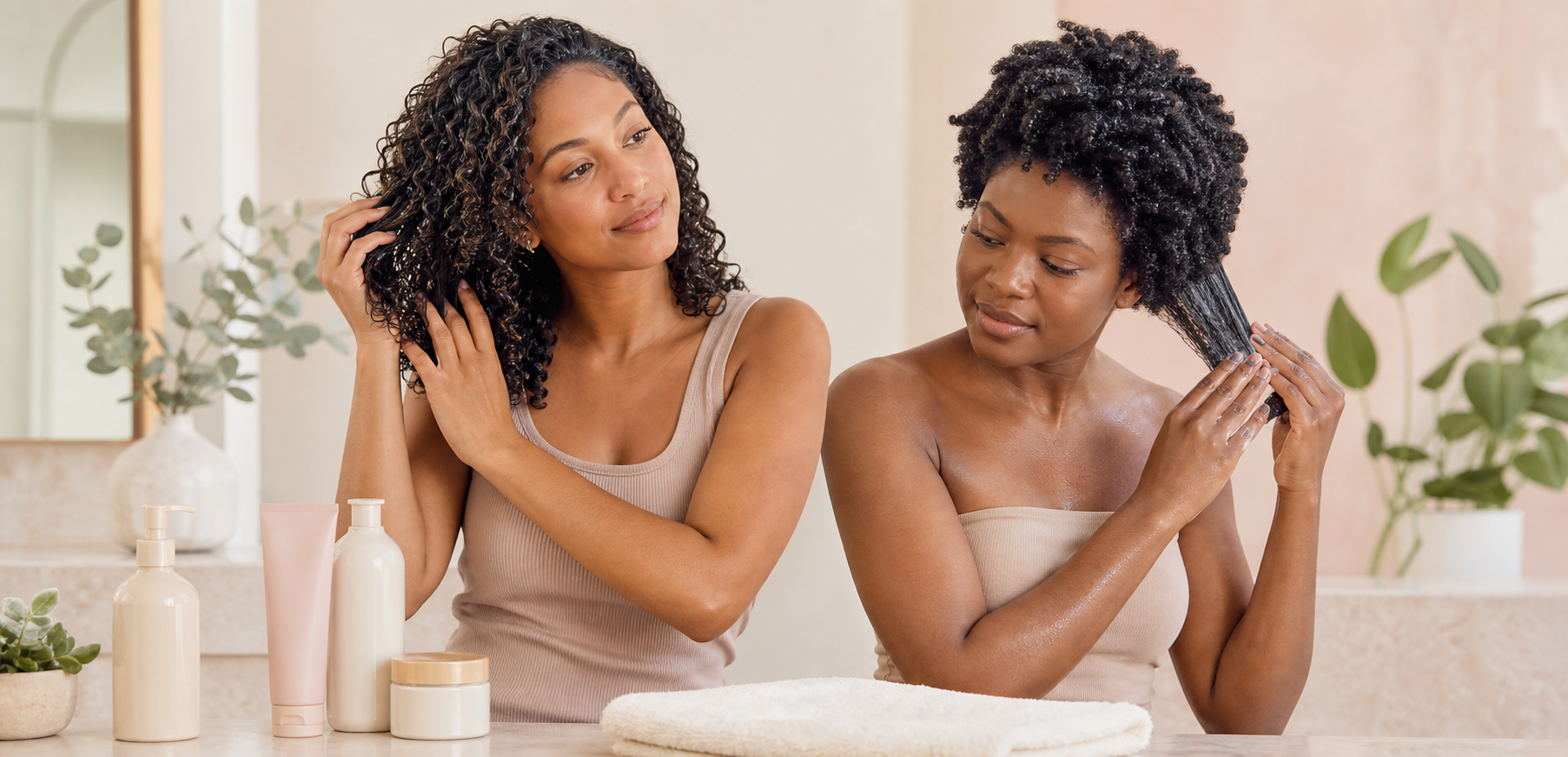
Build a curly or coily hair wash-day routine with the right order for cleansing, conditioning, detangling, leave-in, styling, drying and overnight protection.
A good wash day should leave your scalp clean, your hair manageable and your curls or coils prepared to hold their shape. It should not require ten products, hours of detangling or a rigid routine copied from someone whose hair behaves differently from yours.
The most useful order is simple:
- Cleanse the scalp.
- Condition the lengths.
- Detangle with slip.
- Apply leave-in where it is needed.
- Choose curl cream, gel, mousse or foam or layer products with a clear purpose.
- Dry with minimal friction.
- Protect the finished style overnight.
The products and techniques within those steps should change according to your scalp, strand thickness, density, porosity, damage and styling goal. Your curl pattern matters, but it is not the only or always the most important factor.
This guide will help you build a complete wash-day routine without burying your hair beneath unnecessary layers.
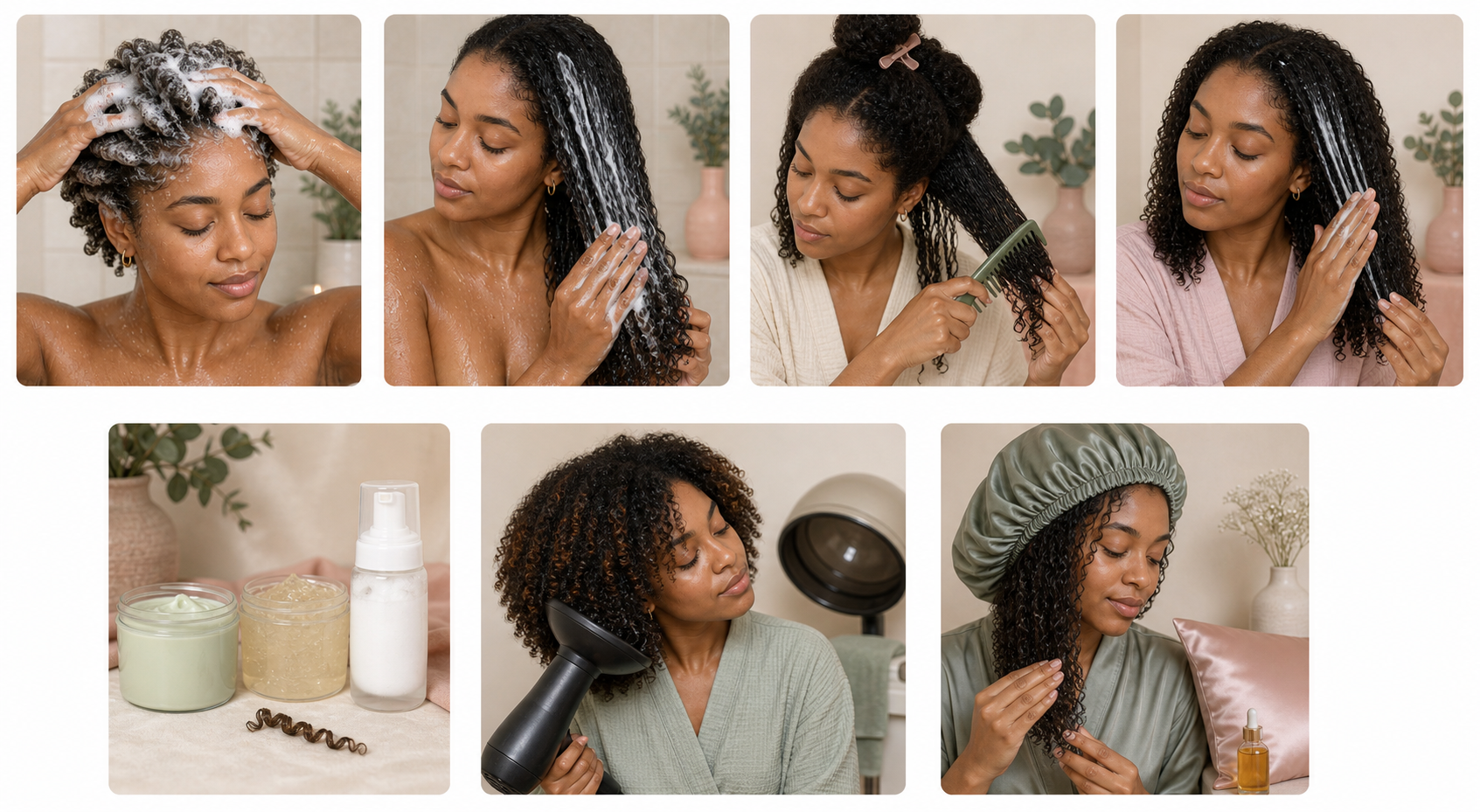
Want a routine matched to your hair? Take the Radiant Eden Hair Routine Quiz to combine your scalp type, strand thickness, density, pattern, porosity and current hair condition.
Your Wash Day at a Glance
- Cleanse: Remove scalp oil, sweat, dead skin and product residue. Key decision: how strong and how frequent should cleansing be?
- Condition: Improve softness, slip and manageability. Key decision: does your hair need a light conditioner or a richer treatment?
- Detangle: Separate knots while limiting unnecessary breakage. Key decision: how much slip, water and sectioning do you need?
- Leave-in: Extend conditioning and improve manageability. Key decision: how much weight can your strands support?
- Cream, gel, mousse or foam: Add definition, softness, volume, hold or humidity resistance. Key decision: do you need softness, volume, hold or a combination?
- Dry: Set the curl pattern with minimal friction. Key decision: air-dry, diffuse or use a combination?
- Protect: Reduce overnight friction and preserve the style. Key decision: pineapple, twists, braids, bonnet or pillowcase?
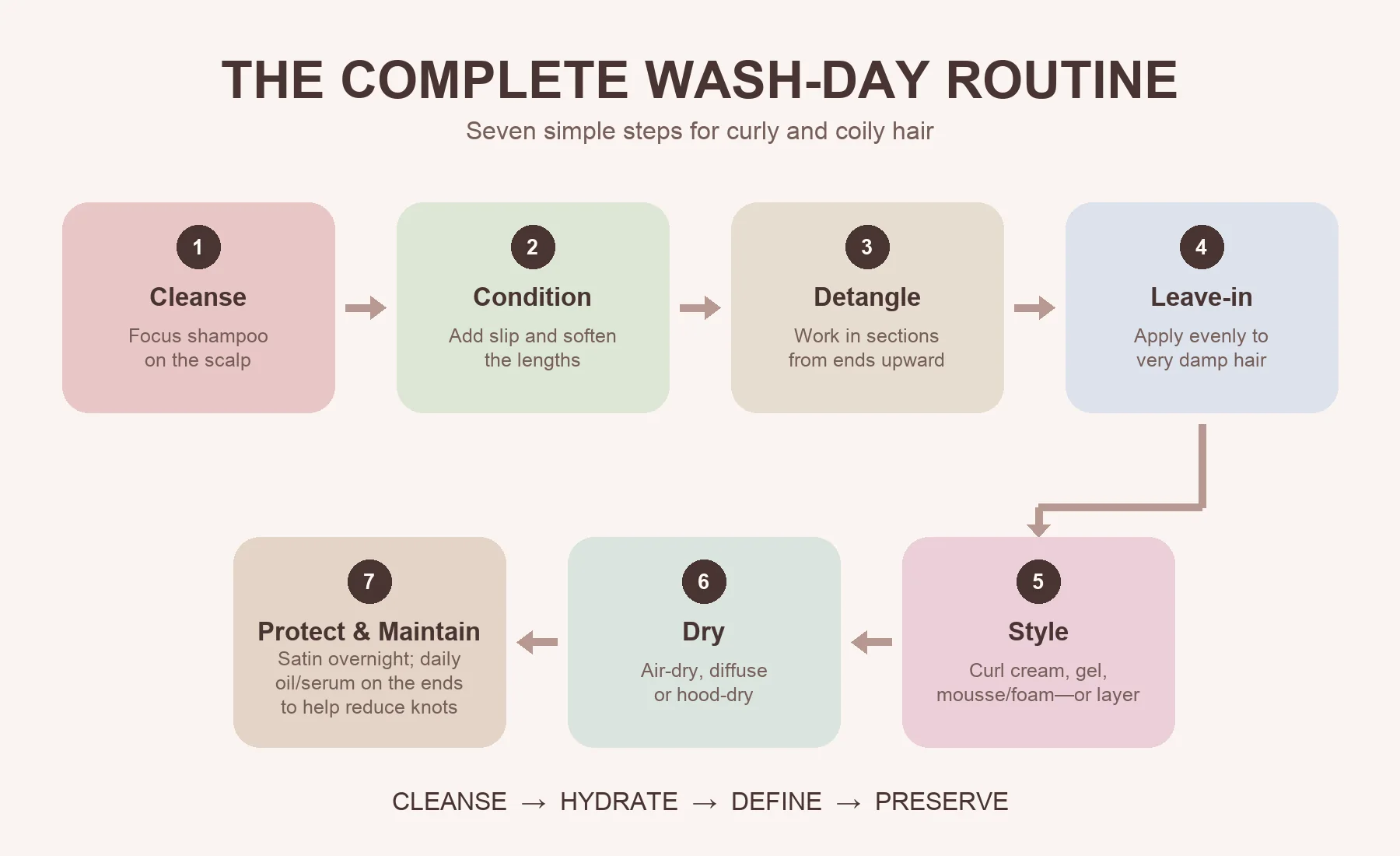
You do not need the maximum number of products at every stage. A cleanser, rinse-out conditioner and one styler may be enough. Add another product only when it solves a clear problem.
Before You Begin: Read Your Hair and Scalp
Wash day becomes easier when you decide what your hair needs before it is soaking wet.
Start with your scalp
Your scalp determines cleansing frequency and shampoo choice.
- Oily, sweaty or frequently styled scalp: may need more regular shampooing or occasional clarifying.
- Dry or easily irritated scalp: may suit a mild cleanser and careful product placement away from the skin.
- Flaky or persistently itchy scalp: may need an appropriate anti-dandruff treatment rather than additional oil.
- Scalp under braids, twists or another long-term style: still needs cleansing; product and sweat do not disappear because the hair is protected.
The American Academy of Dermatology recommends applying shampoo mainly to the scalp, where oil and build-up collect, instead of repeatedly scrubbing the full length of the hair (AAD).
Check strand thickness and density
Strand thickness affects how much product an individual hair can carry. Density affects how much product is needed to cover the whole head.
- Fine strands are easily overwhelmed by rich leave-ins, butters and multiple stylers.
- Medium strands often tolerate moderate product weight.
- Coarse strands may benefit from richer conditioning, but coarse hair can still develop build-up.
- Low-density hair usually needs less total product.
- High-density hair may require more sections and better distribution—not necessarily heavier formulas.
This is why two people with the same curl pattern can need completely different routines.
Consider porosity and current condition
Porosity describes how readily hair takes up and loses water. You do not need to rely on a floating-hair test, which can be affected by oil, product and surface tension. Look at how your hair behaves over several washes.
- Hair that wets slowly and becomes coated easily may prefer lighter layers and more thorough cleansing.
- Hair that dries very quickly, tangles easily or loses softness soon after styling may benefit from richer conditioning and careful sealing.
- Bleached, relaxed, permanently coloured or heat-damaged hair may behave as higher-porosity hair even when the new growth does not.
Treat the condition you observe rather than chasing a perfect label.
Step 1: Cleanse the Scalp Thoroughly but Gently
Curly and coily hair often feels dry through the lengths, but the scalp still produces oil, sheds skin and collects sweat and styling residue. Cleansing is not the enemy of healthy curls; unsuitable cleansing is the problem.
How often should curly or coily hair be washed?
There is no universal wash-day calendar. Your frequency should keep the scalp comfortable and the hair manageable.
Some people wash weekly. Others need every few days because of exercise, an oily scalp or scalp treatment. Very dry or tightly coiled hair may be washed less frequently, but regularly extending wash day while the scalp itches or develops build-up is not protective.
Dermatology guidance varies because individual needs vary. The AAD advises washing dry, textured, curly or thick hair when needed and not leaving it indefinitely between washes; its guidance for Black hair also notes that weekly or every-other-week washing can help prevent drying product build-up (AAD healthy-hair guidance, AAD Black-hair guidance).
Wash sooner if you notice:
- persistent itching;
- visible residue or flakes;
- an oily or unpleasant-smelling scalp;
- roots that remain coated after refreshing;
- increased tangling caused by product accumulation; or
- a style that can no longer be refreshed with water.
Choose the right cleanser
A gentle or conditioning shampoo suits many regular wash days. It should clean the scalp without leaving it painfully tight.
A clarifying shampoo is useful when oils, gels, butters, dry shampoo or repeated conditioning layers are resisting your normal cleanser. It is a reset product, not an automatic weekly requirement.
A chelating shampoo targets mineral deposits from hard water or swimming. Clarifying and chelating overlap, but they are not always the same.
A co-wash can refresh hair that becomes dry with frequent shampooing, but it may not remove every type of oil, silicone, styling polymer or scalp residue. If the roots remain coated, alternate it with an effective shampoo rather than adding more product.
"Sulphate-free" does not automatically mean gentle, and a shampoo containing sulphates is not automatically unsuitable. Judge the whole formula and how your scalp and hair feel afterwards.
How to shampoo curly or coily hair
- Divide very dense or long hair into four to eight loose sections before wetting it.
- Saturate the scalp and hair fully with lukewarm water.
- Apply shampoo to the scalp in several small placements rather than one large blob.
- Massage with the pads of your fingers, not your nails.
- Let the lather run through the lengths as you rinse. Cleanse the lengths directly only when they are heavily coated.
- Repeat only when the first wash did not remove significant oil or residue.
Avoid piling the hair on top of the head and rubbing it in circles. This encourages tangling and makes the next step harder.
Step 2: Condition for Slip, Not Just Softness
Conditioner helps reduce friction between strands, makes detangling easier and supports the most fragile areas of the hair. The ends deserve particular attention because they are the oldest part of the fibre.
The AAD recommends using conditioner after washing and applying it throughout dry or curly lengths. DermNet likewise describes conditioning as an important way to reduce knotting and minimise breakage in textured hair (AAD, DermNet).
Choose conditioner by what your strands can support
Fine or easily weighed-down curls may prefer a fluid conditioner that rinses clean. Use enough for slip, but do not assume that a thick mask is always more moisturising.
Medium, coarse, dense or very dry hair may benefit from a richer cream with strong slip, especially at the ends.
Damaged or chemically treated hair may need a balance of conditioning and occasional protein or bond-support products. If repeated strengthening treatments leave the hair rigid, rough or difficult to style, reduce their frequency.
Is deep conditioning necessary every wash?
No. A good rinse-out conditioner may be enough for healthy hair. Use a richer mask when the hair is unusually dry, has been exposed to heat or colour, or needs more slip than the everyday conditioner provides.
Heat caps and very long treatment times are not automatically better. Follow the product instructions. If a mask says ten minutes, leaving it on for two hours may add inconvenience without improving the result.
Apply conditioner effectively
- Gently squeeze out excess water if the conditioner immediately slides off.
- Apply in sections, concentrating on the mid-lengths and ends.
- Add a little water and smooth the section between your hands to distribute the product.
- Check for slip before detangling. If the hair feels rough, add water first, then a little more conditioner if needed.
Keep heavy conditioner away from the scalp unless the label specifically says it is intended for scalp use.
Step 3: Detangle with Water, Slip and Patience
Detangling is often the longest part of coily-hair wash day, but force should never be the solution. Curved fibres can catch around one another, and accumulated grooming damage can create weak points that eventually break. Research on curly-hair breakage highlights the cumulative effect of mechanical grooming damage (PubMed).
The aim is not to make every section perfectly straight. It is to remove shed hairs and separate knots with the least avoidable stress.
The safest order for detangling
- Work on wet, conditioned hair with enough slip.
- Divide the hair into manageable sections.
- Use your fingers to separate large tangles and remove trapped shed hairs.
- Hold the section above the knot to reduce pulling at the root.
- Begin at the ends and work gradually upwards.
- Follow with a flexible brush designed for wet curly and coily hair if needed.
- Twist or clip the finished section so it does not retangle.
Dermatologists recommend detangling thick or curly hair in the shower before rinsing out conditioner and working from the ends upwards. Roughly rubbing wet hair or forcing a brush through dry curls can increase damage (AAD).
Finger detangling or a flexible brush?
Many people think a wide-tooth comb is the standard tool for detangling curls and coils. However, its teeth are relatively stiff. When they meet a tight knot, they can pull against it before you have identified how the strands are caught, increasing tension and the risk of breakage.
For knot removal, use a method that gives you more feedback and flexibility:
- Finger detangling gives the most feedback and helps locate knots, but it can be slow.
- A flexible detangling brush can organise clumps efficiently once larger tangles have been loosened, but it should glide rather than tear.
Stop if you hear repeated snapping or the tool will not move without force. Add water, add slip, reduce the section size and try again.
What is a wide-tooth comb useful for?
A wide-tooth comb can be useful once the hair is already detangled and styled. It is particularly effective for gently separating and fluffing roller-set curls or blowouts. Unlike a standard bristle brush, it can tease apart the finished curls without flattening the style or breaking up all its structure, helping create softer, fuller and more voluminous results.
Use it as a finishing tool rather than forcing it through wet knots. Insert the teeth gently, work in small areas and stop if the comb catches.
Is all shed hair breakage?
No. Hair that has naturally shed may remain trapped within curls until wash day, so the amount can look dramatic after several days. Shed hairs usually have a small bulb at one end and are close to full length. Breakage tends to appear as shorter pieces without a root bulb.
Seek professional advice if shedding suddenly increases, the parting becomes wider, the hairline changes, or you see smooth or scaly patches of hair loss.
Step 4: Apply Leave-In Conditioner Strategically
Leave-in conditioner is not compulsory for curly and coily hair. However, it can improve manageability, reduce frizz and make styling easier. It performs a different job from rinse-out conditioner and should be formulated to remain on the hair.
The AAD advises applying leave-in to damp hair, using the smallest amount that does the job and concentrating on the hair rather than the scalp, where it can contribute to build-up (AAD).
Match the texture to your strands
- Fine curls or low-density hair: begin with a light milk, lotion or spray.
- Medium strands: try a lotion or light cream.
- Coarse, dense or very dry hair: may prefer a richer cream, used section by section.
- Damaged ends: apply a little extra only where the hair is roughest.
High density can require more total product for coverage, but it does not automatically require a heavier formula.
How much leave-in should you use?
Start with less than you think you need. Add it in sections and assess the feel.
You have probably used too much if:
- the roots look flat before drying;
- the hair feels waxy, sticky or coated;
- the styler forms white flakes;
- drying takes much longer than usual; or
- the curls feel soft but will not hold their shape.
Apply to soaking-wet hair for maximum clumping and dilution, or to damp hair for slightly more volume and concentrated control. Compare the result over two wash days rather than changing several variables at once.
Step 5: Choose Curl Cream, Gel, Mousse or Foam
Curl creams and gels do different jobs.
A curl cream usually adds softness, lubrication and flexible definition. It often suits hair that needs help staying pliable, but it may not provide enough hold for humid weather or long-lasting definition.
A gel forms a film around curl clumps and provides hold. Stronger gels may dry into a firm cast that can be gently scrunched once the hair is completely dry.
A mousse or foam is a lighter alternative for volume, faster drying and less weight. It may suit fine strands or loose curls particularly well.
Do you need cream and gel together?
Not necessarily.
- Choose cream alone for soft definition when hold is not the priority.
- Choose gel alone when your leave-in already provides enough conditioning.
- Layer cream under gel when the hair needs both softness and stronger hold.
- Try mousse or foam when cream makes the roots flat.
More layers do not guarantee more moisture. Leave-in, cream, oil and gel together can overwhelm fine or low-density hair and may create flakes when formulas are incompatible.
Test product compatibility
Rub a small amount of the products together in your palm. If they immediately form lumps, strings or white curds, the combination may flake on the hair. The palm test is not perfect, but it can prevent an obvious mismatch.
When testing a new styler, keep the cleanser, conditioner and application technique the same. This makes the result easier to interpret.
Choose an application technique
Praying hands: smooths product over existing curl clumps with less separation.
Raking: distributes product thoroughly and can separate dense hair, but may create smaller clumps.
Shingling: defines small sections individually. It offers control but takes time.
Brush styling: can create consistent clumps and tension. Use a tool designed for wet styling and avoid repeatedly brushing once the product begins to set.
Scrunching: encourages curls to contract and helps distribute product through the ends.
Work in enough sections to reach all the hair, especially at the back and crown. Styling only the visible surface often leaves the underneath frizzy and uneven.
Step 6: Dry Without Undoing Your Work
Freshly styled curls need time to set. Excessive touching, rough towels and high heat can separate clumps and increase frizz before the styler forms a film.
Remove excess water gently
Use a smooth cotton T-shirt or microfibre towel to scrunch or press out water. Do not rub the hair back and forth. The AAD recommends wrapping or blotting rather than rough towel drying, which can damage wet hair (AAD).
"Plopping" can encourage some curl patterns, but leaving very wet hair tightly wrapped for a long period may flatten roots, distort clumps or delay drying. A brief plop or gentle micro-plop is often easier to control.
Air-drying
Air-drying avoids direct heat but can take many hours in dense hair. Keep the roots lifted with clips if volume is important, and avoid repeatedly rearranging the hair as it dries.
Diffusing
A diffuser speeds drying and can improve volume.
- Apply heat protectant if the product directions recommend it for blow-drying.
- Use low or medium heat and airflow.
- Hover around the roots first if they take longest to dry.
- Cup sections gently rather than pushing and shaking the diffuser continuously.
- Stop before the hair feels overheated or brittle.
Dermatologists advise limiting excessive heat, using low or medium settings and applying a heat-protecting product when appropriate (AAD).
Scrunch out the cast
If gel leaves a firm cast, wait until the hair is completely dry. Scrunch gently with clean, dry hands. A drop of lightweight oil can add slip, but it is optional; too much may reduce volume or shorten the life of the style.
Step 7: Protect Curls and Coils Overnight
Night-time protection reduces friction and helps a finished style last beyond day one.
Go to bed with fully dry hair whenever possible. Sleeping on wet hair can flatten the pattern, stretch fragile fibres and leave the scalp damp for hours.
Choose the method that suits your length and style:
- Pineapple: gather long curls loosely at the top of the head with a soft scrunchie.
- Loose high ponytail: similar to a pineapple but suitable when the hair is not long enough to fall forward.
- Loose braids or twists: useful for coils that tangle or shrink significantly overnight.
- Satin or silk bonnet: reduces contact with bedding and keeps the hair contained.
- Satin or silk pillowcase: provides a second layer of friction reduction and helps when a bonnet slips off.
Keep every style loose. Overnight protection should not pull at the hairline, hurt the scalp or create tension around the edges. The AAD recommends loose pineapples, braids or twists and satin or silk bonnets or pillowcases to reduce friction and preserve curls (AAD).
Refreshing the next morning
Do not automatically soak and restyle the entire head.
- Release the hair and allow it to settle.
- Fluff the roots gently with your fingertips.
- Mist only flattened or frizzy sections with water.
- Smooth in a tiny amount of leave-in or styler if needed.
- Reshape individual curls with your fingers.
If your ends are prone to single-strand knots, smooth a very small amount of lightweight hair oil or serum over them as needed. This can add lubrication and help reduce friction between the oldest, most vulnerable parts of the hair. It will not repair split or severely weathered ends, and using too much may weigh the hair down or cause build-up.
If every refresh requires another heavy layer of cream, wash day may be too product-heavy or the styler may not provide enough hold.
Adjust the Routine to Your Hair
Fine curls or low-density hair
- Use a cleanser that rinses clean.
- Choose a lightweight conditioner and rinse thoroughly.
- Use a small amount of leave-in or skip it.
- Try mousse, foam or gel instead of a rich cream.
- Apply products away from the roots for more volume.
- Clarify when the pattern becomes limp or coated.
Dense curls or coils
- Section before shampooing.
- Place cleanser directly on the scalp in several areas.
- Condition and detangle in smaller sections.
- Use enough product for distribution, but choose weight according to strand thickness.
- Dry the roots thoroughly; they often remain wet long after the surface feels dry.
Coarse, very dry or tightly coiled hair
- Use a conditioning shampoo for regular washes and clarify when genuinely needed.
- Prioritise a conditioner with excellent slip.
- Detangle patiently in sections and protect finished sections from retangling.
- Try a richer leave-in or cream, then add gel only if more hold is needed.
- Consider twists or loose braids overnight to reduce tangling.
High-porosity, bleached or damaged hair
- Handle wet hair carefully and minimise repeated brushing.
- Use conditioner consistently and concentrate on the ends.
- Consider occasional strengthening or bond-support treatments without stacking several in one wash.
- Use heat protectant and moderate diffuser temperature.
- Trim split or severely weathered ends when they repeatedly knot around neighbouring hairs.
Dry, sensitive or flaky scalp
- Keep leave-in, cream, butter and oil off irritated skin.
- Use a shampoo appropriate for the scalp condition.
- Do not scratch scale with combs or fingernails.
- Avoid treating persistent dandruff with oil alone.
- Seek professional advice for redness, swelling, pain, sores, patchy hair loss or symptoms that do not improve.
Common Wash-Day Mistakes
Using more product instead of more water
Water helps distribute conditioner and styling products. When hair feels sticky or uneven during application, try wetting the section again before adding another layer.
Detangling large sections by force
Smaller sections, more slip and support above the knot are safer than pulling harder.
Applying everything to the scalp
Most conditioners and stylers are intended for the hair. Heavy scalp application can contribute to residue, itching or spots around the hairline.
Believing every curl needs large amounts of oil
Oil can add lubrication, help reduce friction at vulnerable ends and slow moisture loss, but it does not hydrate dry hair by itself. It can also reduce volume and create build-up. If your ends are prone to single-strand knots, start with one or two drops of a lightweight oil or serum and add more only when it improves the result.
Avoiding shampoo indefinitely
Co-washing and gentle cleansers have a place, but a scalp that remains itchy, oily or coated needs effective cleansing.
Using cream and gel without a purpose
Cream is mainly for softness and flexible definition; gel is mainly for hold. If one product performs both jobs, the extra layer may be unnecessary.
Touching the hair while it dries
Constant fluffing and rearranging break apart curl clumps before they set. Finish the application, place the hair where you want it and leave it alone until mostly dry.
Sleeping with unprotected or damp hair
Friction, tension and dampness can undo the work of wash day. Dry fully and use a loose protective method.
Your Quick Wash-Day Builder
Use this framework when you want to simplify your shelf.
1. Pick one cleanser
- Gentle shampoo for most wash days
- Clarifying shampoo for persistent product residue
- Chelating shampoo for hard-water or swimming deposits
- Medicated shampoo when the scalp condition requires it
2. Pick one rinse-out conditioner
- Light lotion for fine or easily coated hair
- Rich cream for coarse, dense or very dry hair
- Occasional strengthening treatment for damaged hair
3. Pick one detangling method
- Fingers
- Flexible wet-detangling brush
Use the tool on wet hair with slip, working from the ends upwards.
4. Pick your styling level
- Minimal: leave-in or one styler
- Soft definition: leave-in plus cream, or cream alone
- Stronger hold: leave-in plus gel, or gel alone
- Volume: light leave-in plus mousse or foam
- Softness and hold: a small amount of cream under gel
5. Pick one drying method
- Air-dry
- Diffuse
- Air-dry partly, then diffuse to finish
6. Pick one overnight method
- Pineapple
- Loose braids or twists
- Satin or silk bonnet
- Satin or silk pillowcase
That is a complete routine. Everything else is optional.
Build a Routine You Can Repeat
The best wash day is not the most elaborate one. It is the routine you can repeat without leaving your scalp coated, your arms exhausted or your hair buried beneath products.
Cleanse according to your scalp. Condition according to your strand needs. Detangle with water and slip. Apply leave-in deliberately. Choose cream for softness, gel for hold, or mousse or foam for lighter volume. Layer products only when your hair genuinely benefits. Dry with minimal friction, then protect the finished style overnight.
Most importantly, judge the routine by the result across several days, not by how impressive the product line-up looks on wash day.
Build your personalised wash day. Take the Radiant Eden Hair Routine Quiz to match cleanser strength, conditioner weight, leave-in texture and styling hold to your hair.
Related products


Frequently asked
Should curly and coily hair be detangled before shampooing?+
Should I detangle before or after conditioning?+
Do I need both rinse-out and leave-in conditioner?+
Is curl cream the same as leave-in conditioner?+
Should gel go before or after curl cream?+
Why does my curly hair look good wet but frizzy when dry?+
Why do my curls feel sticky after wash day?+
How can I make wash day shorter?+
How do I know whether I need a trim?+
Find your perfect haircare routine
Answer a few questions and we'll tailor Radiant Eden's picks to you.
Build my haircare routineKeep reading

The Best Amazon Black Friday Beauty Deals to Watch in 2026
Discover which Amazon Black Friday skincare, haircare and beauty tool deals are worth watching, plus how to recognise a genuine saving.
Protein Overload vs Moisture Overload: Signs and How to Fix Your Hair
Learn how to distinguish too much strengthening support from overconditioning, product build-up and structural hair damage—and reset your routine.
How to Choose a Premium Multi-Styler: Dyson Airwrap vs Shark FlexStyle
A hands-on guide to choosing between Dyson Airwrap and Shark FlexStyle multi-stylers, based on gentleness, speed, attachments and value.