Dry Scalp, Dandruff or Product Build-Up? How to Tell the Difference
How to compare the clues, choose an appropriate shampoo or scalp serum and know when to seek professional help.

Learn how to tell dry scalp, dandruff and product build-up apart, which shampoo or scalp serum to use, and when to seek professional help.
You notice flakes near your roots, your scalp has started itching and your hair no longer feels clean after washing. Is your scalp dry? Do you need an anti-dandruff shampoo? Or has dry shampoo, oil and styling product simply accumulated?
These problems can look similar, but they do not need the same routine:
- Dry scalp usually needs gentler cleansing and help reducing dryness.
- Dandruff often responds to a shampoo containing a proven anti-dandruff ingredient.
- Product build-up needs thorough cleansing and changes to how products are applied.
Choosing the wrong response can make matters worse. Repeated clarifying may irritate an already dry scalp, while layering oils and serums over dandruff or build-up can leave the scalp feeling even more coated.
This guide will help you compare the clues, choose an appropriate shampoo or scalp serum and recognise when flaking may be caused by a condition that needs professional assessment.
*Want a routine matched to your scalp and hair? Take the Radiant Eden Hair Routine Quiz to identify your scalp needs, strand thickness, density, pattern and current hair condition.
First: Flakes Do Not Automatically Mean Dandruff
Dandruff is common, harmless and not contagious. It causes white or grey flakes that may collect in the hair or fall onto the shoulders, and the scalp can feel dry or itchy. It is not caused by poor hygiene, although flakes may become more noticeable when the hair is not washed regularly (NHS).
However, "flaky scalp" is a symptom rather than a complete diagnosis. Dryness, seborrhoeic dermatitis, eczema, psoriasis, contact dermatitis and tinea capitis can all cause scaling. Product residue can also resemble flakes without being shed skin at all.
The NHS specifically notes that dandruff can resemble several other scalp conditions. If the pattern is severe, unusual, or unresponsive to treatment, do not switch cosmetic products indefinitely.
The Quick Comparison
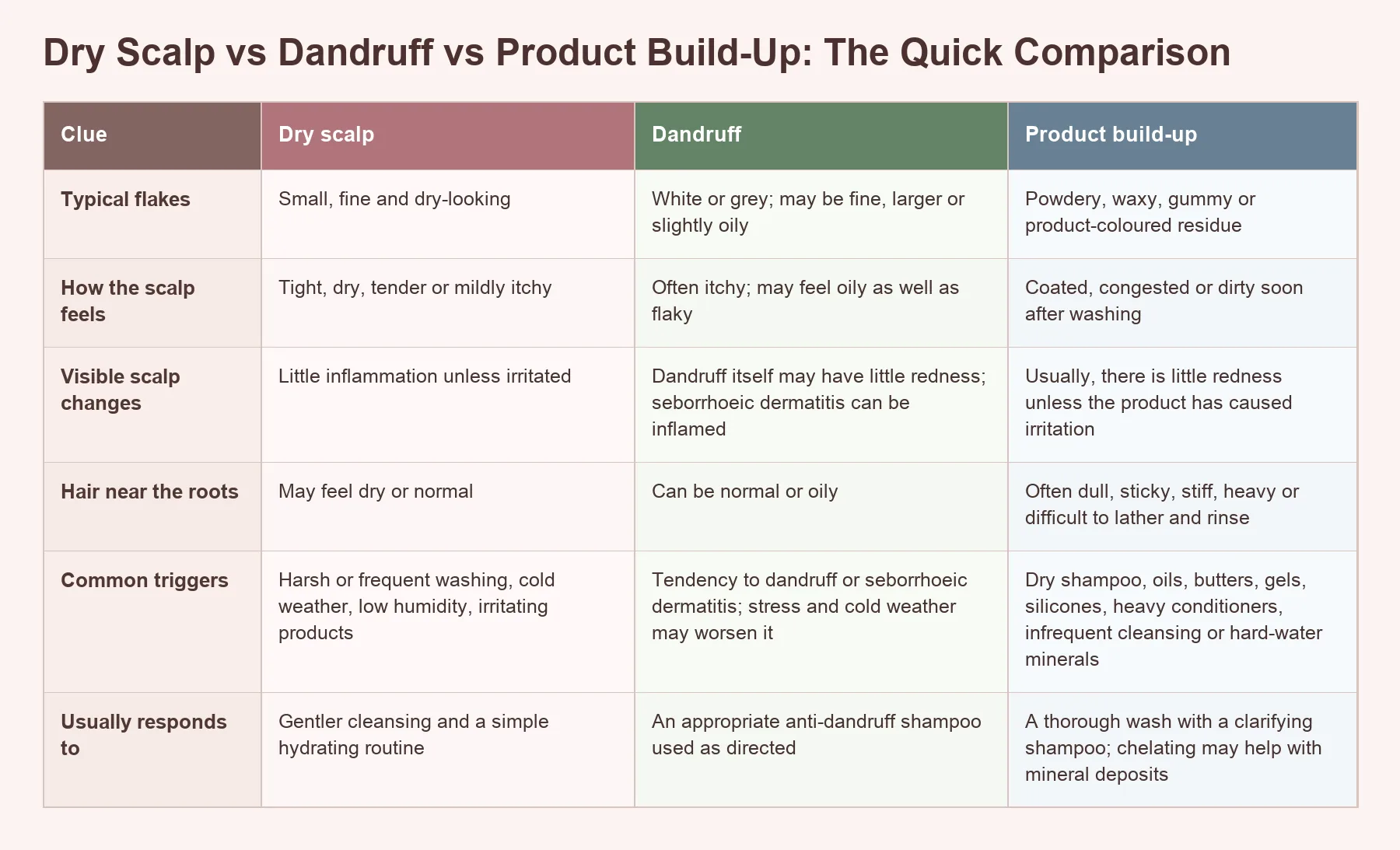
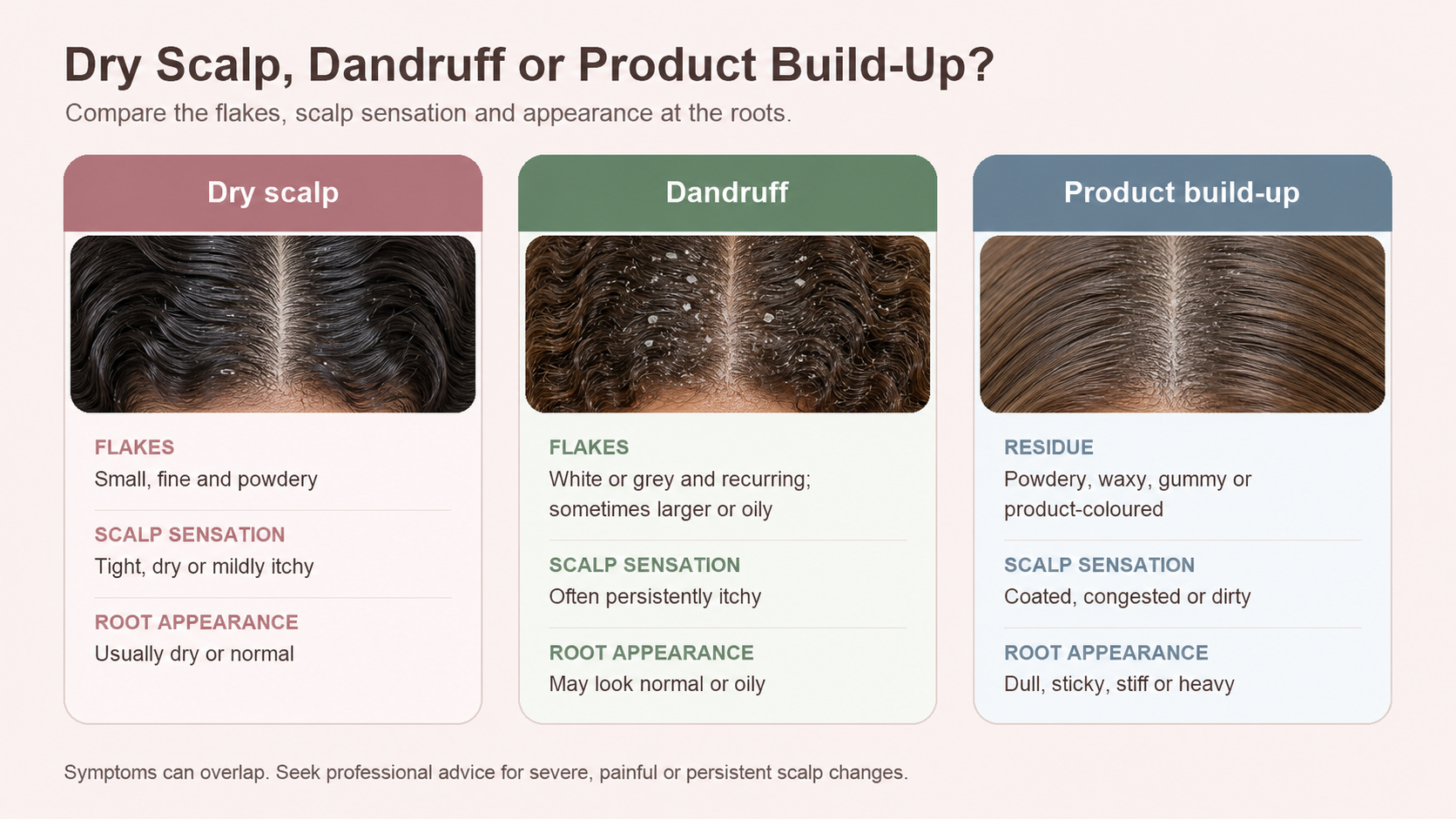
This table is a starting point, not a diagnostic test. More than one column may apply. For example, someone can have dandruff and styling-product residue, or an oily scalp that has become irritated by a harsh clarifying shampoo.
What Dry Scalp Usually Looks and Feels Like
A dry scalp lacks enough water, surface oil or both. The skin may feel tight after washing, and the flakes tend to be small and light. You may also notice dryness around the hairline or elsewhere on the body.
Clues that point towards dry scalp include:
- small, powdery white flakes;
- tightness after shampooing;
- mild itching without greasy scale;
- a scalp that feels comfortable for longer when you use a gentler shampoo;
- worsening during cold weather, low humidity or frequent washing; and
- a recent switch to a strong cleanser, fragranced scalp treatment or frequent exfoliation.
Overwashing and unsuitable shampoos can remove surface oils, increase water loss and contribute to an irritated, dry scalp. DermNet notes that excessive washing may disturb barrier function and cause irritant contact dermatitis (DermNet).
What shampoo suits a dry scalp?
Look for a mild shampoo that cleans without leaving the scalp painfully tight. Useful label descriptions include:
- gentle;
- moisturising or hydrating;
- suitable for a sensitive scalp; and
- fragrance-free if you are easily irritated.
The word "sulphate-free" is not a guarantee that a shampoo will be gentle, and a shampoo containing sulphates is not automatically harsh. The whole formula, how much you use and how frequently you wash all matter.
Apply shampoo mainly to the scalp, massage with the pads of your fingers and rinse thoroughly with lukewarm water. Avoid scratching with your nails or using an abrasive scalp brush on sore skin.
Can a scalp serum help?
A light, fragrance-free, water-based scalp serum may improve comfort between washes. Ingredients such as glycerin, panthenol, betaine or low levels of urea can support hydration, depending on the formula.
Use a small amount directly on the scalp and stop if it stings, increases itching or leaves persistent residue. A serum is optional: if a gentle shampoo and sensible wash frequency keep your scalp comfortable, you do not need another product.
Heavy oils are not the only way to manage dryness. Oil may soften the surface temporarily, but it does not add water and can make it harder to judge whether you also have dandruff or build-up.
What Dandruff Usually Looks and Feels Like
Dandruff is considered an uninflamed or minimally inflamed form of seborrhoeic dermatitis. DermNet describes it as a diffuse, bran-like scale across hair-bearing areas of the scalp, sometimes with mild itching and without obvious underlying redness (DermNet).
Clues that point towards dandruff include:
- recurring white or grey flakes through the hair or on clothing;
- persistent itch;
- flakes that return despite ordinary washing;
- a scalp that may feel oily as well as flaky;
- improvement when using anti-dandruff shampoo; and
- flaking that worsens during periods of stress or cold weather.
If the scalp is clearly inflamed, with red, darker, purple-grey or discoloured patches and greasy scale, the problem may be seborrhoeic dermatitis rather than mild dandruff. It can also affect the eyebrows, sides of the nose, ears, beard area or chest.
Which anti-dandruff shampoo should you choose?
The NHS recommends looking for a shampoo containing one of the following:
- ketoconazole, an antifungal ingredient;
- selenium sulphide, which helps control excess shedding and yeast; or
- coal tar with salicylic acid, which helps manage scale.
Different ingredients work in different ways, so one shampoo may suit you better than another. A pharmacist can help you choose, particularly if you are pregnant, breastfeeding, treating a child, using other medicines or have a sensitive scalp.
Use the product exactly as its label directs. Medicated shampoos generally need to reach the scalp, not merely the hair, and may need to remain in place for several minutes before rinsing. More frequent use or a longer contact time is not automatically better.
The NHS suggests trying an anti-dandruff shampoo for a month to see whether symptoms improve. If it does not help, you may need a different active ingredient or a professional diagnosis (NHS).
Adjust the routine to your hair texture
The scalp needs treatment, but the lengths still need protection.
- Straight, fine or oily hair: may tolerate more frequent washing, with medicated shampoo used according to the label.
- Wavy or medium-textured hair: Concentrate the medicated shampoo on the scalp and condition the lengths.
- Curly, coily, coarse or very dry hair: apply medicated shampoo carefully to the scalp, avoid unnecessarily coating the lengths and follow with conditioner. A dermatologist may recommend a lower treatment frequency.
The American Academy of Dermatology notes that people with straight or wavy hair may use dandruff shampoo two or three times weekly, while once-weekly use may be recommended for curly or tightly coiled hair. Individual product directions and professional advice take priority (AAD).
Be cautious with coal-tar shampoo on blonde, bleached, grey or tinted hair because it may cause discolouration. Coal tar can also increase sun sensitivity, so follow the product warnings carefully.
Do scalp serums treat dandruff?
A cosmetic serum may soothe or hydrate, but it does not replace a proven anti-dandruff treatment. Avoid layering several oils, fragranced tonics or essential oil blends onto an itchy scalp; they add variables and can cause contact irritation.
If you use a leave-on scalp product, choose a simple formula and introduce it only after you know how your scalp responds to the medicated shampoo.
What Product Build-Up Usually Looks and Feels Like
Product build-up is the accumulation of styling products, conditioning ingredients, dry shampoo, oil, sweat and environmental residue on the scalp or hair. Hard-water minerals and swimming-pool deposits can add a separate type of coating.
Unlike dandruff, build-up is not a single medical condition and does not have a formal diagnostic test. The most useful clues are your product habits and how the hair responds to a thorough wash.
Signs that point towards build-up include:
- roots that feel waxy, sticky or dirty shortly after washing;
- hair that looks dull, limp or unusually heavy;
- curls that lose definition despite adequate conditioning;
- shampoo that struggles to lather or rinse clean;
- powdery patches after repeated dry-shampoo use;
- small product-coloured crumbs from gel, edge control or styling cream;
- a visible film around the hairline; and
- noticeable improvement after one careful clarifying wash.
Build-up can itch, particularly when residue, sweat and friction remain on the scalp. However, burning, a rash or persistent redness may indicate irritant or allergic contact dermatitis rather than simple residue.
The AAD emphasises that dry shampoo absorbs oil but does not clean the hair. Shampoo and water are still needed to remove dead skin, oil, microorganisms and accumulated dry shampoo (AAD).
What is a clarifying shampoo?
A clarifying shampoo is designed to remove more residue than an everyday shampoo. It may use stronger cleansing agents or a more concentrated cleansing system.
A chelating shampoo is slightly different: it contains ingredients intended to bind mineral deposits, which can be useful after swimming or in hard-water areas. Some shampoos both clarify and chelate.
Clarifying shampoo is useful when there is something to remove. It is not a treatment for every itchy or flaky scalp.
How often should you clarify?
There is no universal schedule. Start with your actual product use and how your hair responds.
- Occasional styling products: clarify approximately every three to four weeks, if needed.
- Frequent gels, butters, oils or silicone-rich stylers: every one to two weeks may be useful.
- Regular dry shampoo, swimming or very hard water: clarify or chelate when residue becomes noticeable rather than waiting for a fixed date.
- Dry, colour-treated, damaged, curly or coily hair: clarify less often and follow with conditioner or a mask on the lengths.
These are starting points, not rules. If clarifying leaves your scalp tight, burning or excessively flaky, reduce the frequency or choose a gentler product. If it does not remove the "flakes", consider whether you may be dealing with dandruff or another scalp condition instead.
Should you use a scalp serum after clarifying?
Only if your scalp needs it. A light hydrating serum may feel comfortable, but a heavy oily product immediately after clarifying can restart the same residue cycle.
If build-up is recurring, changing product placement may help more than adding another serum:
- Apply conditioner mainly from the mid-lengths to the ends unless the label says it is intended for the scalp;
- Use smaller amounts of oils, butters and edge products;
- Avoid applying dry shampoo for many consecutive days;
- Cleanse after sweating heavily; and
- Rinse shampoo and conditioner thoroughly.
The Gentle One-Wash Check
When symptoms are mild and there are no warning signs, one careful wash can provide useful information.
- Look at your routine. Have you recently used more dry shampoo, oils, gel or scalp serum than usual?
- Wash thoroughly but gently. Use your normal shampoo or a clarifying wash if build-up is genuinely likely.
- Do not add several new scalp products afterwards. Keep the result easy to interpret.
- Observe the next few days.
If the coating, dullness and product-like flakes disappear, build-up was probably contributing. If tightness and fine flaking worsen, the cleanser may have been too strong. If itch and scale repeatedly return, an anti-dandruff shampoo or professional assessment may be more appropriate.
This is not a diagnostic test. Do not repeatedly clarify a sore scalp to "prove" that build-up is present.
Can You Have More Than One Problem?
Yes. Common combinations include:
- dandruff plus dry-shampoo build-up;
- an oily scalp irritated by over-cleansing;
- dry scalp plus residue from heavy oils;
- seborrhoeic dermatitis plus sensitivity to fragranced products; and
- psoriasis with additional product accumulation around thick scale.
When problems overlap, simplify first. Use one treatment with a clear purpose, keep styling products away from irritated areas and judge the scalp over several washes rather than changing everything at once.
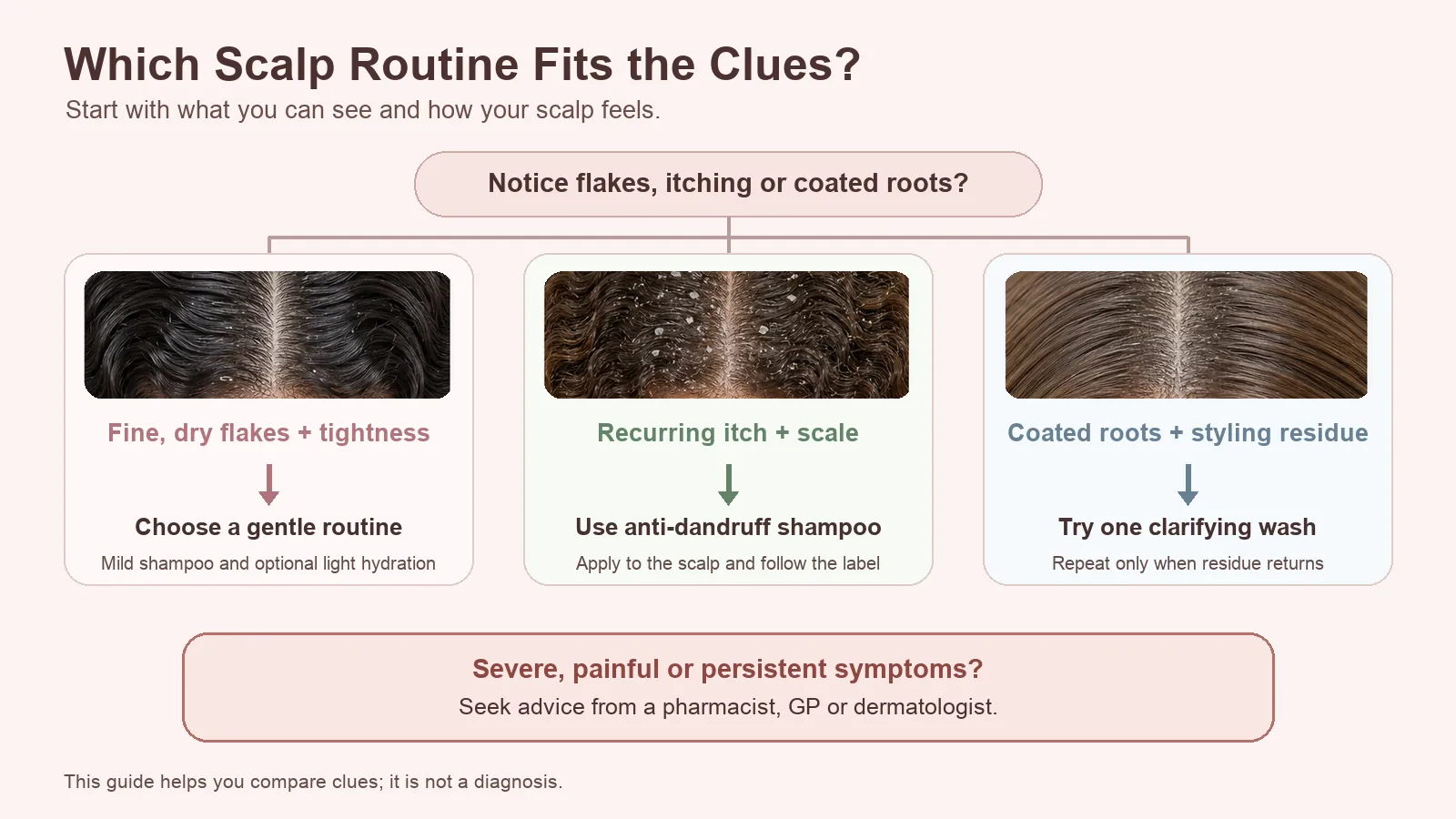
A Routine for Each Scalp Pattern
If your scalp seems dry
- Wash with a gentle shampoo at a frequency that keeps the scalp clean but comfortable.
- Use lukewarm water and your fingertips rather than scratching or scrubbing.
- Apply an optional light, fragrance-free hydrating scalp serum.
- Keep conditioner and treatments appropriate for your hair lengths.
- Clarify only when there is genuine residue.
If your symptoms resemble dandruff
- Choose one appropriate anti-dandruff shampoo with help from a pharmacist if needed.
- Apply it to the scalp and follow its contact-time and frequency instructions.
- Condition the lengths to reduce dryness, particularly with curly, coily or processed hair.
- Give the treatment up to a month unless irritation develops sooner.
- Seek professional advice if symptoms remain severe or do not improve.
If product build-up seems most likely
- Use one thorough clarifying wash; use a chelating formula if mineral deposits are the concern.
- Rinse carefully and condition the lengths.
- Reduce heavy scalp-applied products and consecutive dry-shampoo use.
- Repeat clarifying only when your hair or scalp shows signs that it needs it.
- Reconsider the diagnosis if itching or flaking quickly returns.
Common Mistakes That Can Prolong the Problem
Treating all flakes with oil
Oil can soften dry scale, but it can also increase residue and does not treat the underlying causes of dandruff. Stop if oiling makes the scalp itchier or greasier.
Clarifying every week by default
Some routines need frequent residue removal; others do not. Clarifying without build-up can leave the scalp and hair unnecessarily dry.
Applying anti-dandruff shampoo only to the hair
The product needs to come into contact with the scalp. Part dense hair into sections if necessary and follow the label's contact time.
Scratching or lifting scale
Scratching can break the skin, increase inflammation and raise the risk of infection. Soften and treat scale rather than picking it.
Changing several products at once
If you introduce a clarifier, medicated shampoo, exfoliating serum and oil together, you will not know which one helped or which one caused irritation.
Assuming "natural" products cannot irritate
Essential oils, fragrance and botanical extracts can cause irritant or allergic contact dermatitis. Natural describes the source, not how your scalp will respond.
When to See a Pharmacist, GP or Dermatologist
A pharmacist can help you choose and use an over-the-counter anti-dandruff shampoo. See a GP or dermatologist if:
- symptoms have not improved after a month of appropriate anti-dandruff shampoo;
- the dandruff or itching is severe;
- your scalp is red, markedly discoloured or swollen;
- you also have flaky, itchy patches on your face or body;
- scale is thick, sharply defined or silvery;
- you have a persistent rash after using hair dye, gel, spray or another product;
- there is pain, bleeding, oozing, pus or crusting;
- you notice broken hairs, round scaly patches or patchy hair loss; or
- the problem repeatedly returns, and you are unsure what is causing it.
Patchy hair loss with scale can be a sign of tinea capitis, a fungal infection that requires medical treatment rather than shampoo alone. DermNet notes that it can sometimes resemble generalised dandruff and requires systemic antifungal medicine (DermNet).
Seek urgent medical advice for rapidly spreading swelling, severe pain, fever, extensive oozing or signs of a serious allergic reaction.
Choose the Treatment That Matches the Clues
Flakes are information, but they are not a diagnosis by themselves.
If your scalp feels tight and depleted, begin with gentler cleansing and simple hydration. If itch and scale keep returning, use an appropriate anti-dandruff shampoo as directed. If your roots feel coated after repeated styling or dry shampoo, one careful clarifying wash may be enough to reset the routine.
Most importantly, do not keep escalating products when the pattern is unclear. A pharmacist, GP or dermatologist can distinguish dandruff from eczema, psoriasis, contact dermatitis and fungal infection and help you avoid months of trial and error.
Build a routine for both your scalp and your strands. Take the Radiant Eden Hair Routine Quiz.
Related products


Frequently asked
Is dandruff caused by a dry scalp?+
How can I tell whether flakes are product residue?+
Should I use an anti-dandruff shampoo on a dry scalp?+
Can I use clarifying shampoo and anti-dandruff shampoo together?+
Does salicylic acid help a flaky scalp?+
Are scalp scrubs good for build-up?+
How often should I wash my hair if I have dandruff?+
Can a scalp serum replace shampoo?+
Find your perfect haircare routine
Answer a few questions and we'll tailor Radiant Eden's picks to you.
Build my haircare routineKeep reading

The Best Amazon Black Friday Beauty Deals to Watch in 2026
Discover which Amazon Black Friday skincare, haircare and beauty tool deals are worth watching, plus how to recognise a genuine saving.
Protein Overload vs Moisture Overload: Signs and How to Fix Your Hair
Learn how to distinguish too much strengthening support from overconditioning, product build-up and structural hair damage—and reset your routine.

How to Choose a Premium Multi-Styler: Dyson Airwrap vs Shark FlexStyle
A hands-on guide to choosing between Dyson Airwrap and Shark FlexStyle multi-stylers, based on gentleness, speed, attachments and value.