How to Build a Hair Care Routine for Your Hair Type
Build a routine around your scalp, strand thickness, density, porosity and natural pattern — from straight and wavy to curly and coily.

Build a hair care routine that suits your scalp, strand thickness, density, porosity and natural pattern, from straight and wavy to curly and coily.
If you have ever bought a product "for curly hair" only to end up with limp, coated curls or followed a routine for fine hair that left your scalp clean but your ends parched, you have found the problem with most hair typing advice: one label cannot describe everything your hair needs.
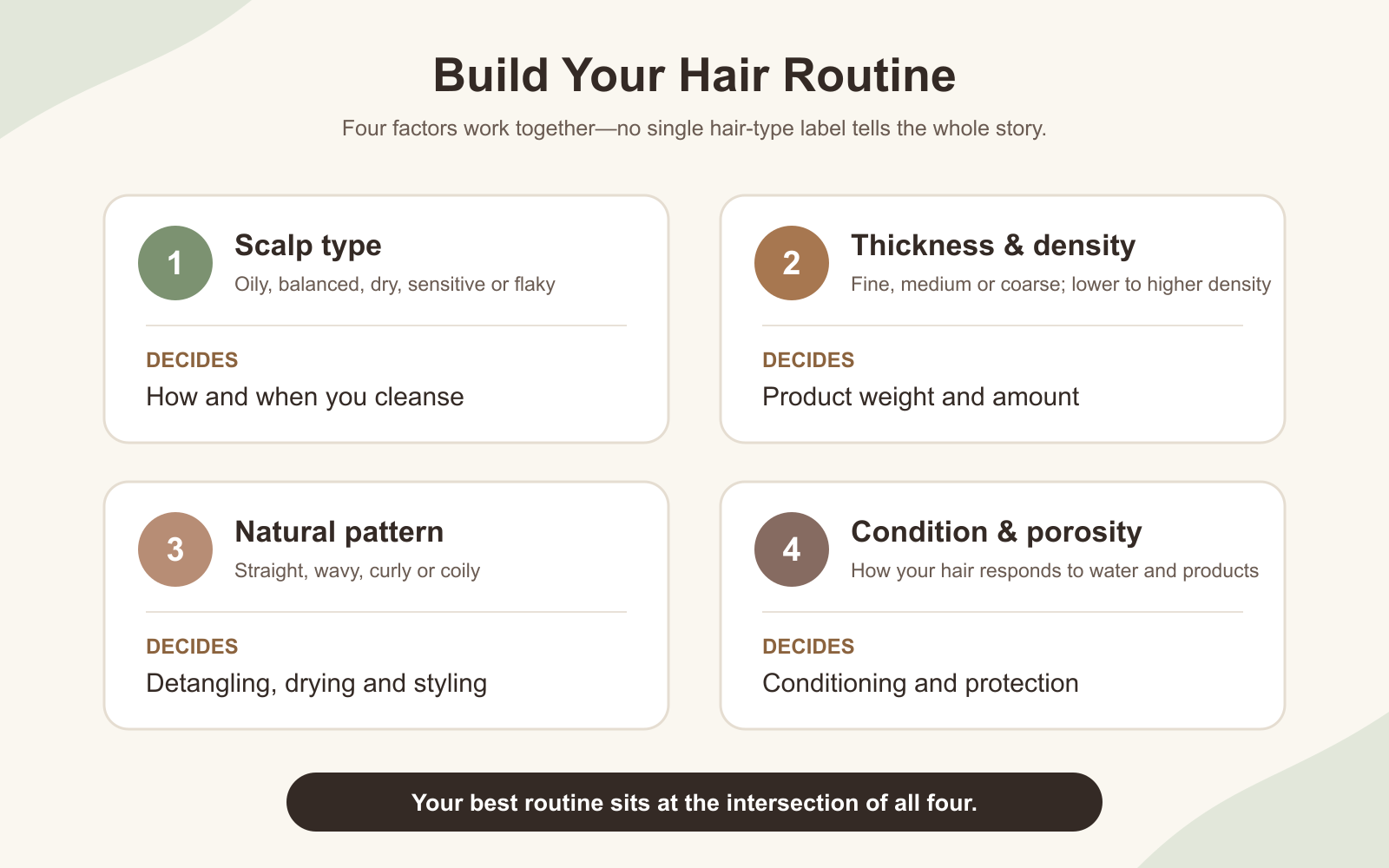
Straight, wavy, curly and coily describe your hair's natural pattern. They can help you choose styling and detangling techniques, but they do not tell you the whole story. A useful routine also considers your scalp, the diameter and density of your hair, how your strands respond to water and products, and any damage they have accumulated.
The simplest way to think about it is:
- Your scalp decides how and when you cleanse.
- Your strand thickness and density decide how much product your hair can carry.
- Your pattern decides how you detangle, dry and style.
- Your hair's condition and porosity decide how much conditioning and protection it needs.
Once you understand those four parts, you can stop copying someone else's routine and build one that makes sense for your own hair.
Want the short version? Take the Radiant Eden Hair Routine Quiz to match your scalp, strands and natural pattern with a personalised routine.
First, Meet Your Hair, Not Just Your Curl Type
Hair typing is useful when it gives you clues, not rules. You may have fine, high-density curls; coarse, low-density straight hair; an oily scalp with dry ends; or several curl patterns on the same head. All of these combinations are normal.
Before choosing products, look at five characteristics.
1. Scalp type: your cleansing starting point
Your scalp is skin. It produces sebum and collects sweat, shed skin and styling product residue, so its needs should guide your wash schedule.
- Oily scalp: Roots look or feel greasy soon after washing. You may need to shampoo more frequently or use a more effective cleanser, and you can use dry shampoo if you want to delay your next wash by a day.
- Balanced scalp: It feels comfortable between washes, without persistent oiliness, tightness, itching or visible flakes.
- Dry or sensitive scalp: It may feel tight, itchy or easily irritated. Gentle, fragrance-conscious products and comfortable water temperatures may help.
- Flaky scalp: Do not automatically assume flakes mean dryness. Dandruff and seborrhoeic dermatitis can also cause flaking and may need an anti-dandruff shampoo or medical advice.
Wash when your scalp needs it rather than stretching wash days to match a hair type chart. Shampoo belongs mainly on the scalp; the lather running through the lengths is usually enough to cleanse them. Regular washing with shampoo and water removes oil, dead skin and microorganisms that dry shampoo alone cannot remove, according to the American Academy of Dermatology.
If itching, burning, sores or heavy flaking persist, or you notice sudden or patchy hair loss, speak to a GP or dermatologist rather than trying to solve it with a more elaborate cosmetic routine.
2. Strand thickness: fine, medium or coarse
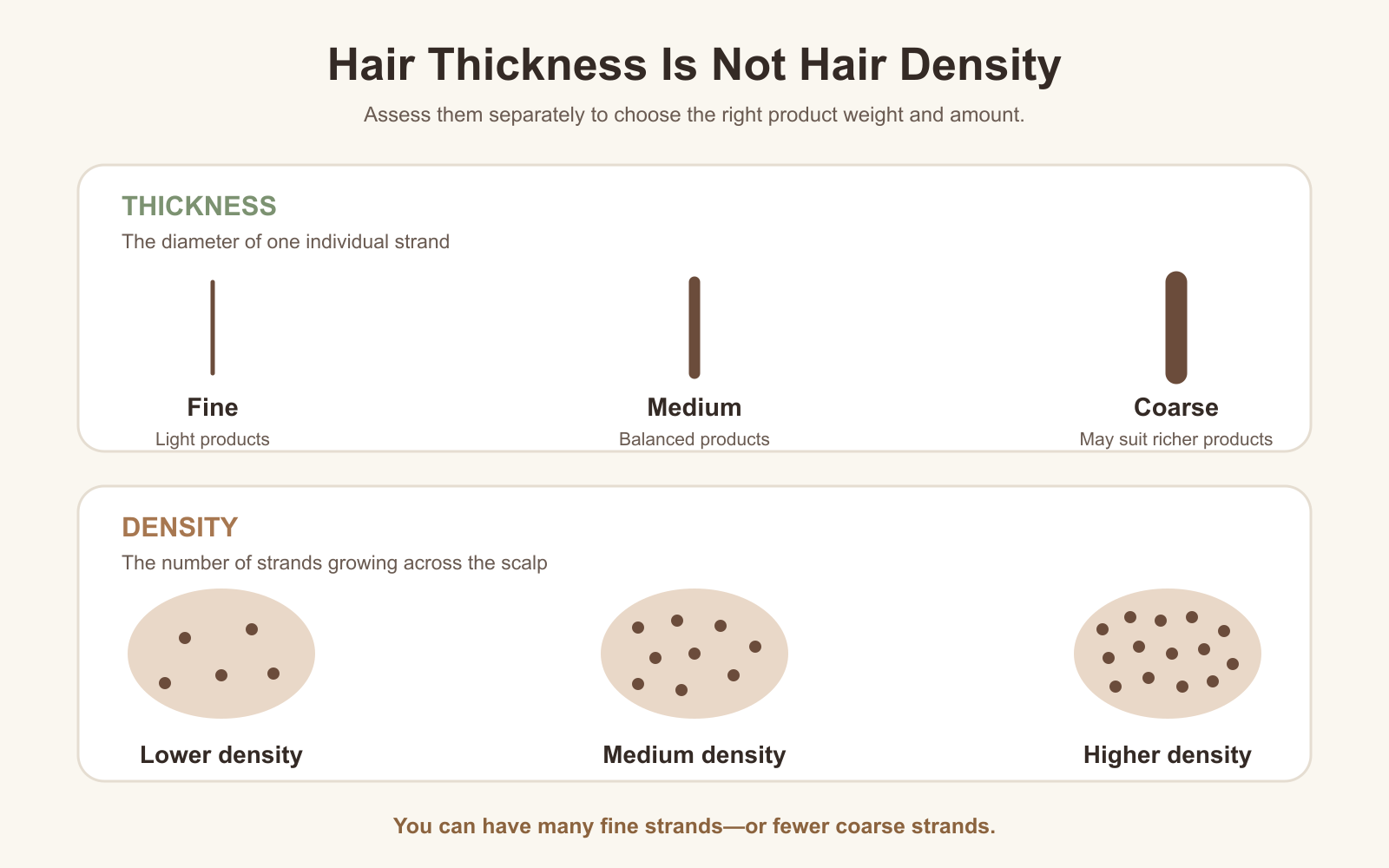
This is the diameter of an individual strand, not the amount of hair on your head.
Take a clean, dry strand between your fingers:
- Fine hair is difficult to feel and can be easily overwhelmed by rich creams, but it may also be fragile and prone to breakage.
- Medium hair is easier to feel and often tolerates a wider range of formulas.
- Coarse hair feels substantial between the fingers. It may tolerate richer products, but "coarse" does not automatically mean dry, strong or curly.
Strand thickness is often more useful than curl type when choosing product weight. A fine coil may prefer a light leave-in plus gel, while a coarse wave may enjoy a richer conditioner. The words "fine" and "coarse" describe diameter, not quality.
3. Density: how much hair you have
Density is the number of strands on your scalp. It is different from strand thickness, although both are often described as "thin" or "thick".
With dry, loose hair and no sharply made parting, look at how easily you can see your scalp:
- Lower density: More scalp is visible. Smaller amounts and lighter layering can help preserve volume.
- Medium density: Some scalp is visible.
- Higher density: Little scalp is visible. Sectioning may make cleansing, conditioning, detangling and drying more thorough.
Someone can have lots of fine strands or fewer coarse strands, so assess diameter and density separately.
4. Pattern: straight, wavy, curly or coily
Assess your natural pattern on clean hair with little or no styling product and allow it to dry without brushing it straight.
- Straight hair (Type 1) has little or no natural bend.
- Wavy hair (Type 2) forms loose S-shaped bends.
- Curly hair (Type 3) forms spirals or ringlets.
- Coily hair (Type 4) forms tight curls, coils, zigzags or a mixture, and usually shows significant shrinkage.
The familiar 1A-to-4C system can be a helpful visual shorthand, but you do not need to identify a perfect letter and number to care for your hair well. Pattern can vary across your head and can look different depending on length, weather, styling and damage.
5. Porosity and condition: how your hair behaves
Porosity is commonly used to describe how readily hair takes up and loses water. In everyday hair care, it is best treated as an observation rather than a permanent identity.
- Lower-porosity behaviour: Hair takes time to become fully wet, products tend to sit on it and build-up happens easily.
- Medium-porosity behaviour: Hair wets, conditions and dries without obvious extremes.
- Higher-porosity behaviour: Hair becomes wet quickly and dries quickly, feels rough or catches easily, or loses softness soon after conditioning.
Bleaching, permanent colour, chemical relaxing or perming, repeated high heat, UV exposure and everyday friction can damage the cuticle and make hair more porous over time. The cuticle is the hair shaft's protective outer layer, and research reviews describe its role in protecting the inner cortex from physical and chemical damage.
Skip the viral glass of water "float test". Oil, product residue, trapped air and surface tension can affect whether a strand floats. Your hair's behaviour over several wash days and its history of chemical or heat exposure give you more useful information.
The Five Step Routine That Works for Every Hair Type
Every routine needs only a few core functions. The products and frequency change; the framework does not.
Step 1: Cleanse the scalp
Choose a shampoo that leaves your scalp comfortable and your roots clean without making the lengths unnecessarily tangled.
- For an oily scalp, frequent exercise or regular use of oils and stylers, use an effective regular shampoo as often as needed.
- For a dry or sensitive scalp, try a gentler formula and avoid scratching or aggressive scalp scrubs.
- If hair is dense, curly or coily, work in sections so water and shampoo reach the scalp.
- If your usual products stop working, roots remain coated or hair looks dull and limp, use a clarifying shampoo occasionally, then condition the lengths.
There is no universally healthy number of wash days. Your ideal frequency is the one that keeps your scalp clean and comfortable while allowing you to handle your lengths gently.
Step 2: Condition the lengths
Conditioner reduces friction, improves slip and makes detangling easier. Apply it mainly from the mid-lengths to the ends unless the product is specifically designed for the scalp.
- Fine or low-density hair often prefers a light rinse out conditioner.
- Medium strands can begin with a balanced everyday conditioner.
- Coarse, very dry, highly textured or damaged hair may benefit from a richer formula and a periodic mask.
Deep conditioner is an optional adjustment, not a compulsory weekly ritual. Use it when your normal conditioner no longer gives enough softness and manageability.
Step 3: Detangle with as little force as possible
Hair is more vulnerable when swollen with water, so technique matters.
- Straight hair that tangles lightly may be gently brushed before washing or detangled carefully after conditioning.
- Wavy, curly and coily hair is usually best detangled in sections while damp and slippery with conditioner, using fingers or a wide tooth comb.
- Start at the ends and work upwards.
- If a knot resists, add slip and tease it apart instead of pulling through it.
Step 4: Style for your desired result
Styling products are where pattern matters most.
- A leave-in conditioner adds softness and slip.
- A mousse or foam adds light hold and volume.
- A curl cream adds moisture and definition but can overwhelm fine strands.
- A gel creates longer lasting hold and can reduce frizz across waves, curls and coils.
- A serum or light oil adds lubrication and shine but does not replace water, leave-in conditioner or conditioner.
You do not need every layer. Start with one styling product, assess the result, then add another only if it solves a clear problem.
Step 5: Dry and protect
Use a microfibre towel or smooth cotton T-shirt to squeeze out water without rough rubbing. Air dry, diffuse or blow dry according to your pattern and goal. When using hot tools, apply heat protectant and use the lowest temperature that achieves the result; the AAD recommends low or medium heat to limit damage.
Between washes, reduce avoidable friction with gentle handling, snag free accessories and a smooth sleep surface or protective style if these suit your hair. Avoid styles that feel painful or pull persistently at the hairline.
Now Adapt the Routine to Your Strand Thickness
If you are unsure which advice to prioritise, begin here. Strand diameter and density strongly affect how much conditioning and styling product your hair can carry.
Fine hair routine
Your aim is enough conditioning and hold without residue or collapse.
- Cleanse the scalp as often as it becomes oily or coated.
- Use a lightweight conditioner, concentrating on the ends.
- Choose one light leave-in, foam, mousse or gel rather than several rich layers.
- Clarify when hair becomes unusually flat, tacky or dull.
- Handle gently and keep heat moderate; fine does not mean weak, but each strand has less material and can be easy to snap.
Start with: lightweight liquids, sprays, foams and gels.
Use cautiously: heavy butters, generous oils and multiple leave-in creams at once.
Medium hair routine
Medium strands often have the widest margin for experimentation.
- Begin with a standard shampoo and conditioner matched to your scalp and current damage.
- Add a leave-in or styling product according to your pattern.
- Adjust richer or lighter based on the result, not the label on the bottle.
- Use an occasional mask if hair is long, chemically treated or frequently heat-styled.
Start with: balanced conditioners, lotions, creams or gels in moderate amounts.
Coarse hair routine
Your aim is even coverage, softness and reduced friction without assuming your scalp also needs oil.
- Cleanse according to scalp need, sectioning dense hair if necessary.
- Use a conditioner with good slip and take time to distribute it.
- Try a richer leave-in or cream if the lengths remain rough; add gel if you need hold.
- Pay extra attention to older ends and areas that rub against clothing.
Start with: richer conditioners and creamier stylers, then adjust for density and porosity.
Remember: a coarse strand can still become coated, and coarse straight hair does not automatically need a "coily hair" routine.
Adapt the Routine to Straight, Wavy, Curly or Coily Hair
Once product weight suits your strands, use pattern to refine your handling and styling.
Straight hair routine
Sebum can travel along straighter strands relatively easily, so the roots may show oil sooner than the ends.
- Shampoo when the scalp becomes oily, sweaty or coated.
- Keep conditioner mainly on the lengths if roots lose volume easily.
- Use a light leave-in or heat protectant for blow drying.
- Apply oils sparingly, beginning with the ends.
- Avoid repeatedly brushing through resistance; straight hair can still break.
Fine straight hair may suit frequent cleansing and very light conditioning. Coarse straight hair may need a richer conditioner or smoothing cream while following the same cleansing logic.
Wavy hair routine
Wavy hair often needs a careful balance: enough hold to preserve the wave, but not so much conditioning that it becomes flat.
- Cleanse the scalp thoroughly; co-washing is optional, not a requirement.
- Apply a light conditioner and detangle gently.
- Scrunch mousse, foam or gel into wet hair.
- Air dry or diffuse on low heat without repeatedly touching it.
- Once dry, gently scrunch out any firm gel cast.
Fine waves often prefer foam or a small amount of gel. Coarse or damaged waves may enjoy a leave-in or cream underneath, but add layers one at a time.
Curly hair routine
Curves make it harder for sebum to coat the full strand, while each bend can become a point of friction.
- Cleanse when your scalp needs it, working in sections if helpful.
- Condition generously enough to detangle without force.
- Apply styler to wet hair in sections for even coverage.
- Choose mousse for light volume, gel for hold, cream for softness or a small, purposeful combination.
- Dry with minimal disturbance, then separate or fluff only when fully dry.
If curls are fine, rich "curl" products may still be too heavy. If they are coarse or damaged, they may need more conditioning and stronger protection at the ends.
Coily hair routine
Tight bends, shrinkage and friction can make coily hair particularly vulnerable to knots and breakage, but the right routine still depends on the scalp and strand thickness.
- Divide dense hair into sections for cleansing, conditioning and detangling.
- Use plenty of water and slip; detangle patiently from the ends upwards.
- Layer a leave-in and styler only to the level your strands can hold.
- Use twists, braids, "wash and gos" or other low manipulation styles according to your preference, not because coils must be hidden to be manageable.
- Keep the scalp accessible and cleanse often enough to prevent uncomfortable build-up.
Dermatologists advise washing curly and coily hair when needed and at least every two to three weeks for scalp and hair health, though many people will prefer or need to cleanse more often (AAD curly hair guidance). Fine coils may prefer lighter layers and more frequent cleansing than coarse, high-density coils.
Adjust for Porosity, Damage and Product Build-Up
Porosity should fine tune your routine, not overrule everything else.
If products sit on your hair or it is slow to wet
- Clarify first to rule out build-up.
- Apply products to thoroughly wet hair.
- Use smaller amounts and lighter layers.
- Give conditioner time and even distribution rather than piling on more products.
- Judge the result after several wash days.
If hair wets quickly, feels rough or loses softness fast
- Use conditioner consistently and concentrate on vulnerable ends.
- Try a richer conditioner or a leave-in if strand thickness allows.
- Reduce bleaching, overlapping chemical treatments and excessive heat.
- Use hold products and friction reducing styles to limit tangling.
- Trim split or severely weathered ends; products can temporarily improve feel, but they cannot permanently fuse a split end back together.
The goal is not to force hair into a fixed "moisture versus protein" category. It is to notice what changed, alter one variable, and see whether manageability improves.
Your Quick Routine Builder
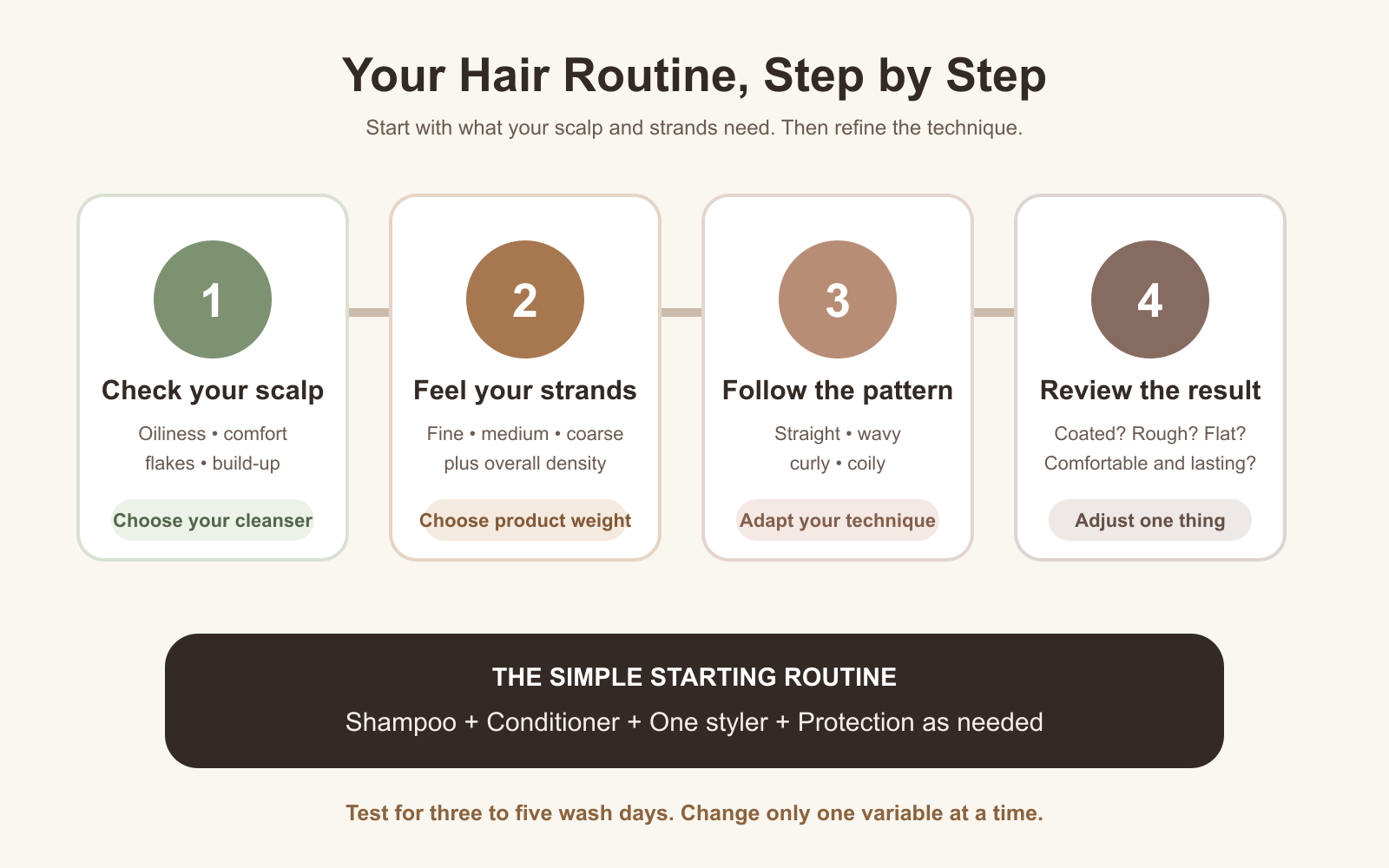
Use this order when choosing your next product or changing your routine:
- How does my scalp feel? — Shampoo type and wash frequency.
- Are my strands fine, medium or coarse? — Product weight and amount.
- Is my density low, medium or high? — Amount, sectioning and drying time.
- Is my hair straight, wavy, curly or coily? — Detangling, styling and drying technique.
- Is it coated, chemically treated or heat damaged? — Clarifying, conditioning and protection.
Then build the smallest routine that meets those needs:
- Shampoo for your scalp.
- Conditioner for your strand thickness and condition.
- One styler for your pattern and desired finish.
- Heat or friction protection as needed.
Use that routine for three to five wash days, changing only one thing at a time. This makes it much easier to tell what is helping.
How to Tell Whether Your Routine Is Working
A good routine should make your scalp and hair easier to live with, not give you another set of rules to obey.
Look for:
- a comfortable, clean scalp;
- hair that detangles with less force;
- less avoidable breakage;
- a finish that lasts as long as you reasonably need it to;
- softness without persistent coating or greasiness;
- styling that fits the time and effort you actually want to spend.
If your roots are flat or waxy, reduce product weight or clarify. If your ends stay rough, improve conditioning and reduce heat or friction. If definition disappears quickly, try stronger hold rather than adding more oil. If your scalp itches, flakes or becomes sore, focus on the scalp instead of masking it with dry shampoo or oils.
Build Your Personal Hair Routine
Your hair is not just straight, wavy, curly or coily. It is a combination of scalp needs, strand thickness, density, pattern, condition and daily life. Start with a clean scalp, condition according to what your strands can carry, style for the pattern you want to wear and protect the oldest parts of your hair from unnecessary damage.
That is your real hair type and the foundation of a routine you can keep.
Ready to make it personal? Take the Radiant Eden Hair Routine Quiz and get a simple routine based on your scalp, strands, pattern and hair goals.
Frequently asked
What is the correct order for a hair care routine?+
Is hair thickness more important than curl type?+
How often should I wash my hair?+
Can I have more than one hair type?+
Do I need to know whether I am 2C, 3A or 4B?+
How do I know whether a product is too heavy for my hair?+
Find your perfect haircare routine
Answer a few questions and we'll tailor Radiant Eden's picks to you.
Build my haircare routineKeep reading

The Best Amazon Black Friday Beauty Deals to Watch in 2026
Discover which Amazon Black Friday skincare, haircare and beauty tool deals are worth watching, plus how to recognise a genuine saving.
Protein Overload vs Moisture Overload: Signs and How to Fix Your Hair
Learn how to distinguish too much strengthening support from overconditioning, product build-up and structural hair damage—and reset your routine.
How to Choose a Premium Multi-Styler: Dyson Airwrap vs Shark FlexStyle
A hands-on guide to choosing between Dyson Airwrap and Shark FlexStyle multi-stylers, based on gentleness, speed, attachments and value.