
How to Build a Simple Skincare Routine for Your Skin Type
A gentle cleanser, one treatment if you need it, a moisturiser suited to how your skin feels and a sunscreen you will actually use — that is a complete routine.
Build a simple skincare routine with the right cleanser, treatment, moisturiser and sunscreen for dry, oily, combination or sensitive skin.
Skincare can look far more complicated than it needs to be. A quick scroll online can make it seem as though healthy skin requires ten products, several active ingredients and a different routine for every day of the week.
In reality, a useful skincare routine has a much simpler foundation:
- Cleanse without leaving your skin uncomfortably tight.
- Treat one specific concern, if you need to.
- Moisturise to support your skin barrier.
- Protect your skin from ultraviolet radiation with sunscreen.
Your skin type helps you choose the texture and strength of those products. It does not mean you need an entirely different set of steps from everyone else.
This guide will help you build a straightforward routine for dry, oily, combination or sensitive skin without buying products you do not need.
Want a routine matched to your skin? Take the Radiant Eden Skin Routine Quiz to find your skin type, choose your essential steps and identify which treatment, if any, fits your main concern.
First, Understand Your Skin Type
Skin type describes how your skin generally behaves. It is influenced by oil production, the condition of your skin barrier, genetics, climate, hormones, age and the products you use. It can also change over time or with the seasons.
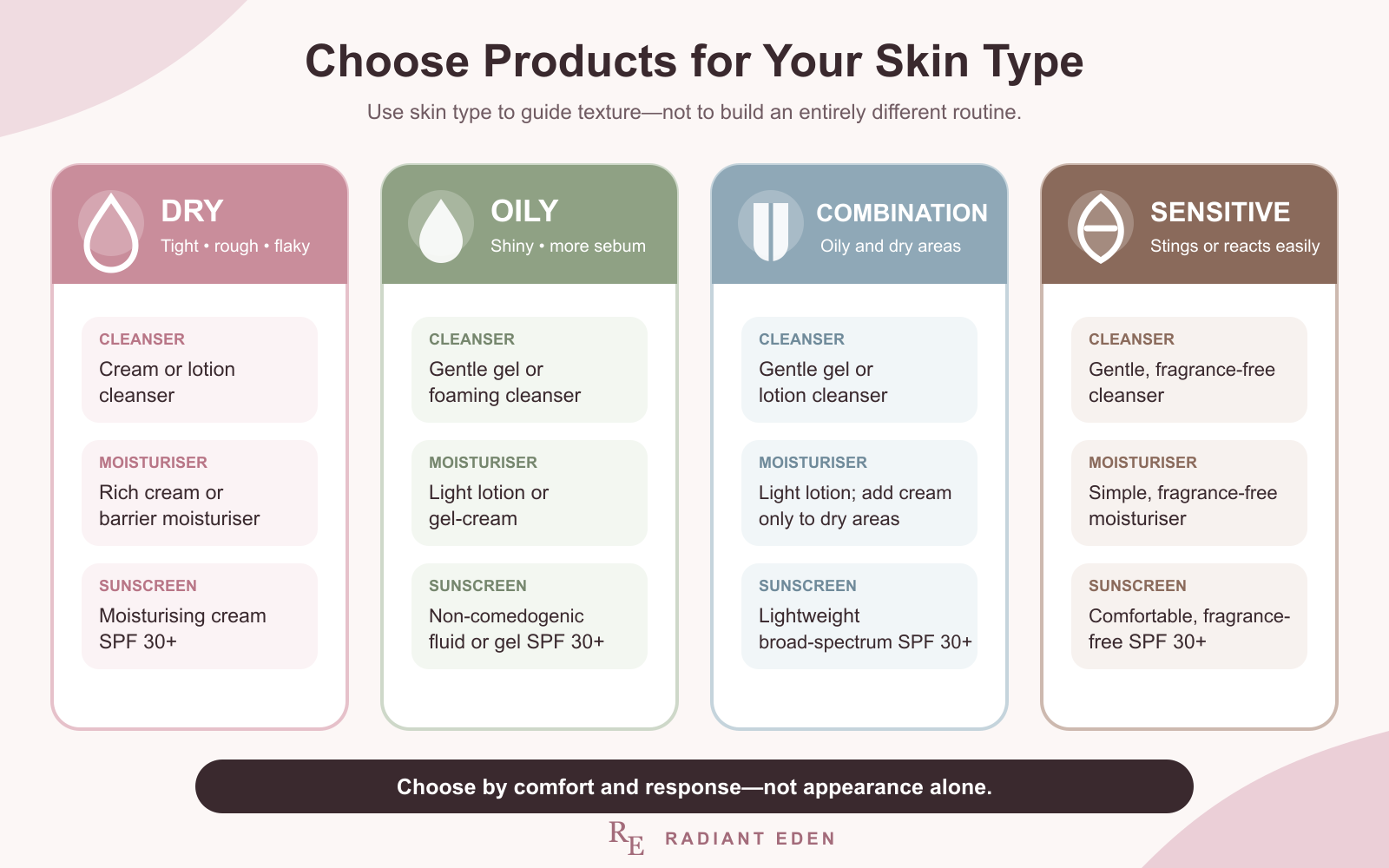
The American Academy of Dermatology describes dry skin as flaky, itchy or rough; oily skin as shiny and greasy; combination skin as dry in some areas and oily in others; and sensitive skin as skin that may sting or burn after product use (AAD).
Dry skin
Dry skin produces less oil or struggles to hold on to enough water. It may feel tight after cleansing and can look dull, rough or flaky.
Usually suits: gentle cream or lotion cleansers, richer moisturisers and comfortable cream based sunscreens.
Oily skin
Oily skin produces more sebum. It may become shiny throughout the day and can be more prone to clogged pores, although oiliness and acne are not the same thing.
Usually suits: gentle gel or foaming cleansers, lightweight moisturisers and non-comedogenic sunscreen fluids or gels.
Combination skin
Combination skin behaves differently in different areas. The forehead, nose and chin may be oily while the cheeks feel balanced or dry.
Usually suits: a balanced cleanser and products applied according to the needs of each area, rather than one heavy or stripping formula across the whole face.
Sensitive skin
Sensitive skin is easily irritated. Products may cause stinging, burning, itching or redness. "Sensitive" can describe a tendency, but persistent symptoms may also be caused by eczema, rosacea, contact dermatitis or another condition.
Usually suits: short ingredient lists, fragrance free products, gentle cleansing and the slow introduction of any treatment.
What about normal skin?
Normal or balanced skin is neither persistently dry nor very oily and is not especially reactive. It still benefits from gentle cleansing, moisturiser as needed and daily sun protection.
Skin type is not the same as a skin condition
You can have dry skin and acne, oily skin and sensitivity, or combination skin with rosacea. Skin type helps you choose product texture; a condition may require a specific treatment or medical advice.
Be cautious about diagnosing yourself from a product quiz or a social media photograph. Speak to a GP, pharmacist or dermatologist if you have:
- painful, deep or scarring acne;
- a persistent rash, swelling, cracking or oozing;
- frequent burning or stinging;
- redness that does not settle;
- sudden changes in your skin; or
- a new or changing lesion that concerns you.
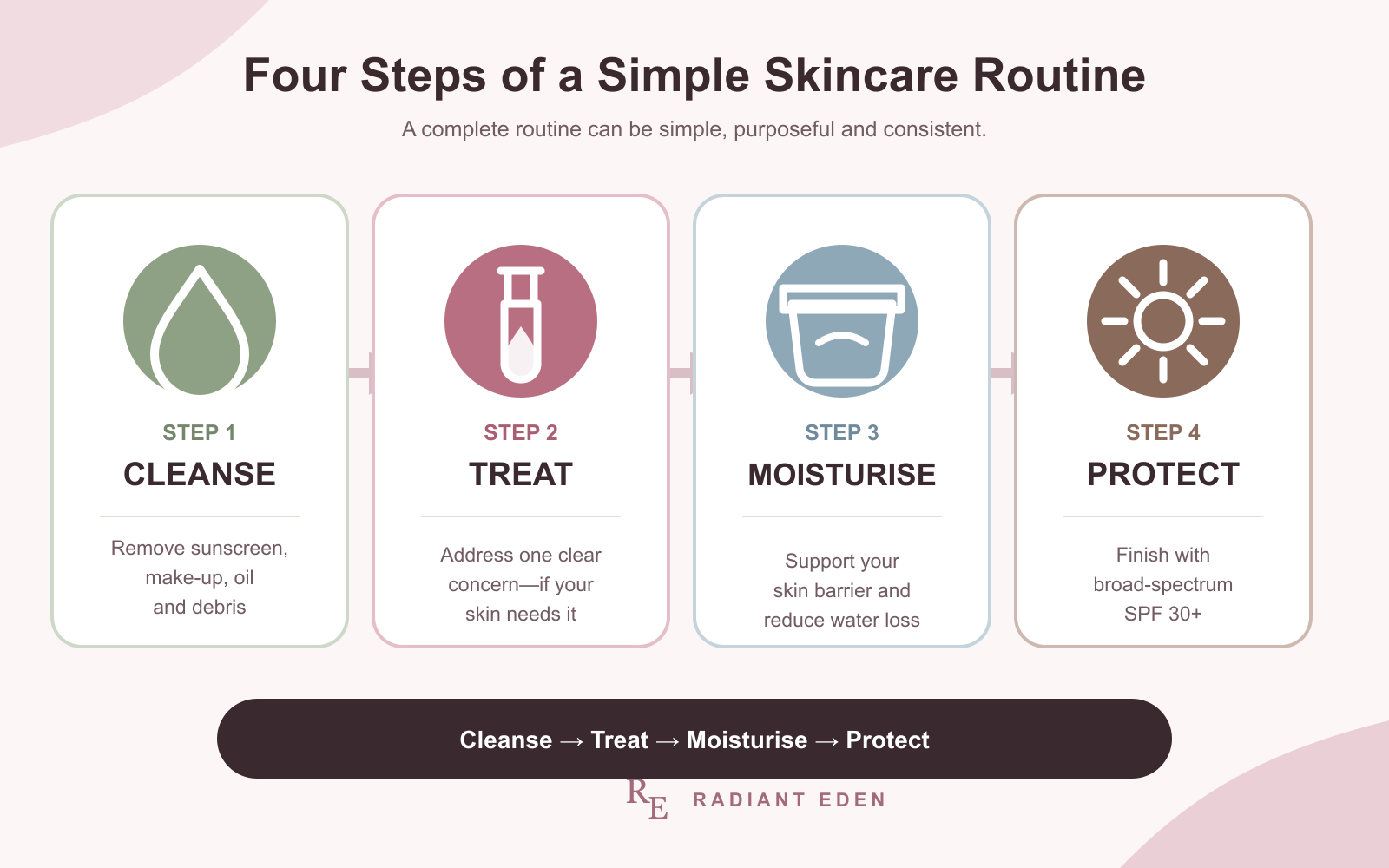
The Four Steps of a Simple Skincare Routine
You do not need every possible product category. Each step should have a clear job.
Step 1: Cleanser
A cleanser removes sunscreen, makeup, excess oil, sweat and everyday debris. The goal is clean, comfortable skin, not a squeaky or tight feeling.
Dermatologists recommend using a gentle, non abrasive cleanser, lukewarm water and your fingertips rather than scrubbing tools. Face washing should generally be limited to twice a day and after heavy sweating (AAD face-washing guidance).
Choose by how your skin feels afterwards:
- Cream or lotion cleanser: often comfortable for dry or sensitive skin.
- Gentle gel cleanser: often suits balanced, combination or oily skin.
- Foaming cleanser: can help remove oil and sunscreen, but it should not leave the skin tight or irritated.
- Oil or balm cleanser: useful for dissolving makeup and water resistant sunscreen. Follow with a water based cleanser only if residue remains or you prefer a double cleanse.
Double cleansing is optional. If one cleanser removes the day comfortably and thoroughly, a second cleanse is not automatically better.
Step 2: Treatment
Treatment is the most personalised step and the only optional one in this framework. Add it when you can name the concern it is meant to address.
Common examples include:
- Salicylic acid for clogged pores, blackheads and some forms of mild acne.
- Benzoyl peroxide for mild inflammatory spots; lower strengths may be less irritating, and it can bleach fabrics.
- Azelaic acid for acne, inflammation and the dark marks that can remain after spots.
- A retinoid such as adapalene for blackheads, whiteheads, spots, and to soften fine lines, where it is available and suitable for you.
- A hydrating serum for temporary dehydration, although a well-formulated moisturiser may make a separate serum unnecessary.
The AAD recommends choosing one acne treatment suited to the type of acne and giving it time to work instead of adding several products at once (adult acne guidance).
Introduce a treatment slowly, follow its label and reduce frequency if irritation develops. More product does not produce faster results. If you are pregnant, trying to become pregnant or breastfeeding, ask a qualified healthcare professional which active ingredients are appropriate before starting a treatment, especially a retinoid.
Step 3: Moisturiser
Moisturiser helps reduce water loss and supports the skin barrier. Even oily and acne prone skin can benefit from one, particularly when using treatments that cause dryness.
The main difference is texture:
- Gel or light lotion: usually feels more comfortable on oily skin.
- Lotion: a flexible starting point for balanced or combination skin.
- Cream: often suits dry skin or dry areas.
- Ointment or balm: useful for very dry patches, although it may feel too occlusive across an oily face.
Ingredients such as glycerin, ceramides, hyaluronic acid, squalane and petrolatum can all play useful moisturising roles. You do not need all of them in one formula.
Apply moisturiser while the skin is slightly damp if that feels comfortable; this helps trap water in the skin. The AAD particularly recommends creams or ointments and fragrance free products for dry skin (dry-skin guidance).
Step 4: Sunscreen
Sunscreen is the final step of your morning skincare routine. It helps protect against sunburn, premature skin ageing, hyperpigmentation and skin cancer.
Choose a sunscreen that offers:
- SPF 30 or higher;
- Broad-spectrum UVA and UVB protection; and
- water resistance when you will be swimming or sweating.
In the UK, look for strong UVA protection as well as the SPF number; for example, a four or five star UVA rating or the UVA symbol in a circle.
Apply sunscreen after your other skincare products and before applying makeup. Cover the face, ears, neck and any other exposed skin. Reapply approximately every two hours when outdoors and after swimming or heavy sweating. The AAD recommends SPF 30 or higher, broad-spectrum protection and water resistance (sunscreen guidance).
The best sunscreen is one you can apply generously and consistently. A tinted sunscreen may reduce visible white cast on deeper skin tones, while a fluid or gel may feel lighter on oily skin. Sensitive skin may prefer a fragrance-free formula; some people find mineral filters such as zinc oxide or titanium dioxide more comfortable.
The Correct Order for Morning and Evening Skincare
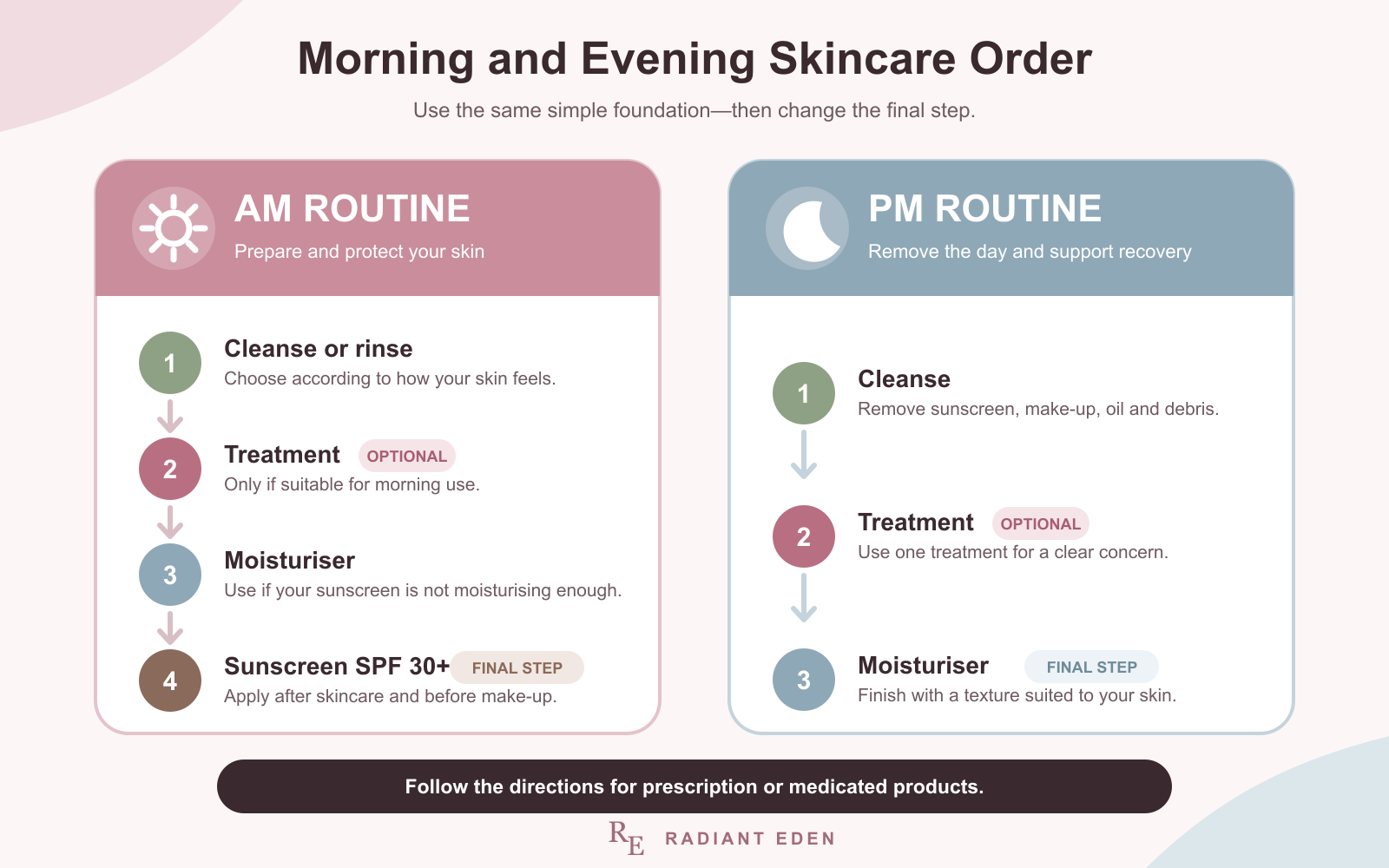
Simple morning routine
- Cleanse or rinse, depending on how your skin feels.
- Treatment, if the product is intended for morning use.
- Moisturiser, if your sunscreen is not moisturising enough by itself.
- Sunscreen as the final skincare step.
Simple evening routine
- Cleanse to remove sunscreen, makeup, oil and debris.
- Treatment, if you are using one.
- Moisturiser.
The "thinnest to thickest" rule can be a useful guide, but the product instructions matter more. A prescription or medicated treatment should be used exactly as directed.
A Simple Routine for Dry Skin
The aim is to cleanse without stripping and reduce water loss.
Morning
- Rinse with lukewarm water or use a gentle cream cleanser if needed.
- Apply an optional hydrating treatment.
- Use a cream moisturiser on slightly damp skin.
- Finish with a comfortable broad-spectrum SPF 30+ sunscreen.
Evening
- Cleanse gently, removing makeup or water resistant sunscreen thoroughly.
- Use your chosen treatment only if your skin tolerates it.
- Apply a richer moisturiser; use a small amount of ointment on very dry areas if needed.
Look for: glycerin, ceramides, hyaluronic acid, squalane and petrolatum.
Use cautiously: harsh foaming cleansers, frequent exfoliation, fragranced products and several strong actives at once.
If dry skin becomes cracked, painful, intensely itchy or persistently inflamed, it may need more than a cosmetic moisturiser.
A Simple Routine for Oily Skin
The aim is to manage excess oil without damaging the skin barrier. Trying to "dry out" oily skin can create irritation and make treatments harder to tolerate.
Morning
- Wash with a gentle gel or foaming cleanser.
- Apply one treatment if needed and suitable for morning use.
- Use a lightweight, non-comedogenic moisturiser or move straight to sunscreen if your sunscreen is moisturising enough.
- Finish with a non-comedogenic SPF 30+ fluid, gel or light lotion.
Evening
- Cleanse thoroughly but gently.
- Apply one treatment for your main concern, such as salicylic acid for clogged pores.
- Use a light moisturiser, especially if the treatment is drying.
Look for: "non-comedogenic", "oil free", gel cream or light lotion textures.
Use cautiously: abrasive scrubs, alcohol heavy astringents, cleansing more than necessary and stacking several exfoliating acids.
Oily skin still needs moisturiser when it feels dry or irritated. The AAD notes that acne treatments, including salicylic acid, benzoyl peroxide and retinoids, can be drying, and moisturiser can help skin tolerate them (AAD).
A Simple Routine for Combination Skin
The aim is flexibility. You do not have to treat your whole face as equally oily or equally dry.
Morning
- Use a gentle gel or lotion cleanser.
- Apply treatment only where it is needed, if the instructions allow targeted use.
- Use a light moisturiser all over, adding a little more to dry areas or moisturise only the areas that need it.
- Finish with a broad-spectrum SPF 30+ sunscreen across the entire face and exposed skin.
Evening
- Cleanse gently.
- Apply your treatment according to the concern and product directions.
- Use a lotion across the face and a richer cream on dry cheeks if needed.
Look for: balanced, layerable formulas that let you adjust by area.
Use cautiously: using a strong oily skin routine across dry areas or a heavy dry skin routine across areas that clog easily.
A Simple Routine for Sensitive Skin
The aim is comfort, consistency and identifying triggers. Begin with the fewest products.
Morning
- Rinse or cleanse with a gentle, fragrance free cleanser.
- Skip treatment while establishing the routine.
- Apply a simple fragrance free moisturiser.
- Finish with a fragrance free broad-spectrum SPF 30+ sunscreen that does not sting.
Evening
- Cleanse gently with lukewarm water.
- Apply moisturiser.
- Add a treatment later only if your skin is comfortable and there is a clear reason to use it.
Look for: "fragrance free", simple formulations and soothing cream or lotion textures.
Use cautiously: essential oils, fragranced botanicals, scrubs, frequent exfoliation and introducing several new products together. "Natural" and "unscented" do not necessarily mean fragrance free or non irritating.
Before applying a new product across your face, test it on a small area. The AAD suggests applying a product to a test spot twice daily for seven to ten days, following the normal contact time, to look for a reaction (patch-testing guidance).
How to Introduce a New Treatment Without Overwhelming Your Skin
Many unsuccessful routines contain good products introduced too quickly.
Use this approach:
- Establish a cleanser, moisturiser and sunscreen first.
- Make sure your skin feels comfortable for at least one to two weeks.
- Choose one concern and one treatment.
- Patch test it.
- Begin at the lowest frequency recommended by the product or your clinician.
- Keep the rest of the routine unchanged while you assess it.
- Give it enough time to work; many concerns improve over weeks, not days.
Stop and reassess if you develop persistent burning, swelling, a rash, marked peeling or worsening irritation. A brief mild tingle from some treatments is not the same as ongoing pain or inflammation.
Your Quick Skincare Routine Builder
Ask yourself these five questions — each one guides a single decision in your routine:
- Does my face feel tight, oily or mixed after cleansing? → Cleanser texture and strength.
- What is the one concern I want to address? → Whether you need a treatment.
- Does my skin feel dry or coated? → Moisturiser texture and amount.
- Does my sunscreen feel comfortable enough to use generously? → Sunscreen format.
- Does my skin sting, burn or become red easily? → Number of products and introduction speed.
Start with:
- One gentle cleanser.
- One moisturiser that feels comfortable.
- One broad-spectrum SPF 30+ sunscreen.
- One treatment only if you need it.
That is a complete skincare routine.
How to Tell Whether Your Routine Is Working
A good routine should become uneventful. Your skin should feel comfortable, and the products should be easy enough to use consistently.
Positive signs include:
- skin that does not feel persistently tight after cleansing;
- manageable oiliness rather than a stripped feeling;
- less stinging, redness or flaking;
- a moisturiser and sunscreen that sit comfortably;
- gradual improvement in the concern being treated; and
- a routine you can follow without excessive time or expense.
If your skin feels tight, choose a gentler cleanser or cleanse less frequently. If it feels greasy or coated, try lighter layers rather than removing moisturiser automatically. If a treatment causes persistent irritation, reduce its frequency or stop using it. If sunscreen pills are used, allow each layer to settle and simplify the products underneath.
Common Skincare Routine Mistakes
Starting too many products at once
If irritation develops, you will not know which product caused it. Introduce one new product at a time.
Treating oily skin aggressively
Scrubs, astringents and repeated cleansing can irritate the skin without addressing the cause of acne.
Confusing dehydration with dry skin
Any skin type can temporarily lack water. Oily skin can feel dehydrated, particularly after over-cleansing or strong treatments.
Using several products with overlapping actives
An acid cleanser, exfoliating toner, treatment serum and retinoid may create more irritation than benefit. Read ingredient lists and give every active ingredient a clear purpose.
Changing the routine every few days
Skincare often needs several weeks of consistent use. Constant changes make results and reactions difficult to interpret.
Saving sunscreen only for sunny days
UV exposure occurs throughout the year. Use sunscreen when you will be exposed and combine it with shade, clothing and other sun protective habits.
Build the Routine Your Skin Actually Needs
A skincare routine does not have to be elaborate to be effective. Begin with a gentle cleanser, a moisturiser suited to how your skin feels and a sunscreen you will use properly. Add one treatment only when it has a specific job.
Dry, oily, combination and sensitive skin do not require completely different philosophies. They require thoughtful adjustments in texture, strength and frequency.
Start simple. Watch how your skin responds. Change one thing at a time. That is how you build a routine that works and one you can realistically keep.
Ready to make it personal? Take the Radiant Eden Skin Routine Quiz for a simple routine based on your skin type, sensitivity and main concern.
Frequently asked
What is the correct order for a skincare routine?+
Do I really need a skincare treatment?+
Can oily skin skip moisturiser?+
Should I cleanse in the morning?+
How long should I test a routine before changing it?+
Is expensive skincare better?+
Can I use the same routine all year?+
Find your perfect skincare routine
Answer a few questions and we'll tailor Radiant Eden's picks to you.
Build my skincare routineKeep reading

Closed Comedones and Clogged Pores: What Helps and What Makes Them Worse
Learn what helps closed comedones and clogged pores, which active ingredient to choose and which common skincare habits can make bumps worse.

Dry Skin vs Dehydrated Skin: How to Tell the Difference
Learn how to distinguish dry skin from dehydrated skin, identify common triggers and choose a simple routine that restores comfort.

How to Layer Skincare Ingredients: A Simple Morning and Evening Guide
Learn the correct order for vitamin C, azelaic acid, retinoids, exfoliating acids, moisturiser and sunscreen without overwhelming your skin.