How to Repair a Damaged Skin Barrier: Signs, Causes and a Gentle Routine
Signs of tightness, stinging, flaking and redness and how to build a simple recovery routine.

Learn the signs of a damaged skin barrier, what causes tightness, stinging, flaking and redness, and how to build a gentle recovery routine.
If your usual moisturiser suddenly stings, your face feels tight after cleansing or smooth skin has become rough and flaky, your skin barrier may be struggling.
This often happens after using too many active ingredients, exfoliating too frequently or repeatedly cleansing the skin until it feels "squeaky clean". Cold weather, low humidity, sun exposure and underlying skin conditions can also produce similar symptoms.
The reassuring part is that an irritated skin barrier rarely needs a complicated rescue routine. In many cases, the most useful response is to remove potential irritants temporarily and return to the three essentials:
- Cleanse gently.
- Moisturise consistently.
- Protect your skin from the sun.
This guide explains how to recognise common signs of barrier disruption, what may have caused them and how to simplify your routine while your skin settles.
Important: "Damaged skin barrier" is a useful skincare description, not a medical diagnosis. Eczema, rosacea, contact dermatitis, infection and other conditions can cause similar symptoms. Seek medical advice if your symptoms are severe, persistent, recurrent or worsening.
Not sure which products your skin needs? Take the Radiant Eden Skin Routine Quiz to build a simple routine based on your skin type and current level of sensitivity.
What Is the Skin Barrier?
The skin barrier is mainly formed by the stratum corneum, the outermost layer of the epidermis.
It is often described as being like a brick wall: skin cells act as the bricks, while a mixture of lipids, including ceramides, cholesterol and fatty acids, helps fill the spaces between them.
This layer has two closely connected jobs:
- limiting the amount of water that escapes from the skin; and
- helping protect the body from irritants, allergens and the outside environment.
When that barrier is disrupted, the skin can lose water more easily and become more reactive. DermNet notes that barrier damage can lead to greater water loss, inflammation and increased sensitivity to irritants and allergens (DermNet).
Signs Your Skin Barrier May Be Damaged

Barrier disruption does not look exactly the same on everyone. It can affect dry, oily, combination and acne prone skin.
Common signs include:
- tightness, especially after cleansing;
- burning or stinging when you apply previously comfortable products;
- roughness or a sandpaper like texture;
- flaking, scaling or peeling;
- itching or tenderness;
- increased sensitivity to water, sweat or weather;
- redness on lighter skin tones;
- darker brown, purple, grey or ashy looking areas on deeper skin tones;
- skin that feels dry but may still look oily; and
- breakouts appearing alongside irritation.
One symptom alone does not prove that the barrier is damaged. For example, flaking may come from dry skin, a retinoid, eczema or seborrhoeic dermatitis. Burning and redness can also be signs of irritant or allergic contact dermatitis.
The NHS describes contact dermatitis symptoms as ranging from dryness, redness, burning and stinging to cracking, intense itching and fluid filled blisters (NHS). If the reaction is pronounced or keeps returning, it is worth getting a proper diagnosis.
Is It Barrier Damage or "Purging"?
Do not dismiss burning, itching, swelling or persistent redness as skin "purging".
Some acne treatments can initially change the pattern of breakouts, but painful stinging, widespread flaking, a rash or discomfort from basic products points towards irritation rather than a routine working more effectively.
A useful rule is to pay attention to comfort as well as appearance. If your skin hurts, burns, feels raw or becomes progressively more inflamed, stop experimenting and simplify your routine. If a prescribed treatment is involved, contact the clinician who prescribed it before changing how you use it.
What Causes a Damaged or Irritated Skin Barrier?
The barrier is often affected by several small sources of irritation rather than one dramatic event.
Using too many active ingredients
Retinoids, alpha hydroxy acids, beta hydroxy acids, benzoyl peroxide and other treatments can be useful when chosen for a clear reason. Problems arise when several are layered together, used too frequently or introduced at the same time.
Your skin does not receive extra credit for tolerating the strongest possible routine. Using more product than directed can increase irritation without producing faster results. The American Academy of Dermatology recommends limiting the number of active products and stopping non prescription products that sting or burn (AAD).
Over exfoliating
Exfoliation may come from more places than you realise. A routine might include an acid cleanser, exfoliating toner, resurfacing serum and weekly peel, even though each product appears gentle when considered alone.
Physical scrubs, cleansing brushes and rough cloths can add friction. Trying to scrub away flakes usually creates more irritation rather than helping the skin recover.
Cleansing too aggressively
Strong cleansers, hot water, repeated washing and scrubbing can remove more surface oil than necessary. A cleanser should remove makeup, sunscreen, sweat and excess oil without leaving the skin painfully tight.
The AAD recommends a gentle, non-abrasive cleanser, lukewarm water and fingertips rather than scrubbing tools. It also advises limiting face washing to twice daily and after heavy sweating (AAD face-washing guidance).
Fragrance, essential oils or a product allergy
"Natural" does not automatically mean non-irritating. Fragrance, essential oils, preservatives and botanical extracts can cause irritation or an allergic reaction in some people. An allergy can also develop after you have used an ingredient for a long time without a problem. A well-defined, itchy or recurring rash needs more caution than simply switching to a richer moisturiser.
Weather and the environment
Cold air, low humidity, indoor heating, wind, sun exposure and sudden temperature changes can all make dry or sensitive skin harder to manage. Frequent swimming and occupational exposure to water, detergents or solvents can also contribute.
An underlying skin condition
Atopic eczema, rosacea, psoriasis, acne treatment irritation and contact dermatitis can all disrupt barrier function. In these situations, a gentle routine may reduce discomfort, but treating the underlying condition is equally important.
A Gentle Skin Barrier Recovery Routine
For a short period, make your routine boring. The aim is to reduce avoidable irritation while maintaining cleansing, moisture and sun protection. You do not need a separate "barrier serum", face oil, mist and sleeping mask. A small number of well tolerated products is easier to assess and less likely to introduce another trigger.
Morning Routine
1. Rinse or cleanse gently
If your skin is dry and comfortable when you wake up, rinsing with lukewarm water may be enough. If you need to remove overnight oil or treatment residue, use a mild fragrance free cream, lotion or low foaming cleanser.
Use your fingertips, rinse thoroughly and pat, rather than rub, your skin dry.
2. Apply a simple moisturiser
Apply moisturiser while your skin is slightly damp if this feels comfortable. Look for a fragrance free cream or lotion with a relatively straightforward formula.
Useful moisturising ingredients may include:
- Glycerin or hyaluronic acid, which attract water;
- Ceramides, which are lipids naturally found in the skin barrier;
- Dimethicone, squalane or other emollients that smooth rough areas; and
- Petrolatum, which is highly occlusive and reduces water loss.
You do not need every ingredient on this list. The best option is the moisturiser you can use without persistent stinging, itching or new redness.
3. Finish with sunscreen
Use a broad-spectrum SPF 30 or higher on exposed skin. Sun protection matters because irritated skin can be more vulnerable to discomfort and inflammation, and inflammation can contribute to lingering dark marks, particularly in deeper skin tones.
Choose a fragrance free sunscreen that your skin tolerates. Some people find a mineral sunscreen containing zinc oxide or titanium dioxide more comfortable during a reactive period, but this is personal rather than a universal rule.
If every sunscreen causes significant burning, use shade, a hat and other protective clothing while asking a pharmacist, GP or dermatologist for help finding a suitable formula. Do not deliberately expose sore skin to strong sunlight.
Evening Routine
1. Remove makeup and sunscreen without scrubbing
Use one gentle cleanser if it removes everything comfortably. If heavy makeup or water resistant sunscreen requires a first cleanse, choose a fragrance free oil or balm and follow it with a gentle water based cleanser only when needed.
Double cleansing is not automatically better. If it leaves your skin tight, use less product, reduce the second cleanse or choose a gentler method.
2. Pause optional active ingredients
Temporarily stop non-prescription products that exfoliate, accelerate cell turnover or repeatedly sting. Depending on your routine, that may include:
- retinol or other cosmetic retinoids;
- glycolic, lactic, mandelic or salicylic acid;
- exfoliating toners, peels and scrubs;
- benzoyl peroxide;
- strong or acidic vitamin C formulas;
- astringent toners; and
- clay masks or cleansing brushes.
This does not mean these ingredients are inherently harmful. It means irritated skin needs fewer variables while it recovers.
Do not stop or alter a prescription medicine solely based on an online article. Ask the prescriber how to manage irritation; they may recommend changing the frequency, amount or way it is applied.
3. Moisturise generously
Apply a fragrance free cream or ointment. Creams are often more comfortable than thin lotions for dry, flaky skin, while ointments reduce water loss most effectively but can feel greasy. If you are acne prone, begin with a non-comedogenic cream and reserve a thin layer of petrolatum for particularly dry areas such as the corners of the nose or lips. Applying a heavy occlusive layer over the whole face is optional, not essential, and may not suit everyone. The NHS explains that emollients help reduce water loss and that ointments contain more oil than creams or lotions, making them effective for very dry skin (NHS).
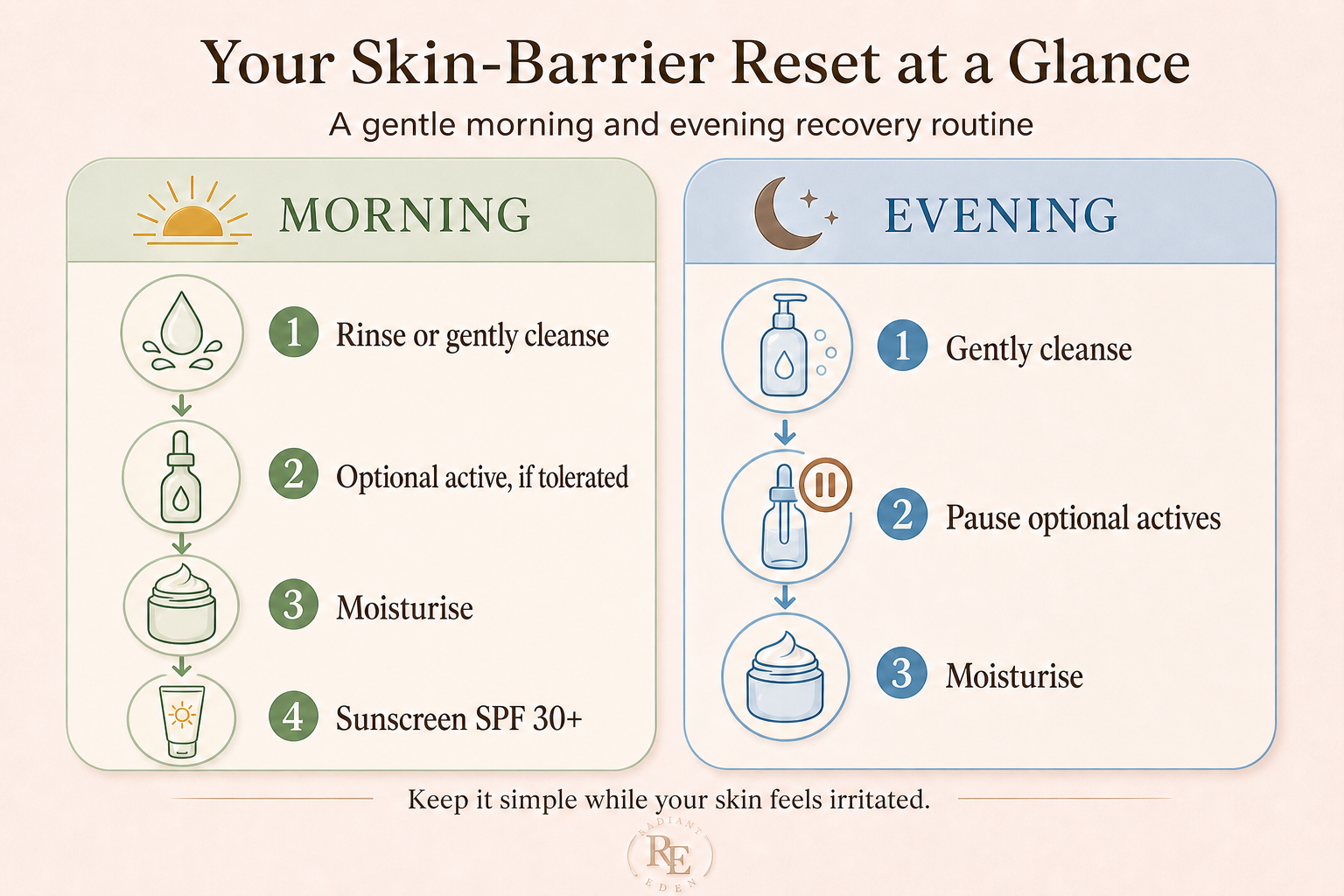
Your Skin Barrier Reset at a Glance
Morning
- Rinse or use a gentle cleanser.
- Apply a fragrance free moisturiser.
- Finish with broad-spectrum SPF 30+.
Evening
- Cleanse gently.
- Skip optional active ingredients while the skin is irritated.
- Apply a fragrance free moisturiser or ointment.
That is enough. Toner, essence, serum, oil and masks can wait.
How to Choose Products While Your Skin Is Reactive
Packaging claims such as "barrier repair", "clean", "medical grade" or "dermatologist tested" do not guarantee that a product will suit you.
Prioritise:
- Fragrance free, rather than merely "unscented";
- a short, manageable routine;
- cream or lotion textures that do not sting;
- a gentle, non-abrasive cleanser;
- a moisturiser you can reapply when needed; and
- a sunscreen you can wear consistently.
Be cautious with:
- fragrance and essential oils;
- exfoliating acids and scrubs;
- strong foaming or deodorant soaps;
- alcohol heavy astringents;
- long ingredient lists full of unfamiliar botanical extracts; and
- introducing several "soothing" products at once.
Even products designed for sensitive skin can cause a reaction. If a new product creates persistent burning, itching, swelling or a rash, rinse it off and stop using it.
Should Oily or Acne Prone Skin Use a Barrier Routine?
Yes. Oily skin can still be dehydrated, irritated or flaky, and acne treatments commonly cause dryness. Repairing an irritated routine does not require using a very heavy cream across the entire face.
Choose a lightweight, fragrance free, non-comedogenic moisturiser and apply more only where needed. Continue cleansing gently rather than trying to remove every trace of oil. Once the skin is comfortable, you can gradually restart the treatment that is most useful for your acne.
If acne is painful, deep, scarring or difficult to control without several irritating products, seek professional treatment rather than repeatedly stripping the skin.
How Long Does Skin Barrier Repair Take?
There is no reliable universal countdown. Mild irritation may begin to feel better within several days after the trigger is removed, while more significant dermatitis or ongoing exposure can take much longer and may need treatment.
Track improvement by how your skin behaves rather than by an arbitrary deadline. Positive signs include:
- water and moisturiser no longer sting;
- tightness is reduced;
- flaking and roughness are settling;
- redness or discolouration is fading; and
- your skin remains comfortable between applications of moisturiser.
If your skin is not improving, the suspected product may not be the real cause, or the reaction may need medical treatment.
When and How to Restart Active Ingredients
Wait until your skin feels consistently comfortable and is no longer stinging, burning or visibly peeling. Then reintroduce products one at a time.
- Start with the treatment that addresses your main concern. Do not restart everything together.
- Use it less frequently than before. One or two applications a week may be a reasonable starting point for some non-prescription products, but follow the label or professional advice.
- Use the recommended amount. More is not faster.
- Keep the rest of the routine stable. This makes a reaction easier to identify.
- Increase slowly only if your skin remains comfortable.
With a retinoid, moisturiser before or after application may improve comfort. The AAD advises beginning with a less intense retinoid formula and building up slowly because starting too aggressively can irritate the skin (AAD retinoid guidance).
If the burning, rash or widespread peeling returns, stop the product and reconsider whether its strength, frequency or ingredients suit you.
Common Skin Barrier Repair Mistakes
Buying an entirely new routine
Introducing five unfamiliar products makes it harder to identify what helps and what irritates. Start with the simplest products you already know your skin tolerates.
Exfoliating away the flakes
Flakes are a sign to reduce friction and improve moisturising, not a request for a scrub or peel.
Treating every tingle as proof that a product is working
Skincare does not need to hurt to be effective. Persistent burning or stinging is a reason to stop and assess the product.
Applying more active ingredients to fix new breakouts
Irritated skin and acne can occur together. Escalating acids, retinoids and spot treatments all at once may make the routine less tolerable.
Relying on one fashionable ingredient
Ceramides can be useful, but no single ingredient repairs every cause of irritation. Removing the trigger and using a well tolerated moisturiser consistently matters more than finding a miracle serum.
Skipping sunscreen because it stings
Try a different fragrance free texture or filter combination and use hats, shade and clothing as additional protection. If all sunscreens cause a significant reaction, ask a healthcare professional for guidance.
When to Speak to a Pharmacist, GP or Dermatologist
Seek professional advice if:
- symptoms are severe, persistent or keep returning;
- your skin is very painful, intensely itchy, swollen, blistered or cracked;
- there is a widespread or sharply defined rash;
- your eyelids or the area around your mouth are affected repeatedly;
- even bland moisturisers cause significant burning;
- you think a prescription treatment is causing the reaction;
- you suspect eczema, rosacea or an allergy; or
- changes to a gentle routine are not helping.
Get urgent medical advice if your symptoms rapidly worsen or you develop increasing pain, discharge, spreading warmth, fever, chills or a general feeling of being unwell. These can be signs of infection (NHS). Seek emergency help for breathing difficulty or swelling of the lips, tongue or throat.
Give Your Skin Less to Fight With
When skin feels tight, raw or reactive, the instinct is often to search for a powerful repair product. A better first step is usually subtraction.
Pause unnecessary active ingredients. Put away the scrub. Use lukewarm water, a gentle cleanser, a comfortable moisturiser and daily sun protection. Once your skin is calm, reintroduce only the treatment that has a clear purpose and do it slowly.
A healthy routine is not the one with the most steps. It is the one your skin can tolerate consistently.
Build a routine around what your skin needs now. Take the Radiant Eden Skin Routine Quiz to choose your essential products and avoid unnecessary steps.
Related products


Frequently asked
Can a damaged skin barrier cause acne?+
Does moisturiser repair the skin barrier?+
Is hyaluronic acid enough for barrier repair?+
Can I use niacinamide on a damaged skin barrier?+
Should I use petrolatum or 'slug' my skin?+
Can I exfoliate if my skin is flaky?+
Can vitamin C damage the skin barrier?+
What is the fastest way to repair a damaged skin barrier?+
Find your perfect skincare routine
Answer a few questions and we'll tailor Radiant Eden's picks to you.
Build my skincare routineKeep reading

Closed Comedones and Clogged Pores: What Helps and What Makes Them Worse
Learn what helps closed comedones and clogged pores, which active ingredient to choose and which common skincare habits can make bumps worse.

Dry Skin vs Dehydrated Skin: How to Tell the Difference
Learn how to distinguish dry skin from dehydrated skin, identify common triggers and choose a simple routine that restores comfort.

How to Layer Skincare Ingredients: A Simple Morning and Evening Guide
Learn the correct order for vitamin C, azelaic acid, retinoids, exfoliating acids, moisturiser and sunscreen without overwhelming your skin.