
How to Stop Frizzy Hair: A Routine for Every Hair Type and Climate
A climate-aware anti-frizz routine for fine, coarse, straight, wavy, curly and coily hair.

Learn what causes frizzy hair and build an anti-frizz routine for humid or dry weather, with practical advice for fine, thick, straight, wavy, curly and coily hair.
Frizz is not one problem with one solution. Hair can become frizzy because humid air disrupts a carefully styled shape, because dry air increases static and roughness, or because heat, colour, friction and breakage have left the fibre less smooth. Your natural texture, strand thickness and styling goal also change what “frizz control” should look like.
That is why the richest anti-frizz cream is not always the best answer. It may smooth coarse, dry hair beautifully while making fine hair flat and greasy. A strong gel may help curls keep their shape in humid weather, but feel unnecessarily rigid on straight hair in a dry climate.
The best routine does three things:
- Conditions the hair enough to reduce roughness and friction.
- Uses the right amount of hold or surface protection for the weather.
- Avoids adding more weight, heat or build-up than the strands can support.
This guide will help you build that routine for fine, medium or coarse strands; low or high density; and straight, wavy, curly or coily hair.
Want a routine matched to your hair and scalp? Take the Radiant Eden Hair Routine Quiz to combine your strand thickness, density, pattern, porosity, scalp needs and current hair condition.
The Quick Answer: Match the Routine to the Cause
Humidity
What is happening: Hair takes up water from the air and a smooth or defined style begins to change shape.
Make this your priority: Flexible conditioning plus humidity-resistant hold; dry the style fully.
Dry air or indoor heating
What is happening: Hair loses softness, develops static and separates into flyaways.
Make this your priority: Conditioning, a light leave-in and a small amount of oil or serum on the ends.
Damage and breakage
What is happening: Raised, worn areas and broken hairs make the surface look uneven.
Make this your priority: Reduce heat and friction; use conditioner and heat protection consistently.
Too much product
What is happening: Residue makes hair sticky, dull or difficult to style, and new products sit unevenly.
Make this your priority: Clarify when needed, then rebuild the routine with fewer or lighter layers.
Natural texture and new growth
What is happening: Shorter hairs, curls and coils do not all lie in one direction.
Make this your priority: Define or smooth according to your goal without treating every halo hair as damage.
Frizz is not automatically a sign that hair is unhealthy. Some volume, flyaways and texture are normal. The aim is to reduce the frizz you do not want while keeping the movement, volume and curl pattern you do.
Why Hair Frizzes
Each hair fibre has an outer cuticle made of overlapping cells. When the surface is well conditioned and the fibres are aligned, hair tends to look smoother and reflect more light. When the surface is weathered, dry or exposed to friction, strands catch against one another and sit less evenly.
Water also affects the temporary bonds that help hair hold a blowout, curl set or stretched style. Research measuring hair at different relative humidity levels found that hair takes up more water as humidity rises and that its mechanical behaviour changes with that water uptake (Journal of Cosmetic Science via PubMed).
This creates two broad weather patterns.
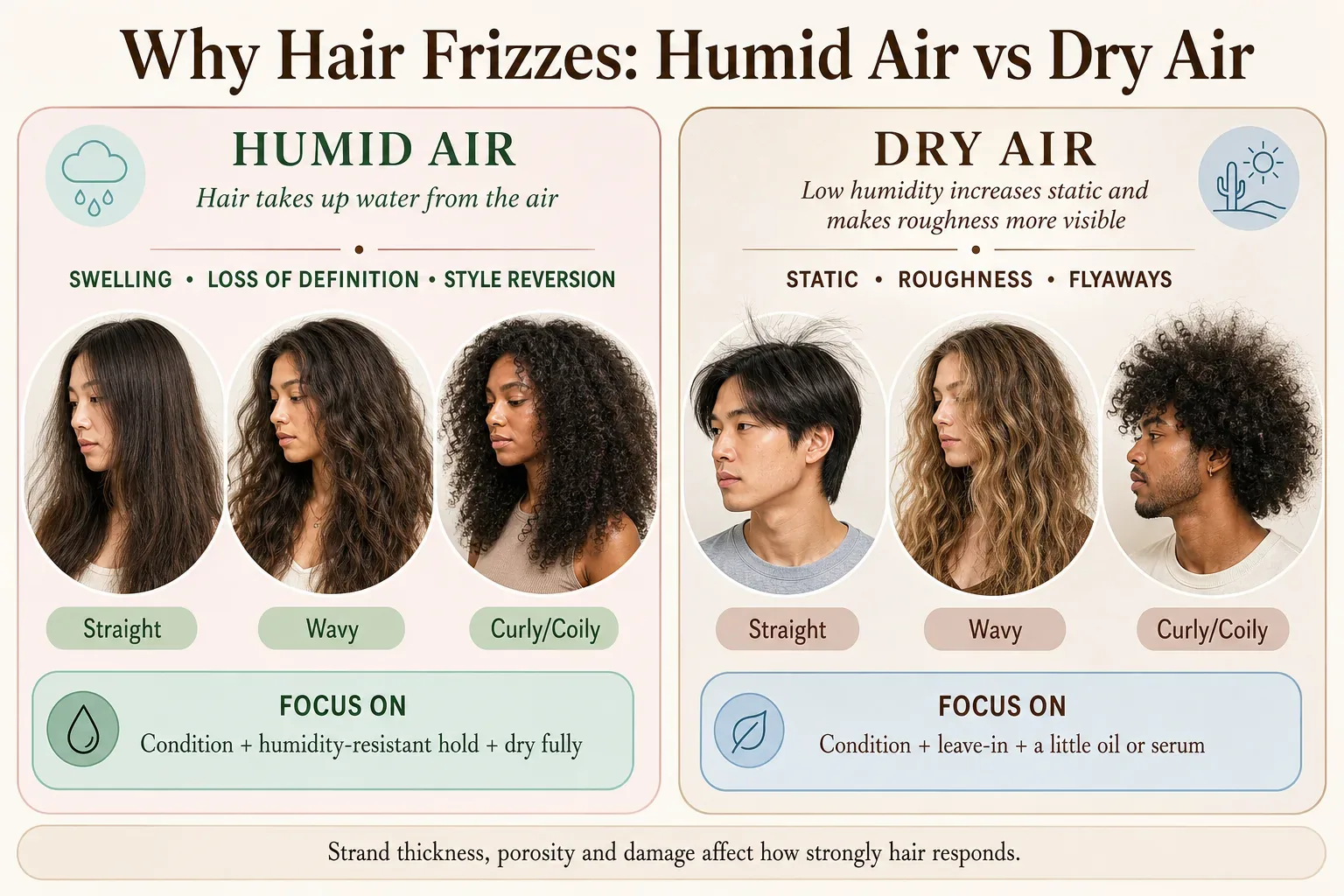
Frizz in humid weather
In high humidity, hair absorbs water from the surrounding air. The effect is often more visible when hair is porous, bleached, heat-damaged or styled into a shape that differs from its natural pattern.
You may notice:
- a blowout beginning to wave or curl;
- curls swelling, separating or losing definition;
- roots expanding while the ends remain straight;
- a gel cast softening sooner than expected; or
- individual hairs lifting away from the finished style.
Humidity control is not about “sealing out” every molecule of water. It is about using a well-balanced conditioner and a styling film that helps the fibres remain aligned for longer.
Frizz in dry weather
In low humidity, cold weather or heated indoor air, hair may feel rougher and develop static. Strands repel one another and appear as light flyaways, particularly around the crown and ends.
You may notice:
- hair crackling when you remove a jumper or hat;
- fine hairs floating around the head;
- curls feeling less flexible;
- ends becoming rough, brittle or difficult to smooth; or
- yesterday’s style looking dry rather than swollen.
Dry-weather frizz usually responds better to conditioning, lubrication and friction control than to the strongest possible hold product.
Frizz caused by damage
Bleaching, permanent colour, relaxers, repeated heat, UV exposure and mechanical wear can make the surface of the fibre less uniform. Hair weathering is cumulative: the oldest ends have experienced the most washing, brushing, sun, heat and friction (review of hair weathering).
Products can make damaged hair feel smoother and help protect it from further wear, but they cannot permanently restore a severely split fibre. Regular trims, gentler handling and lower heat matter alongside anti-frizz products.
First, Read Your Hair Correctly
Curl pattern is useful, but it should not make every product decision. Strand thickness, density and condition often tell you more about how much product your hair can carry.
Fine, medium or coarse strands
Strand thickness describes the diameter of an individual hair.
- Fine strands are easily coated and may collapse under heavy creams, butters and repeated oils.
- Medium strands often tolerate moderate product weight and flexible layering.
- Coarse strands may need more lubrication and richer conditioning, although they can still develop build-up.
If your fine hair becomes frizzy and flat at the same time, adding a richer mask is unlikely to solve both problems. You may need a lighter conditioner and a stronger but weightless styler.
For more detail, read our guide to adding volume to fine hair without weighing it down.
Low, medium or high density
Density describes how many hairs grow across an area of the scalp.
- Low-density hair usually needs less total product.
- High-density hair often needs more sections and more total product for even coverage.
High density does not automatically mean coarse strands. Someone can have a great deal of very fine hair. In that case, use more of a light formula to reach every section rather than switching automatically to a heavy cream.
Straight, wavy, curly or coily pattern
Pattern changes the styling technique and the type of hold that is useful.
- Straight hair often shows frizz as flyaways, rough ends or a blow-dry losing its shape.
- Wavy hair may need help balancing definition with volume.
- Curly hair often needs even product distribution and enough hold to keep clumps together.
- Coily hair may benefit from richer conditioning, careful sectioning and low-friction drying or stretching.
Porosity and damage
Porosity is how readily hair takes up and loses water. Chemical processing and heat damage can increase porosity, so your ends may behave differently from your roots.
Look at repeated behaviour rather than relying on a floating-hair test:
- Hair that wets slowly, takes a long time to dry and becomes coated easily may prefer lighter layers and regular effective cleansing.
- Hair that wets quickly, dries quickly, tangles easily or loses softness soon after styling may need more conditioning and stronger protection at the ends.
The Seven-Step Anti-Frizz Routine
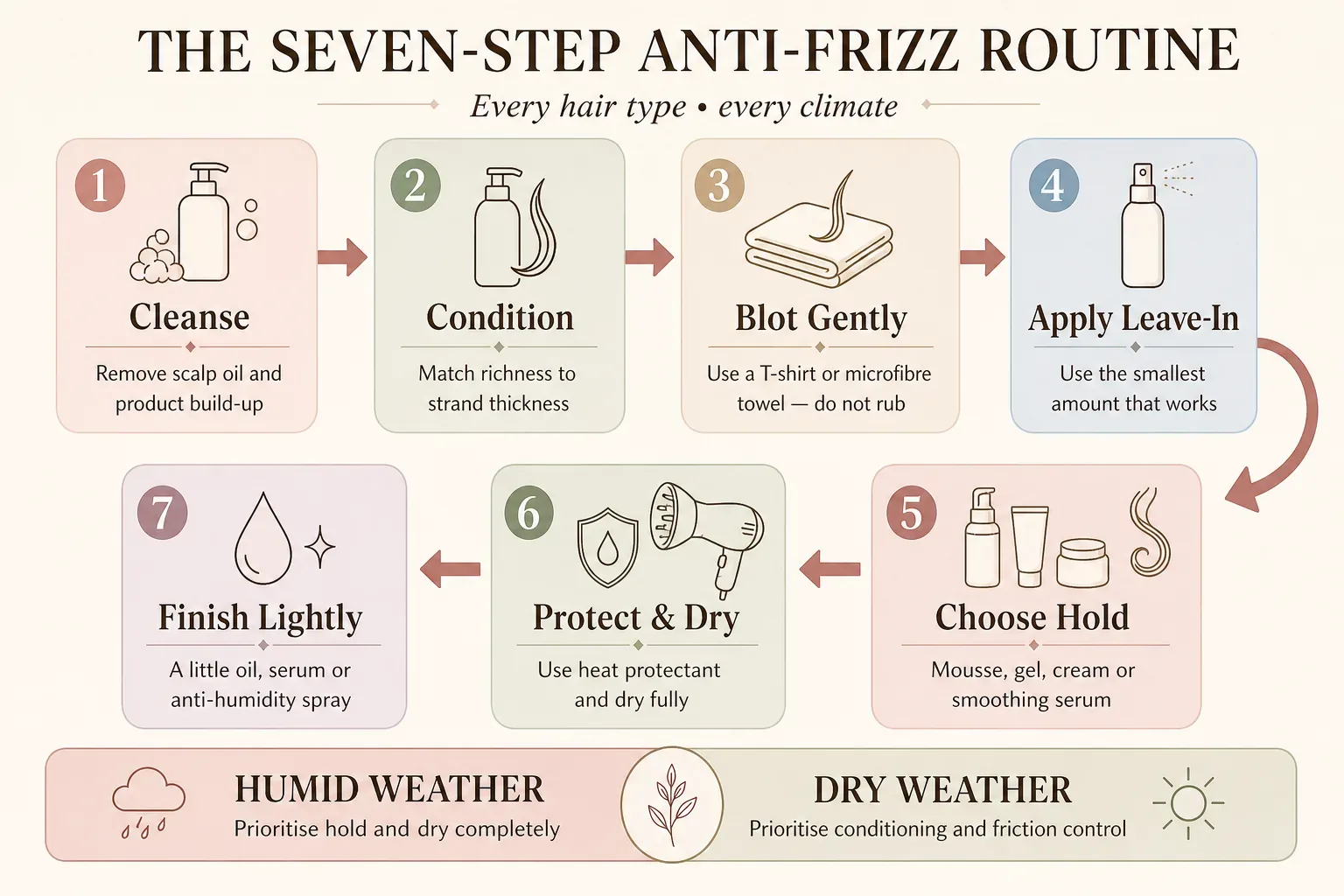
The same framework works for every hair type. The product weight, amount and styling technique are what change.
Step 1: Cleanse Well Enough for Products to Work
Anti-frizz products cannot perform evenly over layers of old oil, dry shampoo, silicone, gel and conditioner. At the same time, repeatedly using a strong clarifying shampoo can leave some hair rough and difficult to manage.
Choose your cleanser according to your scalp and build-up:
- Use a gentle everyday shampoo for regular washing.
- Use a clarifying shampoo when hair remains coated, limp or sticky after its usual wash.
- Use a chelating shampoo when hard-water minerals or swimming deposits are the likely problem.
- Apply shampoo mainly to the scalp and let the lather travel through the lengths as you rinse.
Straight, fine or oily hair may need washing more frequently. Dry, curly, coily or coarse hair may need a gentler cleanser and more conditioning through the lengths, but the scalp should still be washed when it is oily, itchy or coated.
Step 2: Condition for Slip and Alignment
Conditioner reduces friction, improves manageability and helps fibres sit more smoothly. The American Academy of Dermatology recommends conditioner after washing; it suggests concentrating on the ends for fine or straight hair and applying through the length when hair is dry or curly (AAD).
Match the formula to your strands:
- Fine or easily weighed-down hair: use a fluid conditioner and rinse thoroughly. Concentrate on the mid-lengths and ends.
- Medium hair: use a light-to-medium cream and adjust the amount according to density.
- Coarse, very dry or highly porous hair: use a richer conditioner with good slip, especially on older ends.
Deep conditioning is optional. Use a mask when the hair needs more softness or slip than your regular conditioner provides—not simply because the calendar says it is “mask day”.
Step 3: Remove Water Without Creating Friction
Do not rub the hair vigorously with a rough bath towel. Blot or press with a smooth cotton T-shirt or microfibre towel.
- For straight or fine hair, remove excess water before applying leave-in so products do not migrate towards the roots.
- For wavy, curly or coily hair, apply styling products to wet or very damp hair if this helps clumps form, then micro-plop gently if needed.
The AAD recommends wrapping or blotting hair rather than rough towel drying because wet hair is vulnerable to damage (AAD).
Step 4: Add Leave-In Only Where It Solves a Problem
A leave-in conditioner can reduce frizz, improve detangling and make hair easier to style. It is useful for long, dry, curly, colour-treated or heat-styled hair, but the smallest effective amount is usually best (AAD leave-in guidance).
Choose by weight:
- Fine hair: a mist, milk or very light lotion from the mid-lengths to the ends.
- Medium hair: a light lotion or cream.
- Coarse, dense, dry or coily hair: a richer leave-in applied in sections.
Keep leave-in away from the scalp unless the product is designed for scalp use. If the roots are limp, the hair takes much longer to dry or the surface feels sticky, reduce the amount before changing the whole routine.
Step 5: Choose Hold for the Weather and Style
Conditioning makes hair easier to manage. Hold helps it keep the shape you created.
For straight or blow-dried hair
Use a lightweight smoothing lotion, serum or anti-humidity spray. Fine hair often needs one light layer; coarse or porous hair may prefer a cream followed by a small amount of serum.
For wavy hair
Try mousse or foam for volume and a flexible gel for longer-lasting definition. If cream makes the roots flat, skip it and use leave-in only on the driest ends.
For curly or coily hair
Use gel for definition and humidity resistance, or mousse/foam for lighter hold and faster drying. Add curl cream underneath only when the hair needs more softness or lubrication.
Film-forming ingredients—including some styling polymers, conditioning polymers and silicones—can reduce friction and help hair resist changes caused by humidity. Silicones are not automatically damaging; they can improve slip and surface smoothness, although a formula that builds up may require more effective cleansing (review of silicones in hair care).
Do not judge an anti-frizz product by one fashionable ingredient. The complete formula, dose and pairing with other products determine whether it feels light, sticky, soft or firm.
Step 6: Dry the Style Completely
Hair that is still damp can continue to change shape. In humid weather, leaving home with wet roots or breaking a gel cast before the hair is dry often shortens the life of the style.
Air-drying
Keep touching to a minimum while the hair sets. Move the part or lift the roots early, then leave the lengths alone.
Blow-drying or diffusing
Use a heat protectant that is suitable for your styling method. Work in sections, direct airflow from roots towards ends when smoothing straight hair, and use controlled airflow when diffusing curls.
The AAD recommends limiting excessive heat, choosing low or medium settings and using a product labelled for heat protection (AAD).
A heat protectant reduces damage; it does not make unlimited temperature or repeated passes harmless. Use the lowest setting that gives an effective result and avoid applying straighteners or curling irons to damp hair.
Step 7: Finish with Oil or Serum—Not Both by Default
Hair oil and smoothing serum can reduce surface friction, add shine and tame a few flyaways. They work best as a thin finish rather than a heavy coating.
- Fine hair: spread one drop between both palms until they feel almost dry, then skim the ends.
- Medium hair: begin with one or two drops.
- Coarse, dense or very dry hair: work in sections and add slowly, focusing on the oldest ends.
Oil does not hydrate hair by adding water, and more oil does not necessarily mean less frizz. If the hair separates into greasy strings, loses volume or attracts more residue, use less or apply it less often.
For curls and coils, a small amount of oil or serum on the ends between wash days may reduce friction and help limit single-strand knots. It should complement—not replace—conditioning and careful handling.
The Best Routine for Humid Weather
In warm, damp weather, prioritise shape retention without layering so much product that the hair stays wet for hours.
- Cleanse away old styling film and residue.
- Condition according to strand thickness.
- Apply a small amount of leave-in only where needed.
- Use a humidity-resistant styler with enough hold for your pattern.
- Style in sections so coverage is even.
- Dry completely before touching, separating or going outdoors.
- Finish with a minimal amount of serum or anti-humidity spray if needed.
Should you avoid glycerin and all humectants in humidity?
Not automatically. Humectants are part of complete formulas that also contain conditioners, oils and film-formers. A product with glycerin may perform beautifully in humidity, while another may make your hair swell.
Judge the finished formula and your result. If a product repeatedly leaves your style puffy or sticky on humid days, reserve it for different weather rather than assuming every humectant is unsuitable.
Humid-weather adjustments by hair type
- Fine straight hair: skip rich leave-in at the roots; use a light smoothing spray or serum and dry with controlled airflow.
- Fine wavy or curly hair: use mousse or foam plus a light gel if more hold is needed.
- Coarse straight or wavy hair: use a smoothing cream on the lengths, followed by heat protectant and a light serum.
- Coarse curly or coily hair: apply leave-in in sections, add gel for hold and dry thoroughly before breaking the cast or separating.
The Best Routine for Dry, Cold or Heated Air
In low humidity, focus on softness, static control and protecting the ends from friction.
- Use a gentle shampoo and clarify only when residue indicates a need.
- Condition thoroughly, concentrating on the oldest areas.
- Apply a light leave-in to damp lengths.
- Use cream, mousse or flexible gel according to your style rather than defaulting to maximum hold.
- Dry gently with heat protection.
- Smooth a very small amount of oil or serum over the ends.
- Reduce friction from wool collars, hats, bedding and rough towels.
If static is the main problem, mist product onto your hands or brush rather than soaking the hair. A satin-lined hat or scarf can be kinder to the surface than rough wool placed directly against the hair.
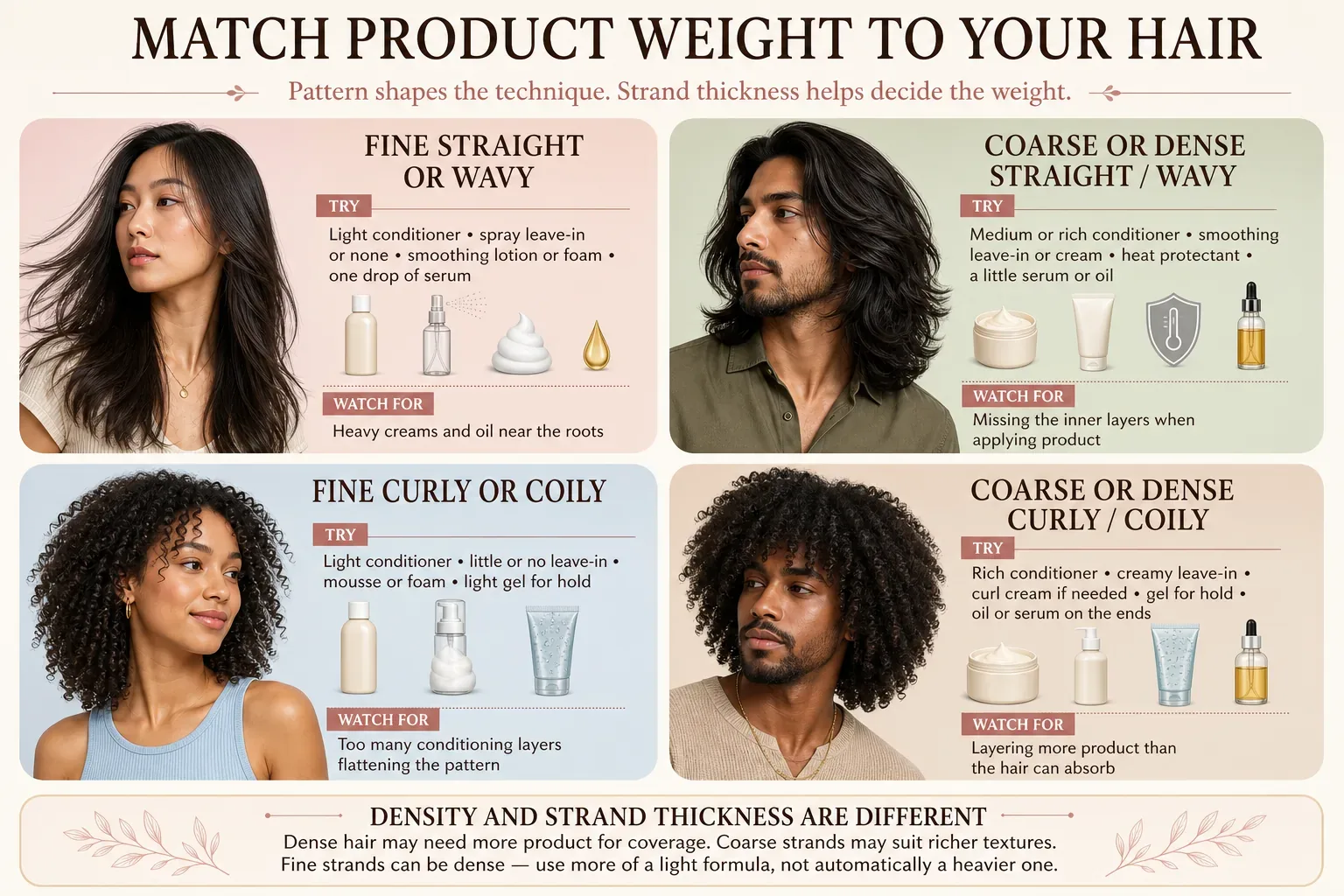
Four Routines by Hair Type
1. Fine, Straight or Slightly Wavy Hair
The challenge is controlling flyaways without losing movement and root volume.
Wash day
- Shampoo the scalp thoroughly.
- Apply a lightweight conditioner from the mid-lengths to the ends.
- Blot excess water.
- Use a light spray leave-in only if the ends need it.
- Apply a heat protectant or weightless smoothing lotion.
- Blow-dry with the nozzle directed down the hair, or air-dry with minimal touching.
- Use one drop of serum on the ends.
In humidity: add a light anti-humidity spray and ensure the roots are completely dry.
In dry weather: use slightly more conditioner or a light leave-in, but keep oils away from the roots.
If this describes your hair, continue with our fine-hair volume and product guide.
2. Coarse or Dense Straight and Wavy Hair
The challenge is achieving even smoothness without missing the inner layers.
Wash day
- Shampoo in sections if the hair is very dense.
- Apply a medium or rich conditioner through the lengths.
- Add a smoothing leave-in or cream in sections.
- Apply heat protectant before blow-drying.
- Use enough tension to align the hair without repeatedly pulling over the same section.
- Finish with a small amount of serum or oil.
In humidity: choose stronger humidity resistance and avoid leaving the underlayers damp.
In dry weather: increase conditioning and protect the ends from coats, scarves and bedding.
3. Fine Wavy, Curly or Coily Hair
Fine curls need hold, but too many conditioning layers can stretch the pattern and flatten the roots.
Wash day
- Cleanse effectively enough to remove old stylers.
- Use a light conditioner with good slip.
- Apply a small amount of leave-in only to dry areas—or skip it if the styler is conditioning enough.
- Use mousse or foam for volume.
- Add a light gel when the weather or style needs more hold.
- Diffuse on low or medium heat, or air-dry without repeated touching.
- Scrunch out any firm cast only when the hair is completely dry.
In humidity: prioritise gel or a humidity-resistant mousse over a heavy cream.
In dry weather: add a light leave-in to the ends and use a drop of serum after drying.
4. Coarse, Dense Curly or Coily Hair
The challenge is distributing enough conditioning and hold through every section while avoiding endless product layers.
Wash day
- Cleanse the scalp in sections.
- Condition generously through the lengths and detangle with water and slip.
- Apply leave-in to wet or very damp hair in sections.
- Add curl cream only if more softness or lubrication is needed.
- Apply gel for definition and weather resistance, or mousse/foam for volume and a lighter finish.
- Air-dry, diffuse or hood-dry until fully set.
- Use a small amount of oil or serum to soften a cast and protect the ends.
In humidity: use stronger hold, smaller sections and complete drying.
In dry weather: use richer conditioning, protect the ends daily if needed and sleep with a satin bonnet or pillowcase.
For a full styling sequence, read The Complete Wash-Day Routine for Curly and Coily Hair.
How to Refresh Frizzy Hair Between Washes
Refreshing should reactivate or add the smallest amount of product needed. Saturating the hair with new layers every morning can create build-up and extend drying time.
Straight or blow-dried hair
- Smooth flyaways with a trace of serum on your palms.
- Use dry shampoo only when oil is the problem; it does not replace washing.
- Reapply heat protectant if the product instructions require it before using more heat.
Wavy, curly or coily hair
- Lightly mist frizzy areas with water.
- Emulsify a small amount of leave-in, gel, mousse or foam between wet hands.
- Smooth or scrunch only the sections that need help.
- Allow them to dry before separating.
- Apply a tiny amount of oil or serum to rough ends, not automatically to the whole head.
If refreshing creates white flakes, stickiness or dullness, wash rather than adding another layer.
Common Anti-Frizz Mistakes
Using the richest product available
Product weight should follow strand thickness and condition. Fine hair can be dry and still need a light formula.
Applying oil before every other product
Heavy oiling can make even distribution difficult and leave some hair types limp. Use oil where it has a clear job, usually as a small finishing or end-protection step.
Leaving the hair partly damp
Partly dry hair is still setting. Humidity, touching, hats or sleep can reshape it before the style has stabilised.
Applying strong hold without enough conditioning
Gel can organise the style, but it cannot replace the slip and manageability supplied by conditioner. If hair feels brittle inside a hard cast, adjust the base routine.
Applying rich conditioning without enough hold
Very soft hair may still frizz because curl clumps or a blow-dried shape are not being supported. Add an appropriate styler instead of another mask.
Brushing a finished textured style
Brushing can separate curl clumps and create a larger halo. Detangle during the conditioning stage, then style with intention.
Turning the heat higher to make the result last
More heat can create more weathering, which may make future frizz harder to control. Use heat protectant, controlled airflow and the lowest effective temperature.
Never clarifying
Repeated leave-in, oil, silicone, gel and dry shampoo can accumulate. If the hair feels coated and products stop behaving normally, one clarifying wash may help more than another treatment.
Troubleshooting Your Routine
Smooth at home, frizzy outside
Likely reason: The style was not fully dry or the hold is too light for the humidity.
Try next: Dry completely and use a stronger or more humidity-resistant styler.
Flat roots with frizzy ends
Likely reason: Product is too heavy near the scalp, but the ends still need protection.
Try next: Keep leave-in and oil below the mid-lengths and use light hold at the roots.
Hair feels sticky and takes hours to dry
Likely reason: Too many layers or too much product.
Try next: Clarify if needed and test leave-in plus one styler.
White flakes after styling
Likely reason: Product incompatibility, too much product or old build-up.
Try next: Use fewer layers, test combinations and cleanse thoroughly.
Fine flyaways in winter
Likely reason: Static and friction.
Try next: Add light conditioning, use a trace of serum and protect hair from rough fabrics.
Curls feel soft but lose shape
Likely reason: Plenty of conditioning but insufficient hold.
Try next: Reduce cream and add mousse, foam or gel.
Hair feels rigid and rough
Likely reason: Too much strong hold, protein or heat, with too little conditioning.
Try next: Simplify, condition and reduce the harshest variable.
Frizz concentrates at the ends
Likely reason: The oldest hair is dry, split or weathered.
Try next: Condition and protect the ends, reduce friction and trim when needed.
Change one variable at a time and compare two or three wash days. That will tell you more than replacing the whole routine after one difficult weather day.
When Frizz May Need More Than a Cosmetic Routine
Speak to a GP, dermatologist or qualified hair-loss professional if a sudden change in texture occurs alongside:
- unusual shedding or visible thinning;
- smooth or scaly patches of hair loss;
- significant breakage close to the scalp;
- persistent itching, burning, pain or inflammation;
- sores, crusting or discharge; or
- hair that remains unmanageable despite a gentle routine and reduced heat.
Frizz itself is usually a cosmetic concern, but scalp disease, hair-shaft disorders and damaging styling practices can require professional assessment.
Your Anti-Frizz Routine at a Glance
- Cleanse according to your scalp and product build-up.
- Condition according to strand thickness and damage.
- Blot without rough friction.
- Apply leave-in only where needed.
- Choose hold for your pattern, style and climate.
- Use heat protectant and dry completely.
- Finish lightly and protect between washes with oil, serum or anti-humidity spray as needed, while limiting friction, static and unnecessary heat.
The key is balance. Humid weather usually needs more shape control. Dry weather usually needs more conditioning and friction control. Fine hair needs less weight, while coarse or highly porous hair may need richer conditioning. Density changes how much product you need for coverage; it does not decide how heavy the product should be.
Build your personalised routine. Take the Radiant Eden Hair Routine Quiz to match cleansing, conditioning, styling and protection to your scalp, strands and climate.
Sources and further reading
- American Academy of Dermatology: Tips for healthy hair
- American Academy of Dermatology: Tips for using leave-in conditioner
- American Academy of Dermatology: Hair styling without damage
- Evaluation of hair humidity resistance and moisturisation
- What Ages Hair?
- Straight to the Point: What Do We Know So Far on Hair Straightening?
- With or without Silicones? A Comprehensive Review of Their Role in Hair Care
Related products


Frequently asked
Can frizz be stopped permanently?+
Is frizzy hair always dry?+
Is oil or serum better for frizz?+
Should anti-frizz products be applied to wet or dry hair?+
Does air-drying prevent frizz?+
Do silicones cause frizz?+
Should I use a hair mask every week?+
Find your perfect haircare routine
Answer a few questions and we'll tailor Radiant Eden's picks to you.
Build my haircare routineKeep reading
How to Add Volume to Fine Hair: The Best Products and Techniques That Actually Work
The complete Radiant Eden routine for adding lasting volume to fine hair — from volumising shampoo and root lift spray to mousse, styling tools and finishing sprays. Every recommendation is a Best Overall, Best Alternative or Best Budget pick.
The Complete Wash-Day Routine for Curly and Coily Hair
Build a curly or coily hair wash-day routine with the right order for cleansing, conditioning, detangling, leave-in, styling, drying and overnight protection.

How to Build a Hair Care Routine for Your Hair Type
Build a hair care routine that suits your scalp, strand thickness, density, porosity and natural pattern, from straight and wavy to curly and coily.