Retinol for Beginners: Why I Recommend Retinal Instead
A practical guide to choosing retinal strength, building tolerance and protecting your skin barrier.
Learn how to start retinal safely, choose the right strength and build an effective routine without overwhelming your skin barrier.
Editor's shortlist

A-Game 5


Retinal 0.2% Emulsion
If you are searching for your first retinol, I recommend considering retinal, also called retinaldehyde.
Both ingredients belong to the retinoid family. Retinal requires one conversion step to become active retinoic acid, while retinol requires two. This allows retinal to work efficiently at relatively low concentrations.
However, stronger is not automatically better. Begin with a low-strength retinal and increase only when your skin is comfortable.
What Can Retinal Do?
Consistent use may improve:
- Fine lines.
- Uneven texture.
- Mild pigmentation.
- Post-acne marks.
- Clogged pores and mild acne.
- The appearance of firmness.
Retinal can still cause dryness, peeling, redness and stinging. The best product is usually the one your skin can tolerate consistently—not the highest percentage available.
Is Your Skin Ready for Retinal?
Do not start retinal while your skin feels tight, raw, unusually flaky or painful when you apply basic products.
Use a gentle cleanser, moisturiser and sunscreen until your skin feels comfortable. Read How to Repair a Damaged Skin Barrier if irritation is already present.
People with eczema, rosacea or very reactive skin may need professional advice before introducing a retinoid.
Best Affordable Retinal Range: Geek & Gorgeous A-Game
Geek & Gorgeous A-Game 5 is my first choice for most retinal beginners.
It contains 0.05% retinal alongside allantoin and comes in a light emulsion suitable for many normal, oily, combination and acne-prone skin types.
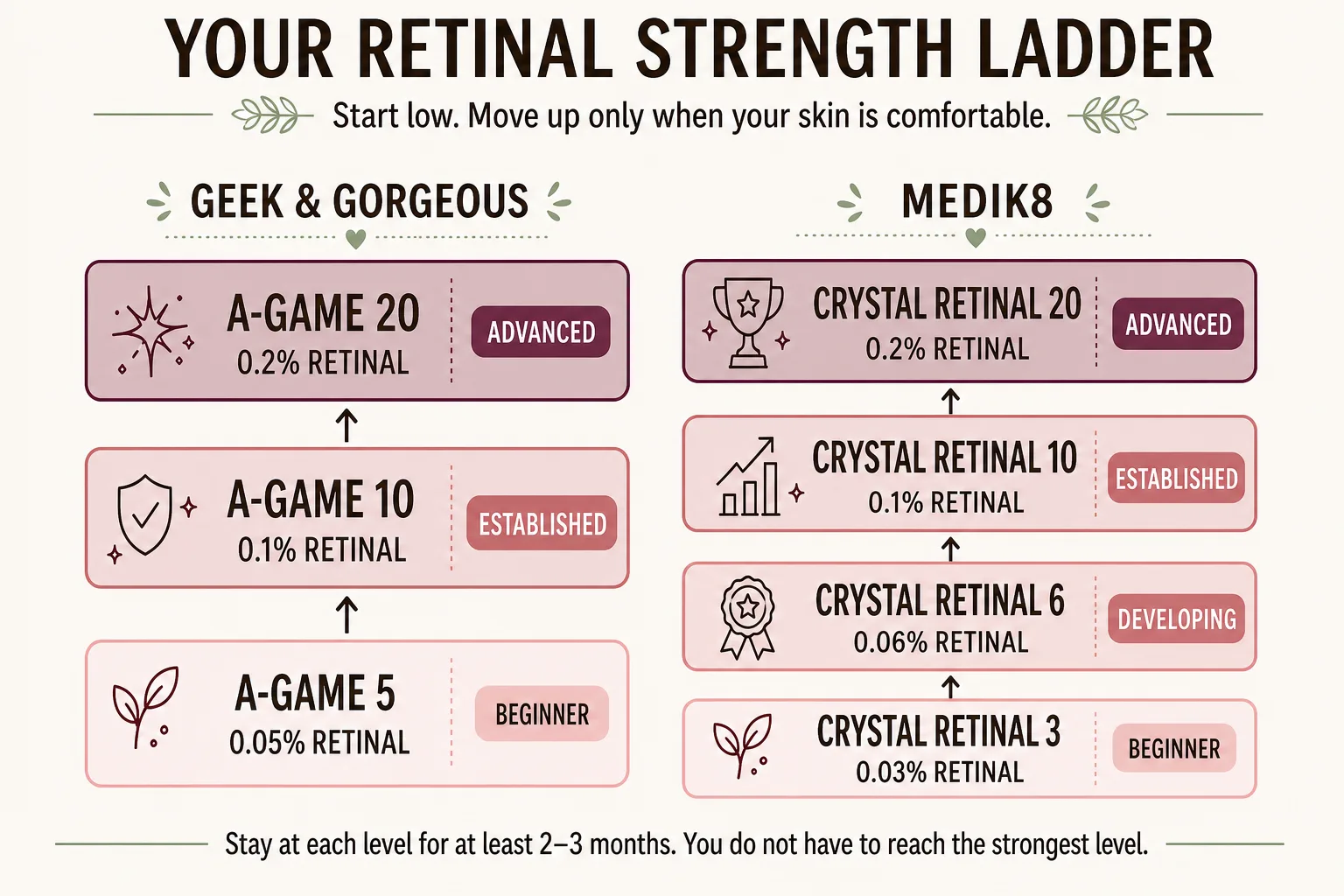
The range provides a clear progression:
- A-Game 5 — 0.05% retinal: the beginner strength.
- A-Game 10 — 0.1% retinal: for established retinal users.
- A-Game 20 — 0.2% retinal: the advanced strength.
The product name does not represent a whole percentage: A-Game 5 contains 0.05%, not 0.5%.
Use each level for at least two or three months before considering the next one. Do not move up while experiencing persistent dryness, peeling, redness or stinging.
You do not need to reach A-Game 20. If A-Game 5 or 10 gives you good results without irritation, remaining at that strength may be the better choice.
Best for: An affordable, well-formulated retinal range with a straightforward progression system.
Best High-End Retinal Range: Medik8 Crystal Retinal
Medik8 Crystal Retinal 3 is the Medik8 strength I would recommend for most first-time users.
Medik8 also provides a structured strength ladder:
- Crystal Retinal 3 — 0.03% retinal: the usual beginner level.
- Crystal Retinal 6 — 0.06% retinal: the developing level.
- Crystal Retinal 10 — 0.1% retinal: for experienced users.
- Crystal Retinal 20 — 0.2% retinal: the advanced strength.
This gradual progression is one of the main reasons I like both Medik8 and Geek & Gorgeous. You can increase methodically instead of jumping from a mild formula to an unnecessarily strong treatment.
Stay at each level for at least two or three months. Sensitive or dry skin may need longer at Crystal Retinal 3, and some people will never need to progress beyond it.
Best for: Someone who wants a premium formula and a carefully graduated retinal system.
Best for Experienced Users: The Ordinary Retinal 0.2% Emulsion
The Ordinary Retinal 0.2% Emulsion is a solid, affordable option for people who already use and trust The Ordinary.
However, 0.2% retinal is an advanced concentration. Its stated retinal strength is comparable to A-Game 20 and Crystal Retinal 20, although their complete formulations differ.
I would not recommend it as someone’s first vitamin A product. Consider it only if your skin already tolerates retinal well.
Best for: Experienced retinoid users wanting a strong retinal from a familiar brand.
When Should You Move Up?
Consider increasing the strength only when:
- You have used the current product consistently for at least two or three months.
- You can apply it on alternate nights without persistent irritation.
- Your skin remains comfortable between applications.
- You want further improvement after giving the current strength sufficient time.
Do not increase simply because you have finished one tube.
Remain at your current strength—or reduce the frequency—if your skin feels tight, burns when moisturiser is applied or develops persistent redness, discolouration, peeling or sensitivity.
How to Begin Without Damaging Your Skin Barrier
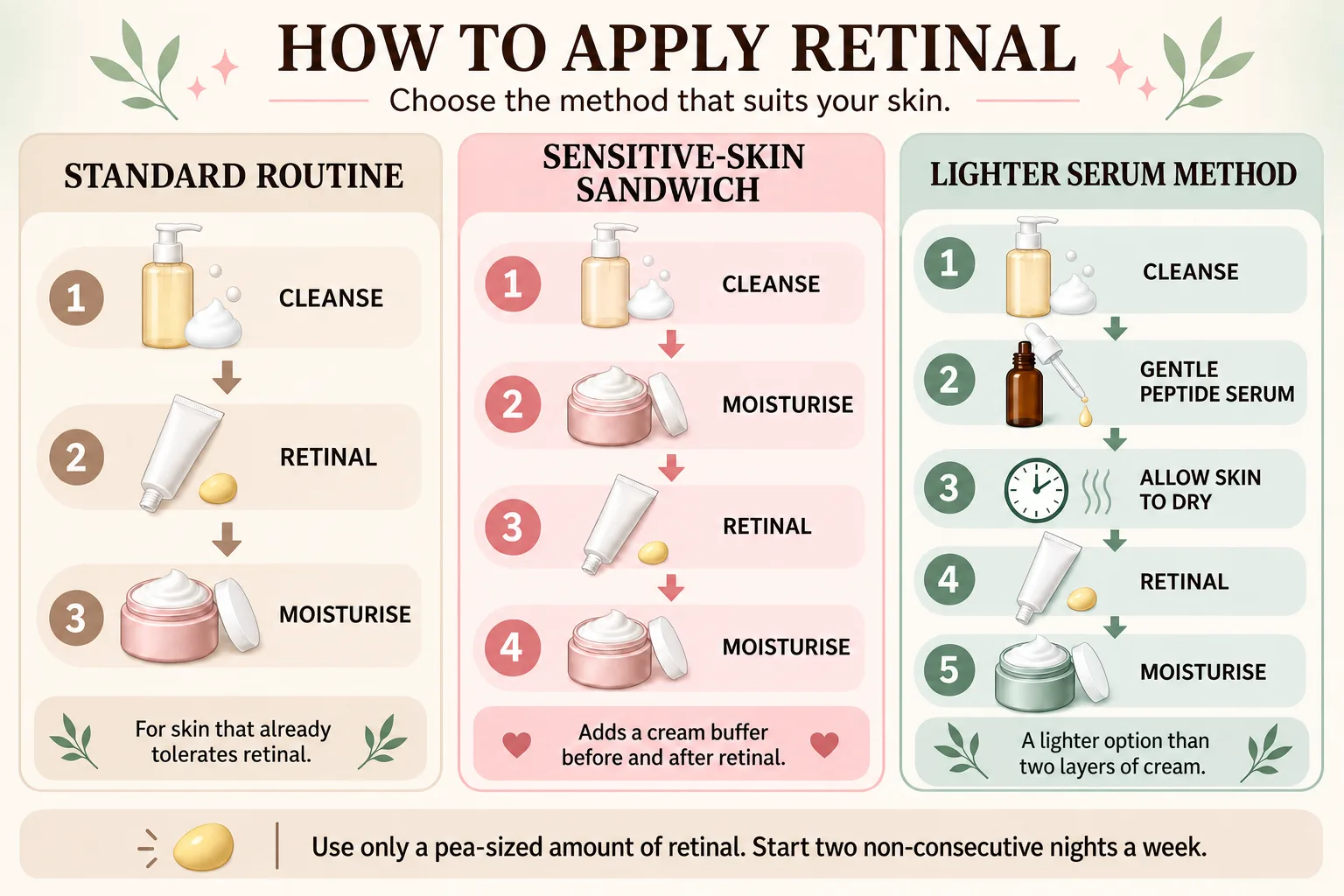
For the first two weeks, use retinal on two non-consecutive nights a week.
At night:
- Cleanse gently.
- Allow your skin to dry.
- Apply a pea-sized amount across the face.
- Avoid the eyelids, lash lines and corners of the nose and mouth.
- Follow with moisturiser.
After two to four weeks, increase to every third night only if your skin is comfortable. Alternate-night use can come later. You do not need to apply retinal every night to benefit from it.
The Sandwich Method for Sensitive Skin
If your skin is very sensitive, try the traditional sandwich method:
Moisturiser → retinal → moisturiser
Apply a thin layer of moisturiser, allow it to settle, apply your pea-sized amount of retinal and finish with another layer of moisturiser. This creates a more substantial buffer and may make retinal easier to tolerate.
If you prefer a lighter routine, try:
Gentle serum → retinal → moisturiser
Choose a hydrating or compatible peptide serum, allow it to absorb and wait until your skin feels dry before applying retinal. Finish with moisturiser.
COSRX The 6 Peptide Skin Booster Serum is a good example. COSRX specifically suggests using it before retinol for people who are sensitive to retinol reactions. Its light, toner-like texture provides hydration without adding the weight of two layers of cream.
The serum method is lighter than a traditional moisturiser sandwich, so very reactive skin may still prefer moisturiser before and after retinal.
What Should You Avoid on Retinal Nights?
While your skin is adjusting, do not use retinal in the same routine as:
- Another retinol, retinal or prescription retinoid.
- Strong glycolic, lactic or salicylic acid treatments.
- Exfoliating peels or scrubs.
- Benzoyl peroxide unless a clinician has explained how to combine them.
Hydrating serums and a plain moisturiser are usually enough. Introduce one new active product at a time.
Your Simple Retinal Routine
Morning: gentle cleanse or rinse → optional hydrating serum → moisturiser if needed → broad-spectrum SPF 30 or higher.
Retinal night: cleanse → retinal → moisturiser.
Recovery night: cleanse → hydrating serum if desired → moisturiser.
Daily sunscreen is essential. Irritation and unprotected sun exposure can make pigmentation more noticeable, particularly on deeper skin tones.
When Should You Stop?
Pause retinal if you develop:
- Persistent burning or stinging.
- Significant redness or discolouration.
- Cracked, painful or raw skin.
- Swelling or severe itching.
- Irritation that does not improve when you reduce the frequency.
Allow your skin to recover before deciding whether to restart at a lower frequency.
Avoid retinoids during pregnancy or while planning a pregnancy. If you are breastfeeding, ask an appropriate healthcare professional for individual advice.
The Quick Verdict
Choose Geek & Gorgeous A-Game 5 for the best affordable introduction to retinal. Progress to A-Game 10 and eventually A-Game 20 only when your skin is ready.
Choose Medik8 Crystal Retinal 3 if you want a premium formula. Move through Crystal Retinal 6, 10 and 20 gradually without skipping strengths.
Choose The Ordinary Retinal 0.2% Emulsion only when you already tolerate retinoids and want an advanced product from a brand you trust.
Start slowly, moisturise well and apply sunscreen every morning. Consistency at a comfortable strength is more valuable than repeatedly pushing your skin through irritation.
For acne advice, read the Adult Acne Skincare Routine. For dark marks, see The Best Routine for Hyperpigmentation and Post-Acne Dark Spots.
Sources
- American Academy of Dermatology: Retinoid or Retinol?
- NHS: Acne Treatment and Topical Retinoids
- American Academy of Dermatology: Acne Diagnosis and Treatment
- COSRX: First Retinol Guide
This article provides general information and is not a diagnosis. Consult an appropriate healthcare professional for individual advice.
Related products
Frequently asked
Is retinal suitable for beginners?+
What is the difference between retinol and retinal?+
How much retinal should I apply?+
Can sensitive skin use retinal?+
Find your perfect skincare routine
Answer a few questions and we'll tailor Radiant Eden's picks to you.
Build my skincare routineKeep reading

How to Repair a Damaged Skin Barrier: Signs, Causes and a Gentle Routine
Learn the signs of a damaged skin barrier, what causes tightness, stinging, flaking and redness, and how to build a gentle recovery routine.
Adult Acne Skincare Routine: What to Use and What to Avoid
Build a simple adult-acne routine for clogged pores, hormonal breakouts and inflamed spots using benzoyl peroxide, salicylic acid, retinoids or azelaic acid.
The Best Routine for Hyperpigmentation and Post-Acne Dark Spots
A calm, evidence-based routine for post-acne dark spots and hyperpigmentation: how to tell PIH, PIE, melasma and acne scars apart, and how to build a simple AM/PM routine around one active.