
How to Choose a Sunscreen for Dark, Oily or Acne-Prone Skin
SPF, white cast, pilling and makeup-friendly protection explained
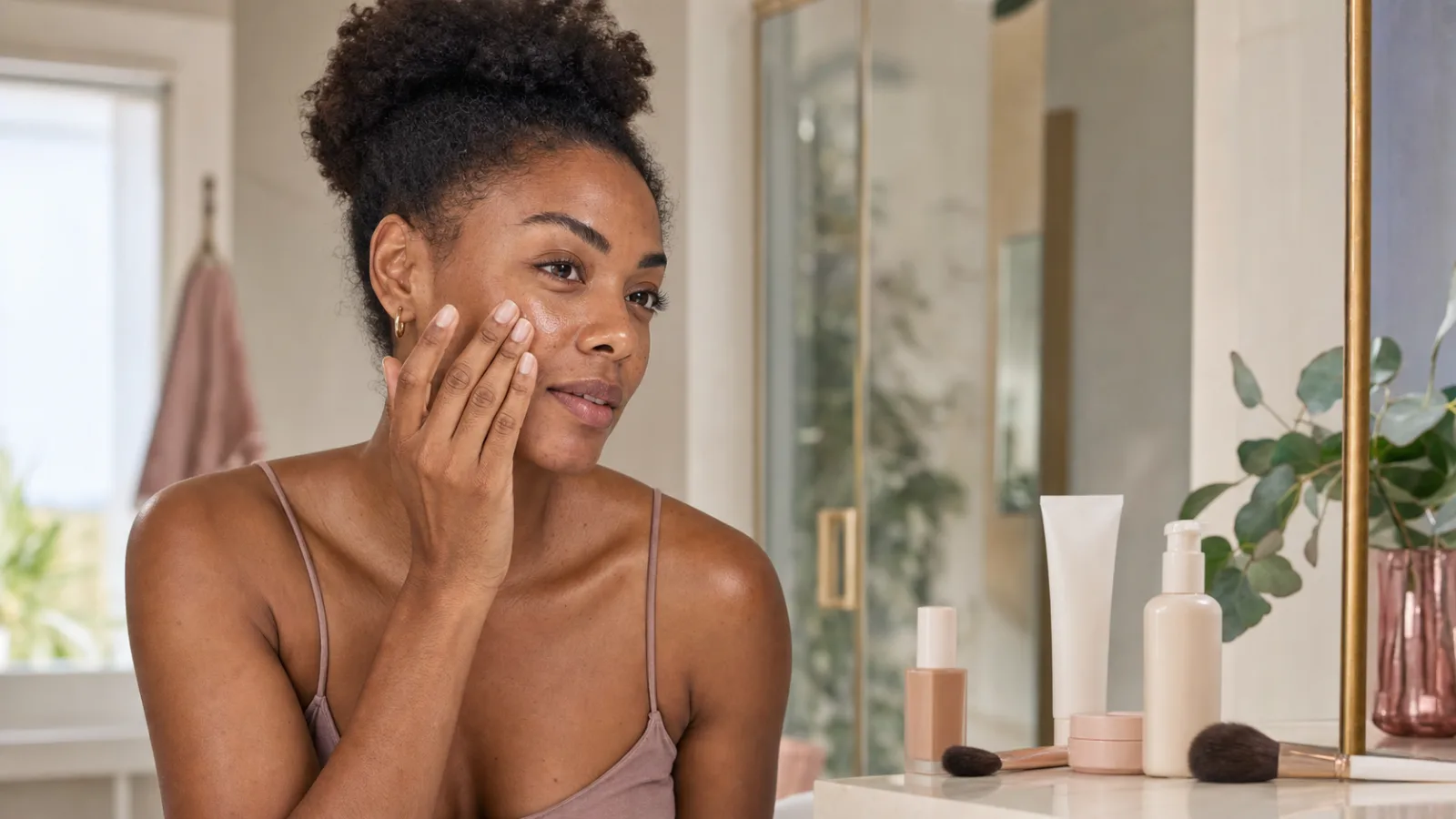
Learn how to choose sunscreen for darker, oily or acne-prone skin, prevent white cast and pilling, and make SPF work smoothly under makeup.
Finding a sunscreen that protects your skin is only half the challenge. It also needs to disappear into your skin without leaving a white or grey cast, making an oily complexion feel heavier, triggering breakouts or rolling into flakes under makeup.
The good news is that you do not need a “perfect” sunscreen. You need one that provides reliable protection and feels comfortable enough to use generously and consistently.
This guide explains SPF and UVA ratings, mineral and organic-filter formulas, tinted sunscreens, pilling and how to make sunscreen work under makeup—especially if you have darker, oily or acne-prone skin.
The short answer: Look for SPF 30 or higher, strong UVA protection and a finish you will happily wear every day. If white cast is a concern, consider a transparent or well-matched tinted formula. If you are oily or acne-prone, begin with lightweight, non-comedogenic textures.
Why Sunscreen Still Matters for Darker Skin
Melanin gives darker skin some natural protection from ultraviolet radiation, but it does not prevent sunburn, skin cancer or sun-related skin damage. UV exposure can also deepen post-acne marks and other forms of hyperpigmentation, making uneven tone more persistent.
Daily sunscreen is therefore not just an anti-ageing step. It is an important part of managing dark spots and protecting overall skin health.
If pigmentation is one of your main concerns, read The Best Routine for Hyperpigmentation and Post-Acne Dark Spots.
Start With the Protection, Not the Texture
A beautiful finish cannot compensate for inadequate protection. Check the label before deciding whether a sunscreen feels elegant.
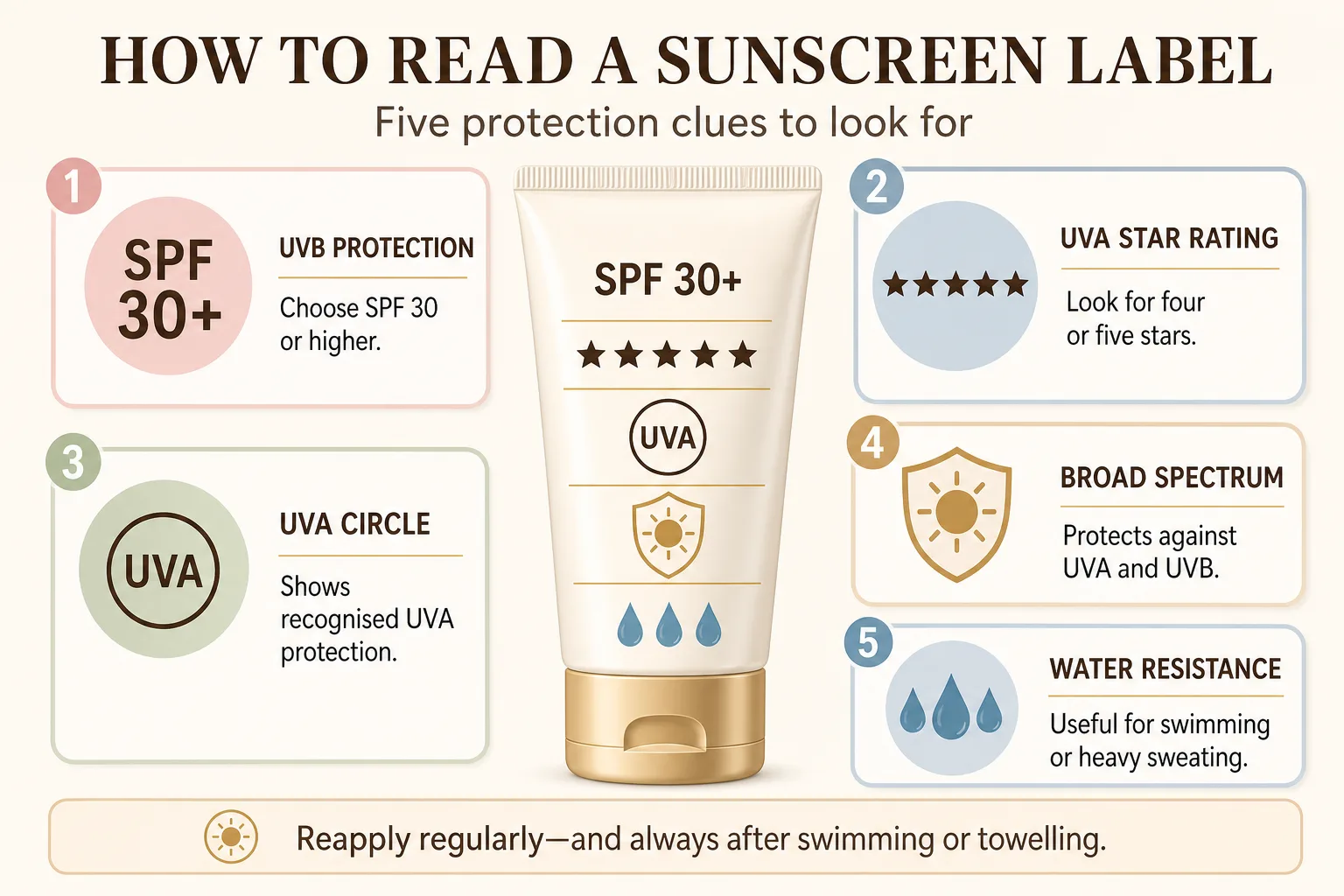
Choose SPF 30 or higher
SPF mainly describes protection from UVB radiation, which is strongly associated with sunburn. The NHS recommends using at least SPF 30 with suitable UVA protection.
SPF 50 can provide a useful extra margin, particularly if you have a history of hyperpigmentation, spend a lot of time outdoors or know that you sometimes apply less than the recommended amount. However, no SPF blocks all UV radiation.
Look for strong UVA protection
UVA rays contribute to premature skin ageing and can worsen pigmentation. On UK packaging, look for:
- four or five UVA stars;
- the letters “UVA” inside a circle; or
- a clear broad-spectrum claim from a reputable brand.
The SPF number and UVA rating tell you different things, so check both.
Consider water resistance when it is relevant
A water-resistant sunscreen can be helpful when swimming, exercising or sweating heavily. It is not waterproof. Reapply after swimming, towelling or heavy perspiration, as well as at the intervals stated on the product.
Sunscreen is only one part of protection. Shade, clothing, hats and sunglasses matter too.
Chemical Versus Mineral Sunscreen
The words “chemical” and “mineral” describe the UV filters used in the formula. Neither category is automatically better, safer or more suitable for every person.
Organic-filter or “chemical” sunscreen
Organic UV filters absorb UV energy and convert it into a small amount of heat. Modern formulas often feel lightweight and can be easier to make transparent on deeper skin tones.
They may suit you if you:
- want an invisible or low-cast finish;
- prefer a fluid, gel or serum-like texture;
- wear sunscreen under makeup; or
- dislike the heavier feel of some mineral formulas.
Some formulas may sting around the eyes or irritate very sensitive skin. This varies by filter blend and overall formulation, not simply by the word “chemical”.
Mineral sunscreen
Mineral sunscreens use zinc oxide, titanium dioxide or both. They can be a good option for sensitive skin, although any formula can still irritate an individual.
Traditional mineral formulas are more likely to leave a white, grey or purple cast on deeper skin tones. Micronised particles, better dispersion and tint can make them more wearable.
They may suit you if you:
- prefer mineral UV filters;
- have found particular organic filters irritating; or
- can find a tint that blends well with your complexion.
Hybrid sunscreen
Hybrid formulas combine mineral and organic filters. They aim to balance cosmetic elegance, broad protection and comfort. Judge the finished product rather than assuming a hybrid will behave in one particular way.
How to Avoid a White or Grey Cast
White cast is most noticeable when sunscreen particles sit visibly on the skin instead of blending into it. It can appear chalky, ashy, grey or slightly purple on deeper complexions.
To reduce it:
- choose a formula described as transparent, sheer or invisible;
- test mineral sunscreen on your face rather than relying only on a hand swatch;
- consider a tinted sunscreen that suits your undertone;
- apply in controlled layers instead of vigorously rubbing one thick blob;
- allow skincare underneath to absorb; and
- check the finish in natural daylight and in photographs.
Tinted sunscreens often use iron oxides to create colour. The American Academy of Dermatology notes that tinted sunscreen containing iron oxide can help protect against visible light, which is particularly relevant for melasma and some forms of hyperpigmentation.
The limitation is shade range. A tint that is too pale, orange, pink or dark can be as noticeable as white cast. If the match is poor, choose a transparent formula instead of trying to make the wrong shade work.
Choosing Sunscreen for Oily Skin
Oily skin does not need to be stripped or left without moisturiser. It usually benefits from fewer heavy layers and a sunscreen with a lighter finish.
Look for terms such as:
- fluid, gel, water-light or serum;
- lightweight or fast-absorbing;
- oil-free, if you prefer it;
- non-comedogenic; and
- natural, satin, soft-matte or matte finish.
“Non-comedogenic” is useful guidance, not a guarantee that a product cannot cause breakouts. Formulas interact differently with individual skin.
If your sunscreen is moisturising enough, you may not need a separate moisturiser every morning. Removing that extra layer can reduce shine and pilling.
Avoid assuming that alcohol in every sunscreen is harmful. Certain lightweight formulas use volatile alcohol to improve spread and reduce greasiness. It may be uncomfortable for dry, irritated or very sensitive skin, but some oily complexions tolerate it well.
Choosing Sunscreen for Acne-Prone Skin
Sunscreen does not need to feel thick or occlusive to work. When you are prone to clogged pores or inflamed breakouts, prioritise a comfortable formula and keep the rest of the morning routine simple.
Useful label clues include:
- non-comedogenic;
- fragrance-free if fragrance irritates you;
- lightweight fluid, gel or lotion;
- suitable for sensitive or blemish-prone skin; and
- easy to remove with your evening cleanser.
Introduce one new product at a time. If new breakouts develop, consider the full picture: hormonal changes, stress, your cycle, hair products, makeup, cleansing habits and other new skincare can all contribute.
If acne treatments have left your skin tight, stinging or flaky, focus on comfort first. Our guide to repairing a damaged skin barrier explains how to simplify your routine.
What If Sunscreen Stings Your Eyes?
Eye stinging is common and does not mean sunscreen is universally unsuitable for your face.
Try:
- leaving a small gap around the lash line;
- allowing the sunscreen to set before exercising or applying makeup;
- using a less mobile, more water-resistant formula around the eyes;
- avoiding eye creams that cause the sunscreen to travel; or
- trying a different UV-filter blend.
Do not continue using a product that causes persistent burning, swelling or a rash.
Why Sunscreen Pills
Pilling is the formation of small rolls or flakes when skincare products collect on the surface instead of forming an even film.
Common causes include:
- applying too many layers;
- using more moisturiser than your skin needs;
- rubbing repeatedly as products begin to set;
- combining incompatible textures;
- not allowing time between layers;
- applying makeup with dragging motions; or
- product residue and flaky skin.
Pilling does not always mean a product is poor. The same sunscreen may pill in one routine and sit smoothly in another.
How to reduce pilling
- Keep the morning routine short.
- Apply thin, even layers of treatment and moisturiser.
- Let each layer settle before adding the next.
- Skip moisturiser if your sunscreen provides enough hydration.
- Spread sunscreen evenly, then stop rubbing.
- Allow it to set before makeup.
- Press or pat foundation on with a sponge, brush or fingertips rather than repeatedly dragging it across the skin.
Never mix sunscreen with moisturiser or foundation in your hand. Mixing can make the protective film uneven and makes it difficult to know whether you have applied enough.
Your Morning Routine at a Glance
1. Cleanse—or rinse
Use a gentle cleanser if you wake with oil or residue. If your skin is dry or sensitive, rinsing with water may be enough.
2. Apply one treatment, if needed
Vitamin C, niacinamide or azelaic acid can fit into a morning routine, but you do not need several serums at once. Use a light, even layer.
3. Moisturise only as much as needed
Choose a lightweight moisturiser or skip it if your sunscreen is sufficiently moisturising.
4. Apply sunscreen generously and evenly
Cover the face, ears and exposed neck. The American Academy of Dermatology recommends applying sunscreen before going outdoors and using enough to cover exposed skin.
5. Allow the sunscreen to set
Give the film time to settle before applying makeup or touching your face.
6. Press makeup on gently
Use pressing or patting motions and avoid vigorous rubbing. If the base begins to pill, adding more product usually makes it worse.
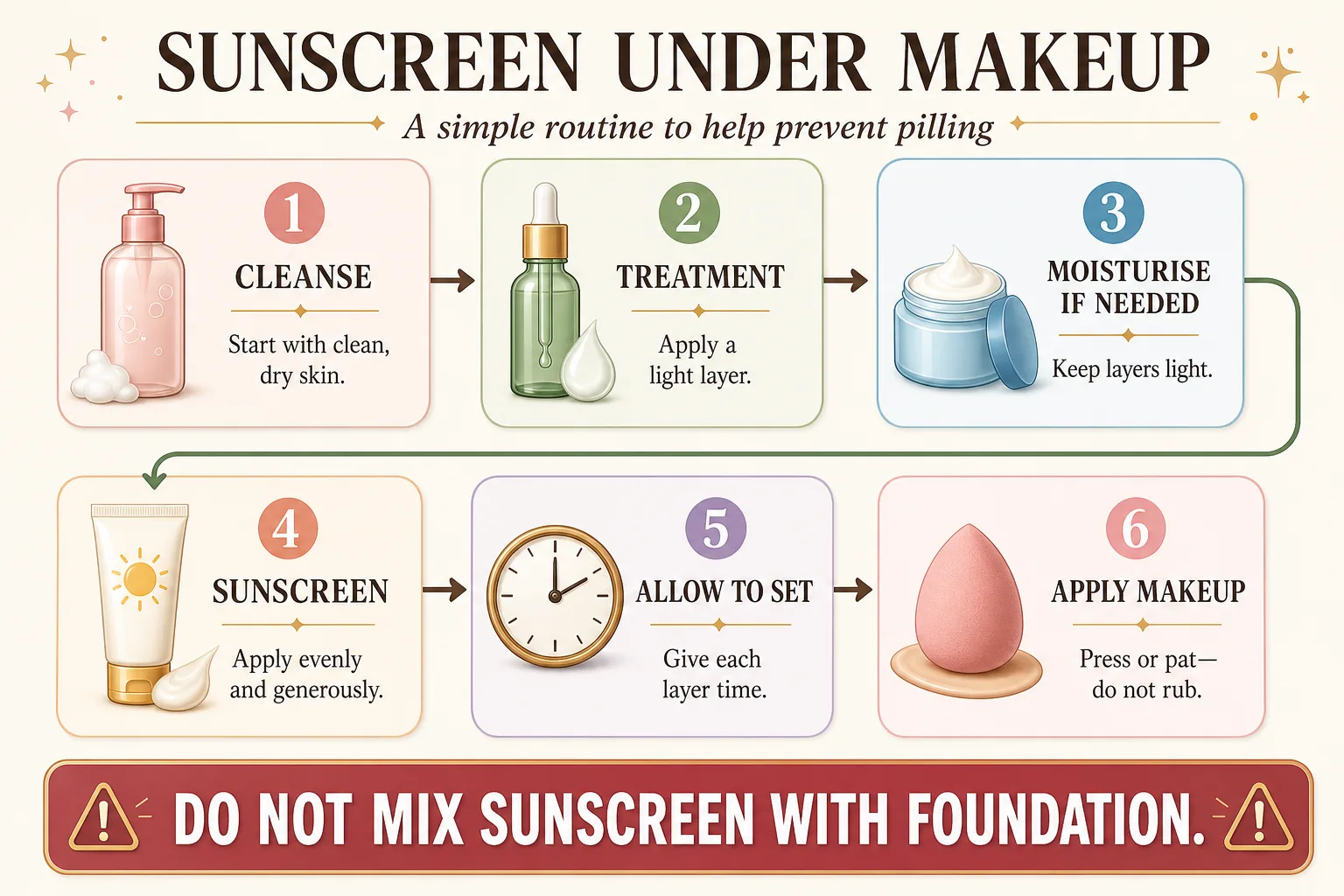
Remember: Do not mix sunscreen with foundation. Apply sunscreen as its own complete layer.
How Much Sunscreen Should You Apply?
The correct amount depends on the formula and the area being covered. For the face alone, many people use roughly two finger lengths of product, but packaging directions should take priority and the neck may require additional product.
If the recommended amount feels impossible to wear, try:
- applying it in two controlled layers;
- choosing a more fluid formula;
- reducing unnecessary products underneath; or
- finding a sunscreen with a finish that suits your skin better.
Using a tiny amount to preserve a beautiful finish undermines the labelled level of protection.
When and How to Reapply
The NHS advises reapplying sunscreen frequently and immediately after swimming, sweating or towelling. Follow the directions on your product, especially during prolonged outdoor exposure.
Over makeup, you can:
- press a fluid sunscreen on carefully with a clean sponge;
- use a sunscreen stick in controlled passes, if the product directions support this; or
- remove and reapply your base when reliable coverage matters most.
SPF sprays and powders can be convenient for touch-ups, but it can be difficult to apply enough for dependable standalone protection. They are better treated as supplements unless their instructions clearly show how to achieve the labelled protection.
Your Sunscreen Decision Guide
Choose a lightweight transparent fluid if:
- you have oily skin;
- white cast is your main concern;
- you wear makeup; or
- you dislike feeling product on your face.
Choose a tinted sunscreen if:
- hyperpigmentation or melasma is a priority;
- you want help with visible-light protection;
- you like light complexion coverage; and
- the tint genuinely matches your skin tone and undertone.
Choose a mineral sunscreen if:
- you prefer zinc oxide or titanium dioxide;
- your skin tolerates it better; and
- you have found a transparent or well-matched tinted finish.
Choose a moisturising lotion or cream if:
- your skin is dry, tight or barrier-impaired;
- you want sunscreen to replace morning moisturiser; or
- matte formulas make your skin uncomfortable.
Choose water-resistant sunscreen if:
- you are swimming;
- you exercise outdoors;
- you sweat heavily; or
- you need a more tenacious formula.
Give Every Sunscreen a Real Wear Test
Do not judge a sunscreen only from a hand swatch. Test it on your face for several ordinary days.
Check:
- Does it leave a cast in daylight?
- Does it become too shiny after a few hours?
- Does it sting your eyes?
- Does it pill over your usual skincare?
- Does makeup sit evenly on top?
- Is it comfortable at the amount needed?
- Can you remove it without harsh scrubbing?
A sunscreen that performs well in your real routine is more useful than one with a fashionable texture that you avoid wearing.
Common Sunscreen Mistakes
- Choosing a low SPF because darker skin rarely burns
- Checking SPF but ignoring UVA protection
- Applying too little to avoid shine or cast
- Mixing sunscreen with foundation
- Relying on makeup with SPF as your only sunscreen
- Assuming every breakout is caused by sunscreen
- Skipping reapplication during prolonged outdoor exposure
- Using water-resistant to mean waterproof
- Expecting one formula to suit every season and situation
The Bottom Line
The best sunscreen for dark, oily or acne-prone skin combines reliable protection with a finish you can use generously.
Start with SPF 30 or higher and strong UVA protection. Then choose the texture: a transparent fluid for minimal cast and weight, a suitable tint for visible-light protection and complexion coverage, or a more moisturising formula when your skin needs comfort.
If sunscreen pills, simplify the layers underneath, allow products to set and press makeup on instead of rubbing. Most importantly, choose a formula you are willing to apply properly and consistently.
Need help building the rest of your routine? Take the Radiant Eden Skincare Routine Quiz.
Sources
- NHS: Sunscreen and sun safety
- American Academy of Dermatology: Sunscreen for skin of colour
- American Academy of Dermatology: How to apply sunscreen
- US Food and Drug Administration: Sunscreen guidance
This article provides general skincare information and is not a diagnosis or substitute for medical advice. Seek professional advice for persistent irritation, severe acne or changing skin lesions.
Related products


Frequently asked
Is SPF 30 enough for dark skin?+
Is mineral sunscreen better for acne-prone skin?+
Does sunscreen make acne worse?+
Why does sunscreen look purple or grey on my skin?+
Can I mix sunscreen with foundation?+
Do I need moisturiser under sunscreen?+
Is makeup with SPF enough?+
Can I use the same sunscreen around my eyes?+
Find your perfect skincare routine
Answer a few questions and we'll tailor Radiant Eden's picks to you.
Build my skincare routineKeep reading
The Best Routine for Hyperpigmentation and Post-Acne Dark Spots
A calm, evidence-based routine for post-acne dark spots and hyperpigmentation: how to tell PIH, PIE, melasma and acne scars apart, and how to build a simple AM/PM routine around one active.
Adult Acne Skincare Routine: What to Use and What to Avoid
Build a simple adult-acne routine for clogged pores, hormonal breakouts and inflamed spots using benzoyl peroxide, salicylic acid, retinoids or azelaic acid.

How to Repair a Damaged Skin Barrier: Signs, Causes and a Gentle Routine
Learn the signs of a damaged skin barrier, what causes tightness, stinging, flaking and redness, and how to build a gentle recovery routine.
How to Build a Simple Skincare Routine for Your Skin Type
Build a simple skincare routine with the right cleanser, treatment, moisturiser and sunscreen for dry, oily, combination or sensitive skin.