Clarifying Shampoo vs Chelating Shampoo: Which One Does Your Hair Need?
Identify product residue, hard-water minerals and scalp flakes—then choose the cleansing step that matches the real cause.
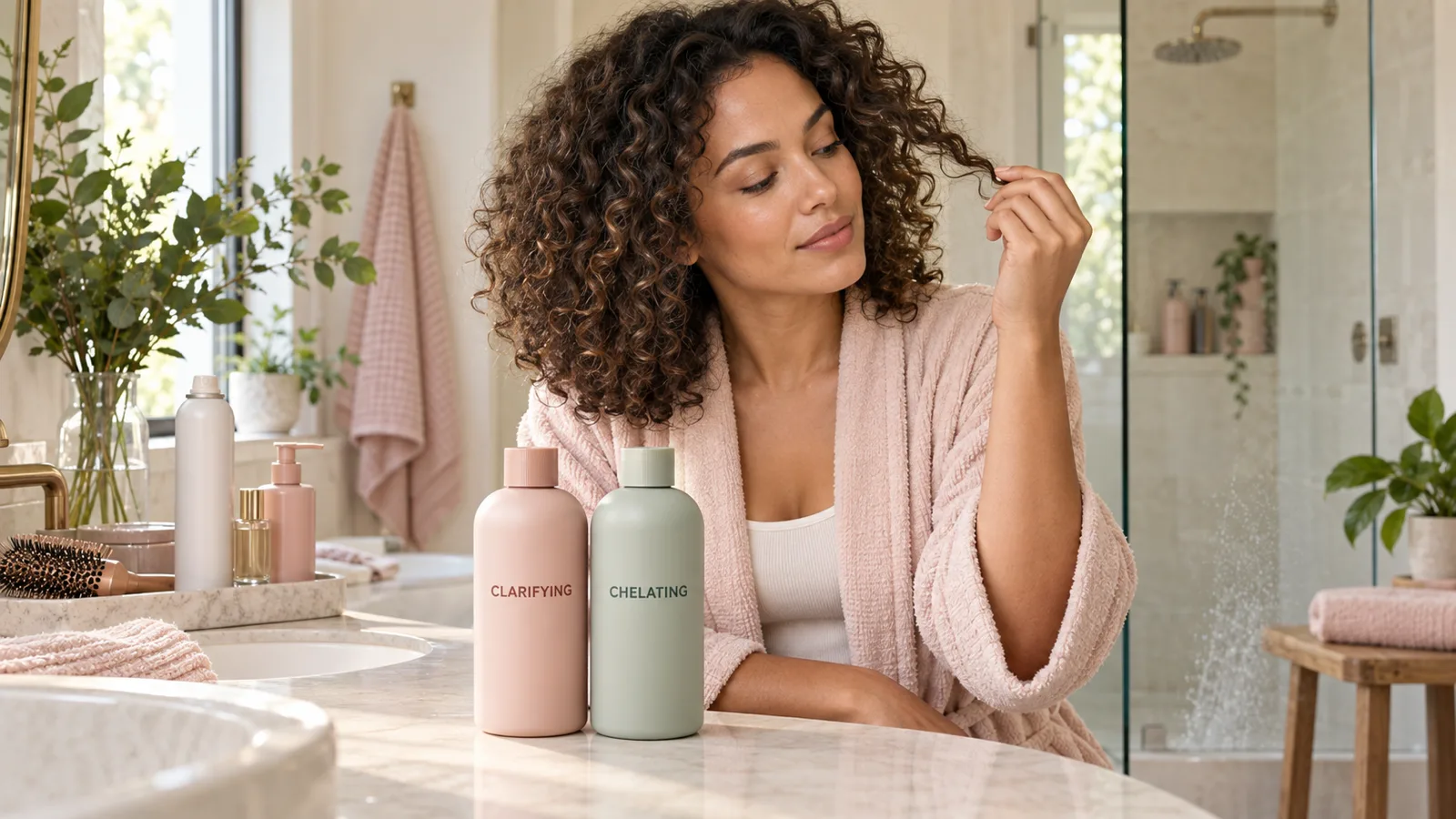
Clarifying or chelating shampoo? Learn which removes product build-up, which targets hard-water minerals, and what dandruff or low-porosity hair needs.
When hair feels coated, heavy, dull or strangely resistant to conditioner, it is tempting to reach for the strongest “detox” shampoo you can find. But a shampoo that removes styling-product residue is not necessarily the best one for hard-water minerals and neither is a substitute for a dandruff treatment.
The right choice depends on what has collected on your hair or scalp.
The short answer: Use a clarifying shampoo for excess oil and residue from dry shampoo, silicones, oils, waxes and styling products. Choose a formula with chelating action when hard-water minerals, metals or frequent swimming are the more likely problem. If your main symptoms are recurring flakes and an itchy or inflamed scalp, use an appropriate anti-dandruff shampoo instead.
Some shampoos clarify and chelate at the same time, so the words on the front of the bottle do not tell the whole story.
Clarifying and Chelating Are Not Exact Opposites
“Clarifying” describes a shampoo’s job: giving the hair and scalp a more thorough cleanse than an everyday shampoo.
A clarifying formula typically uses an effective blend of cleansing agents to remove:
- excess sebum;
- dry shampoo residue;
- hairspray, mousse, gel and styling polymers;
- oils, butters and waxes;
- some silicone and conditioning build-up; and
- residue left by repeated product layering.
“Chelating” describes a mechanism. Chelating agents bind to metal ions so that deposits from water can be rinsed away more effectively. Depending on the formula, these may target calcium, magnesium, copper or iron.
Ingredients such as disodium EDTA, tetrasodium EDTA, tetrasodium glutamate diacetate, sodium phytate, phytic acid or sodium gluconate can provide chelating or mineral-binding support. An ingredient name alone does not reveal how powerful the finished shampoo will be, however; concentration, pH, contact time and the rest of the formula matter.
This is why a product can be:
- clarifying but not especially effective against hard-water deposits;
- primarily chelating;
- both clarifying and chelating; or
- marketed as a “detox” shampoo without explaining which kinds of residue it removes.
Clarifying Shampoo vs Chelating Shampoo at a Glance
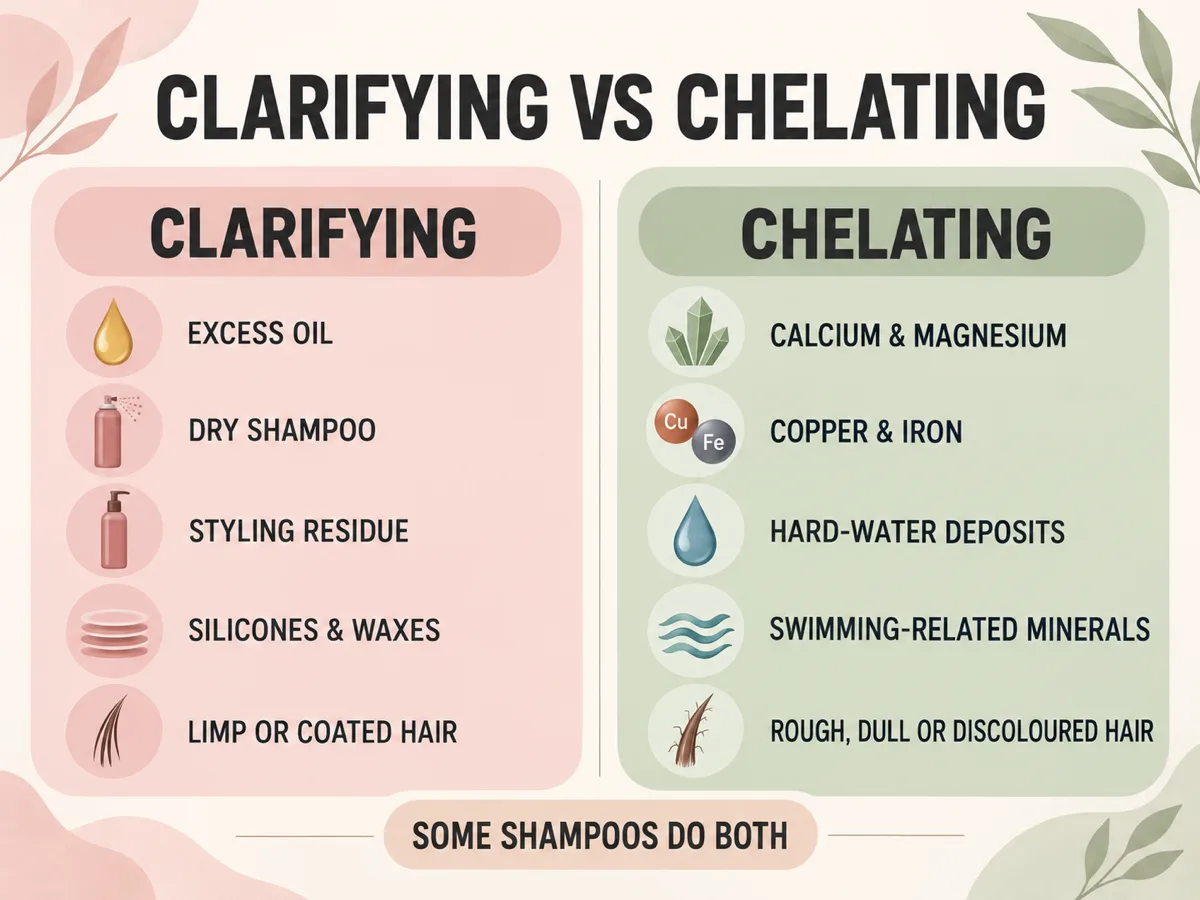
The categories overlap. For example, Living Proof Clarifying Detox Shampoo, K18 PEPTIDE PREP Detox Shampoo, OUAI Detox Shampoo and Redken Hair Cleansing Cream are all positioned by their brands to remove both product residue and at least some deposits associated with hard water.
Signs You May Need a Clarifying Shampoo
Product build-up is more likely when several of these changes appear together:
- roots still feel greasy or waxy after washing;
- hair becomes flat more quickly than usual;
- curls or waves lose spring and definition;
- strands feel tacky, coated or difficult to rinse;
- shampoo does not lather or spread as it normally does;
- your usual conditioner or styler suddenly seems ineffective;
- you use dry shampoo, oils, edge control, gel or silicone-rich stylers regularly; or
- you co-wash frequently without using a shampoo that removes the residue your products leave behind.
Clarifying is particularly useful when the problem follows a change in styling routine. If hair improved after a thorough wash and then gradually became heavy again, product amount, product combination or cleansing frequency is a more plausible explanation than a permanent change in “hair type”.
Before buying a stronger shampoo, also check your technique. Dense hair often needs to be divided into sections so water and shampoo reach the scalp. A rushed rinse can leave conditioner at the roots, while applying a rich mask too close to the scalp can make clean hair feel coated.
Signs Hard Water May Be the Problem
Hard water contains relatively high levels of dissolved minerals, particularly calcium and magnesium. Studies have found greater mineral deposition on hair washed in hard water, although research on whether this always translates into measurable loss of hair strength has produced mixed results (International Journal of Dermatology; International Journal of Trichology).
Consider a chelating formula when:
- hair feels rough, stiff or unusually tangled despite conditioning;
- blonde, grey, highlighted or colour-treated hair looks dull, brassy or altered;
- the problem began after moving house, travelling or changing water supply;
- you swim regularly;
- limescale collects quickly on taps, shower screens or your kettle;
- soap and shampoo lather less easily in your water; or
- a normal clarifying wash removes oil but does not correct the rough, mineral-coated feel.
These clues do not prove that minerals are the cause. Heat damage, bleach, too much protein, insufficient conditioning and product build-up can all make hair feel rough. The most useful clue is a pattern linked to water exposure, especially when the same products behave differently in another location.
Do shower filters remove hard-water minerals?
Most standard shower filters are designed mainly to reduce chlorine, sediment or odour. They do not necessarily soften water by removing calcium and magnesium. A true ion-exchange water softener works differently.
Before spending money on a filter, check exactly which substances it is certified to reduce. For an occasional cosmetic problem, a suitable chelating shampoo may be the simpler first experiment.
Coated Hair: Product Build-Up or Minerals?
“Coated” describes a sensation, not a diagnosis. Use the sequence below to narrow it down.
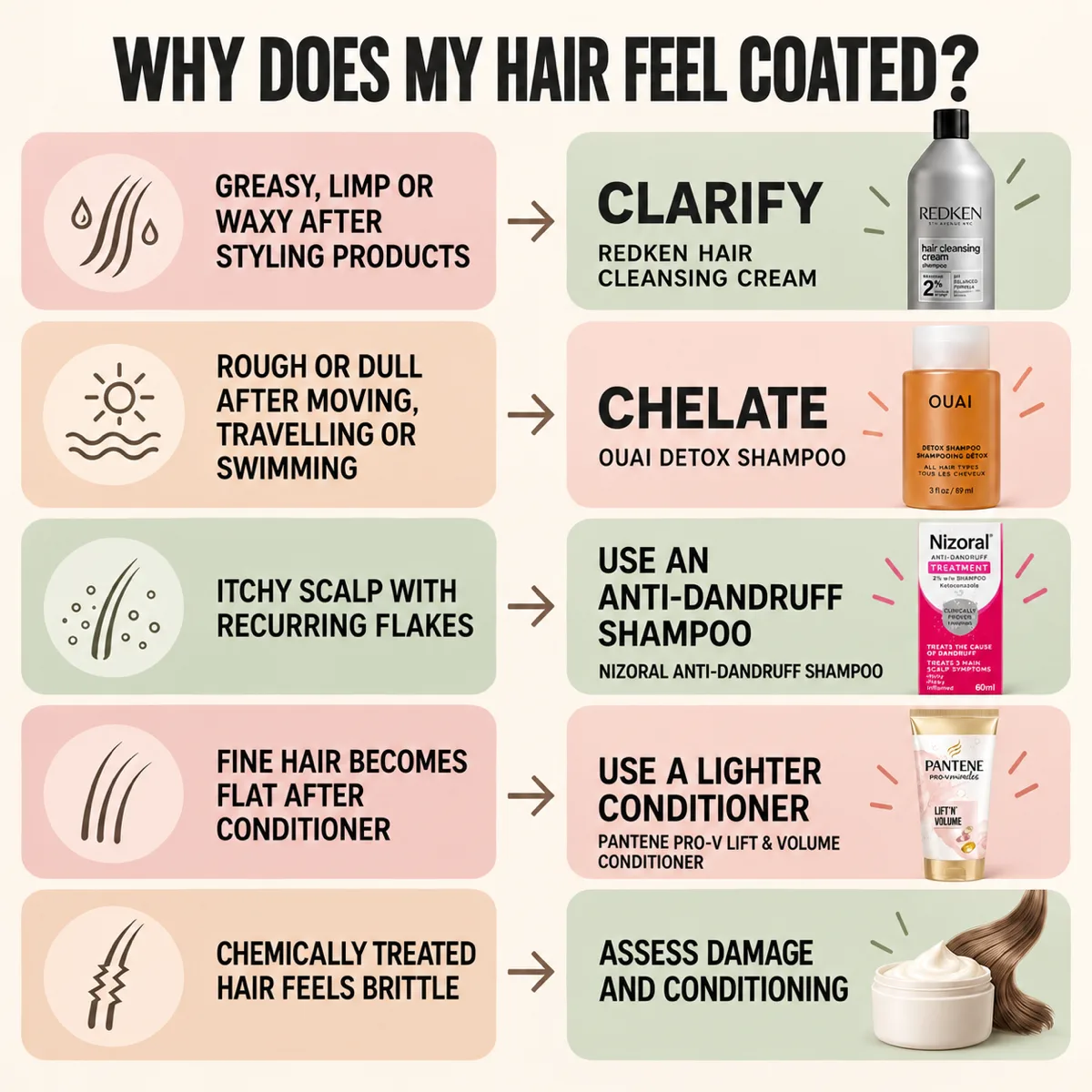
Choose clarifying first if:
- you recently increased dry shampoo, oil, gel, curl cream or silicone use;
- hair is limp, greasy or waxy rather than rough;
- the roots are affected most; or
- you have been stretching wash days or cleansing less thoroughly.
Choose chelating action if:
- your water leaves visible limescale;
- hair became rough or dull after a move, holiday or swimming;
- colour has changed unexpectedly; or
- ordinary clarifying removes grease but not the stiff feeling.
Reassess the rest of your routine if:
- only the ends feel coated after a mask or leave-in;
- the problem appears whenever you use one particular product;
- fine hair becomes flat after rich conditioner; or
- hair is actually brittle, split or chemically damaged rather than coated.
If you cannot tell, start with the least complicated explanation: wash thoroughly with your regular shampoo, condition lightly, skip leave-in layers for one wash day and observe the result. Change one variable at a time.
What About Dandruff and Scalp Build-Up?
Dandruff is not simply dirt trapped on the scalp. It can cause flaking and itching, and it overlaps with seborrhoeic dermatitis. A clarifying shampoo may remove oil and loose residue, but it does not provide the targeted action of an anti-dandruff shampoo.
The American Academy of Dermatology recommends looking for dandruff shampoos with recognised active ingredients such as ketoconazole, selenium sulphide, salicylic acid, sulfur, zinc pyrithione or coal tar, depending on what is available where you live. The shampoo must be used on the scalp and may need several minutes of contact time according to its directions (AAD). The NHS similarly advises using an anti-dandruff shampoo and seeking advice if symptoms do not improve (NHS).
Choose an anti-dandruff shampoo rather than a cosmetic clarifier when your main signs are:
- recurring flakes;
- an itchy, irritated or oily scalp;
- scale that returns soon after washing; or
- a known dandruff or seborrhoeic dermatitis diagnosis.
Options in the Radiant Eden library include Nizoral Anti-Dandruff Shampoo, OUAI Anti-Dandruff Shampoo, Neutrogena T/Gel Scalp Relief Anti-Dandruff Shampoo and Philip Kingsley Flaky/Itchy Scalp Shampoo. These are not interchangeable: compare the active ingredient, directions and suitability for your scalp rather than choosing by brand alone.
If you have painful inflammation, broken skin, thick plaques, hair loss or symptoms that persist despite appropriate treatment, speak to a pharmacist, GP or dermatologist.
Does Low-Porosity Hair Need Clarifying or Chelating Shampoo?
Low-porosity hair does not automatically need either one.
Hair described as low porosity often takes time to become fully wet and may become coated when rich products are layered faster than they are removed. This makes product build-up more noticeable, particularly on fine strands. In that situation, sensible product amounts and occasional clarifying may help.
But porosity does not tell you whether your water is hard. Choose chelating action only when you also have clues pointing to mineral exposure.
For hair that is slow to wet or easily weighed down:
- Saturate it fully before applying shampoo.
- Cleanse the scalp in sections if the hair is dense.
- Use lighter conditioner and smaller styling amounts.
- Clarify when performance changes, not simply because a calendar says to.
- Consider chelating only if water or swimming is part of the pattern.
Do not use the hair-float test to decide. Surface oil, styling residue, trapped air and water tension can affect whether a loose strand floats. How your hair behaves over several wash days is more useful.
Which Radiant Eden Shampoo Fits Which Problem?
For product build-up plus hard-water deposits: OUAI Detox Shampoo
OUAI Detox Shampoo is a concentrated clarifying option designed to remove dirt, oil, styling build-up and hard-water deposits. This makes it a practical dual-purpose choice for someone who uses several styling products and lives in a hard-water area.
For a weekly reset with metal-removal claims: K18 PEPTIDE PREP Detox Shampoo
K18 PEPTIDE PREP Detox Shampoo is positioned as a colour-safe clarifier that removes product build-up and sebum while targeting metals found in tap and hard water. K18 recommends replacing regular shampoo with it weekly or as needed (K18).
For product, pollution and hard-water build-up: Living Proof Clarifying Detox Shampoo
Living Proof Clarifying Detox Shampoo combines a cleansing system with a chelating agent intended to remove mineral and heavy-metal build-up. The brand recommends leaving the lather on for one to two minutes before rinsing, then following with conditioner or a mask (Living Proof).
For a stronger all-round cleanse: Redken Hair Cleansing Cream
Redken Hair Cleansing Cream is designed to remove styling-product residue, excess oil, pollution and minerals including copper, iron, magnesium and calcium. Redken describes it as suitable for colour-treated hair, but you should still follow the current packaging and your colourist’s advice (Redken).
The best option is not necessarily the one with the longest removal list. Choose the product whose purpose matches your most likely source of build-up and whose directions suit your hair’s condition and wash schedule.
How to Use a Clarifying or Chelating Shampoo Without Overdoing It
- Follow the product directions. Contact time and recommended frequency vary.
- Wet the hair thoroughly. In dense hair, work in sections.
- Concentrate first on the scalp and roots. Distribute through the lengths when mineral or product deposits are present there and the label directs you to do so.
- Do not scratch or aggressively scrub. More friction does not create a deeper cleanse.
- Rinse completely. Residual cleanser can make hair feel worse.
- Follow with an appropriate conditioner. Fine or low-porosity hair may need only a light conditioner on the ends; dry, coarse or damaged hair may prefer a richer formula.
- Skip extra “detox” steps that day. A scalp scrub, acidic DIY rinse and strong shampoo together are more likely to irritate than to improve the result.
There is no universal schedule. Weekly use may suit someone who swims, uses heavy styling products or follows a brand’s tested directions, while another person may need a reset only every few weeks. If hair becomes rough, tangled, faded or difficult to manage, reduce the frequency and reassess the product.
Your Quick Decision Guide
Choose clarifying shampoo when the main problem is:
- dry shampoo and styling residue;
- excess oil;
- limp, tacky or waxy hair; or
- product layers that no longer rinse cleanly.
Choose a shampoo with chelating action when the main problem is:
- hard-water mineral exposure;
- regular swimming;
- roughness or dullness linked to a location or water change; or
- unwanted mineral or metal deposits on colour-treated hair.
Choose anti-dandruff shampoo when the main problem is:
- recurring scalp flakes;
- itching and scale; or
- diagnosed dandruff or seborrhoeic dermatitis.
Adjust product weight and technique when the main problem is:
- a rich mask flattening fine hair;
- leave-in or oil sitting on the ends;
- uneven cleansing in dense hair; or
- low-porosity hair becoming coated after too many layers.
The Bottom Line
Do not choose a shampoo simply because your hair feels “dirty” or “coated”. Identify the likely deposit first.
Product residue and excess oil call for clarifying. Hard-water minerals and metals call for chelating action. Recurring flakes and itching call for an appropriate anti-dandruff treatment. Low-porosity hair may need lighter layering and better cleansing, but porosity alone does not prove mineral build-up.
When the signs overlap, a shampoo that both clarifies and chelates can be useful. Start conservatively, follow the directions and judge the result by how clean, flexible, manageable and comfortable your hair and scalp feel over the next few washes.
Compare cleansing shampoos in the Radiant Eden product library, or use the Radiant Eden Hair Routine Quiz to build a routine around your scalp, strand thickness, density and hair condition.
Sources and further reading
- [American Academy of Dermatology: How to treat dandruff]
- [NHS: Dandruff]
- [Scanning electron microscopy of hair treated in hard water]
- [Effects of hard water on hair]
- [Essentials of Hair Care Often Neglected: Hair Cleansing]
- Some product links may be affiliate links. If you buy through them, Radiant Eden may earn a commission at no extra cost to you. Recommendations are based on product purpose, formula and suitability—not commission.*
- This article provides general hair- and scalp-care information. It cannot diagnose dandruff, dermatitis, psoriasis, infection or hair loss.*
Related products


Frequently asked
Can a clarifying shampoo remove hard-water build-up?+
Is chelating shampoo stronger than clarifying shampoo?+
Can I use chelating shampoo on colour-treated hair?+
Will clarifying shampoo cure dandruff?+
Should I deep-condition after chelating?+
How do I know whether my area has hard water?+
Find your perfect haircare routine
Answer a few questions and we'll tailor Radiant Eden's picks to you.
Build my haircare routineKeep reading
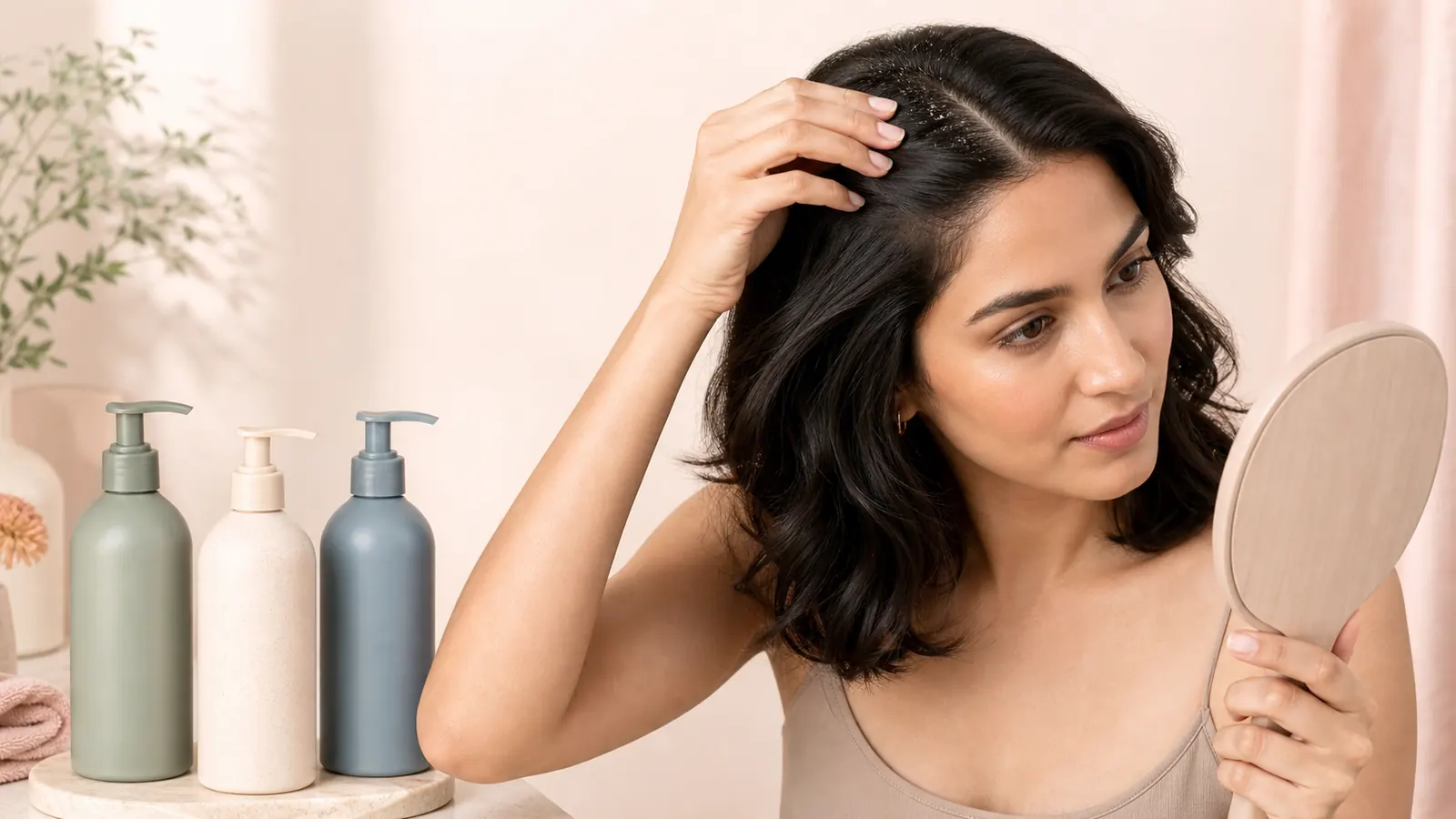
Dry Scalp, Dandruff or Product Build-Up? How to Tell the Difference
Learn how to tell dry scalp, dandruff and product build-up apart, which shampoo or scalp serum to use, and when to seek professional help.
Hair Porosity Explained: How to Test It and Choose the Right Products
Learn how to assess hair porosity without relying on the float test, then choose product weight and protection for your strands.

How to Build a Hair Care Routine for Your Hair Type
Build a hair care routine that suits your scalp, strand thickness, density, porosity and natural pattern, from straight and wavy to curly and coily.