Hair Shedding vs Breakage: How to Tell What’s Actually Happening
How to identify loose strands, reduce avoidable damage and recognise warning signs

Learn how to distinguish hair shedding from breakage, identify damaging styling habits and recognise when thinning or hair loss needs medical advice.
Finding a collection of hair in the shower, on your brush or around your clothes can be alarming. But the hair you see may be coming away for different reasons.
Some strands have naturally completed their growth cycle and shed from the scalp. Others have snapped somewhere along the hair shaft. You may also be noticing a broader form of hair loss that needs professional assessment.
Understanding the difference can help you adjust your routine without relying on treatment claims, miracle supplements or products that cannot address the underlying cause.
The short answer: Shed hairs usually come away from the scalp as complete strands. Broken hairs snap along the shaft, leaving shorter pieces and uneven lengths. However, you can experience shedding, breakage and hair loss at the same time, so changes in density or scalp symptoms deserve closer attention.
Shedding, Breakage and Hair Loss Are Not the Same
Hair shedding
Shedding is part of the normal hair-growth cycle. The American Academy of Dermatology and the NHS note that losing approximately 50 to 100 hairs a day can be normal.
You will not necessarily see those hairs every day. Loose strands can remain caught among curls, coils, braids or dense hair until you wash, brush or detangle.
Excessive shedding occurs when noticeably more hairs than usual enter the resting phase and fall out. One common form is telogen effluvium, which can develop after illness, childbirth, surgery, substantial stress, rapid weight loss or another significant change in the body.
Hair breakage
Breakage happens when a strand snaps somewhere between the scalp and the end. The follicle has not released the complete hair; part of the shaft has broken away.
Damaged hair becomes more fragile and less able to withstand brushing, detangling, heat, chemical processing and everyday friction. Breakage can leave the hair looking frizzy, thin, uneven or unable to retain length.
Hair loss
Hair loss is a broader term. It can involve excessive shedding, changes to the hair-growth cycle, progressive thinning, bald patches, inflammation or damage to the follicles.
The AAD explains that shedding and hair loss are different processes, although some people experience both. A dermatologist or GP can assess the pattern, scalp and medical history to determine what may be happening.
The Quick Comparison
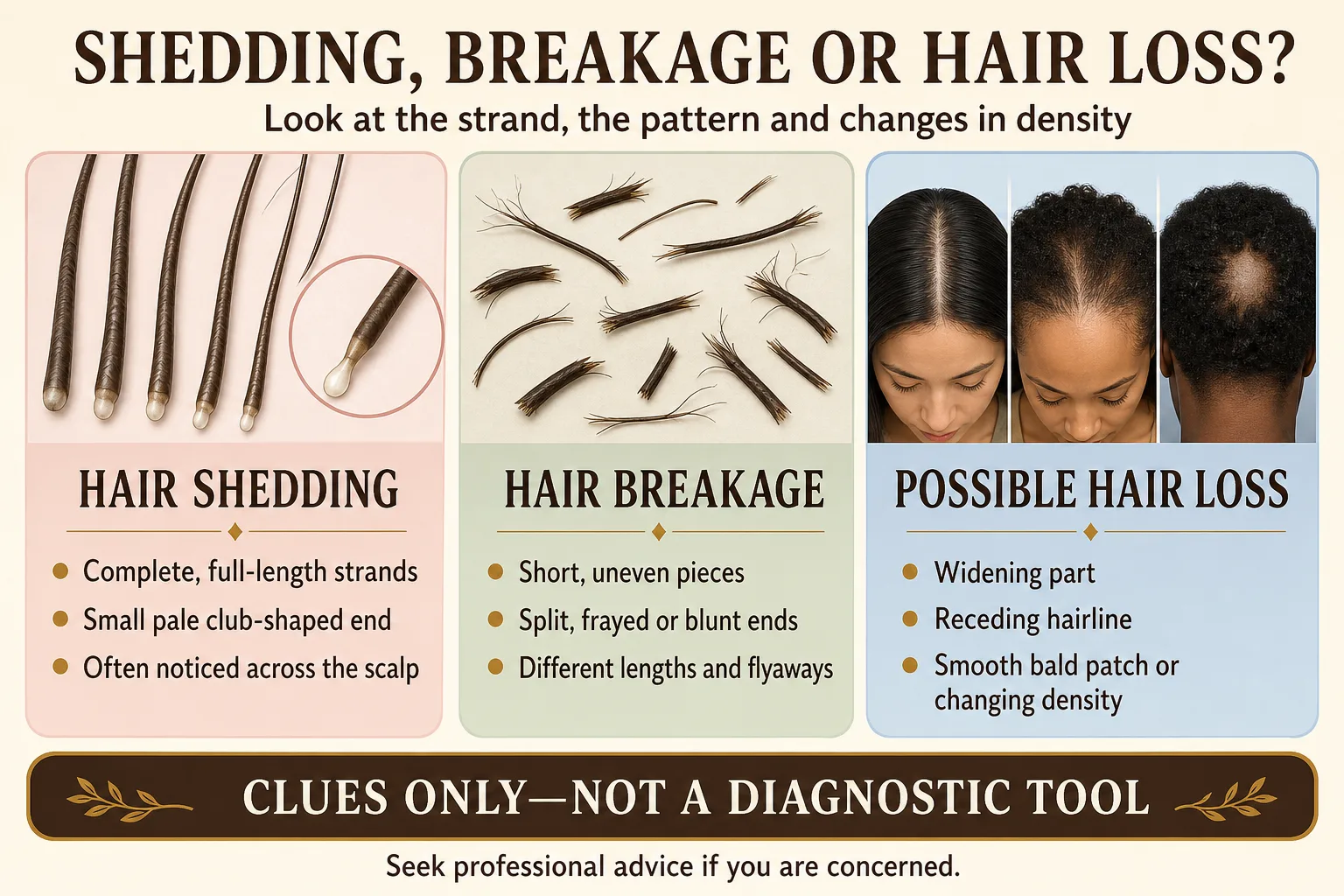
Shedding is more likely when:
- Most of the hairs appear to be complete, full-length strands.
- You notice increased fall from across the scalp.
- The hairs have a small pale or club-shaped end.
- The increase began a few months after illness, surgery, childbirth, significant stress or weight loss.
- Your ends do not appear unusually split or uneven.
Breakage is more likely when:
- You find many shorter pieces mixed with longer hairs.
- There are no obvious club-shaped ends on the broken pieces.
- Your hair has split ends, roughness, knots or a brittle feeling.
- Certain areas look shorter or more frizzy than the rest.
- Breakage is concentrated where you use heat, apply chemicals or create tension.
- Your hair seems to grow at the roots but does not retain length.
Professional assessment is important when:
- Your part is widening or your ponytail feels progressively thinner.
- You have a receding hairline, smooth bald patches or visible scalp.
- Loss is concentrated around the crown, temples or edges.
- Your scalp is painful, burning, intensely itchy, inflamed or scaly.
- You cannot confidently tell whether the problem is shedding, breakage or both.
What Are You Seeing in the Shower or Brush?
A clump in the shower does not automatically indicate severe hair loss. The amount you see on one wash day depends on several factors.
How often you wash and detangle
If you wash every day, shed hairs may appear gradually. If you wash weekly or less often, several days of naturally released hairs can appear at once.
Curly and coily strands can hold shed hairs within the curl pattern until the hair is separated during washing or detangling. This can make wash-day shedding look more dramatic.
Your hair’s length and density
A small number of long strands can look like a large clump, especially when wet. Dense hair can also produce a more substantial-looking collection than fine or low-density hair.
Rather than judging the size of one clump, look for a consistent change from what is normal for you.
Whether the hair is full length
Gently examine a few strands without repeatedly pulling at your scalp.
A shed hair is often approximately the same length as the section it came from and may have a small, pale club-shaped end. This is hardened material from the hair, not the entire follicle, so shedding a hair does not mean that you have pulled out its ability to grow.
Broken hairs are more likely to appear in mixed lengths, sometimes with frayed, split or blunt ends.
This check provides clues, not a diagnosis. A hair can break close to the scalp, and naturally shed hairs are not always easy to examine.
Whether your overall density is changing
Photographs can be more useful than counting every strand. Take occasional pictures of your part, hairline, temples and crown in similar lighting and with the hair styled the same way.
Avoid checking every day, as small changes in lighting, oiliness and part placement can make the scalp look different.
Common Causes of Increased Hair Shedding
A delayed response to physical or emotional stress
Telogen effluvium often begins a few months after a significant event rather than immediately.
Possible triggers include:
- childbirth;
- high fever or a substantial illness;
- surgery;
- major emotional stress;
- rapid or significant weight loss;
- restrictive dieting;
- iron deficiency;
- thyroid or other hormonal changes; and
- starting or stopping certain medicines.
The British Association of Dermatologists describes telogen effluvium as increased shedding caused when illness, stress or major changes in the body disrupt the normal hair cycle.
Because of the delay, readers may not connect current shedding with an event that occurred several months earlier.
Do not stop prescribed medication because you suspect it is affecting your hair. Discuss it with the clinician who prescribed it.
Pattern hair loss
Gradual thinning, a widening part, a receding hairline or reduced density may indicate pattern hair loss rather than temporary shedding alone.
Some people have both pattern hair loss and telogen effluvium, which can make a pre-existing change more noticeable.
Scalp or inflammatory conditions
Inflammation, infection and certain scalp disorders can affect hair growth or contribute to loss. Scaling, pain, pustules, persistent redness, discolouration or intense itching should not be treated as a simple cosmetic problem.
If flakes are your main concern, see Dry Scalp, Dandruff or Product Build-Up? How to Tell the Difference.
Nutritional deficiencies
Iron deficiency and inadequate nutrition can be associated with hair shedding, but taking supplements without knowing whether you are deficient is not a reliable solution.
Some nutrients can be harmful in excessive amounts. A GP can decide whether your symptoms and medical history suggest that blood tests are appropriate.
Common Causes of Hair Breakage
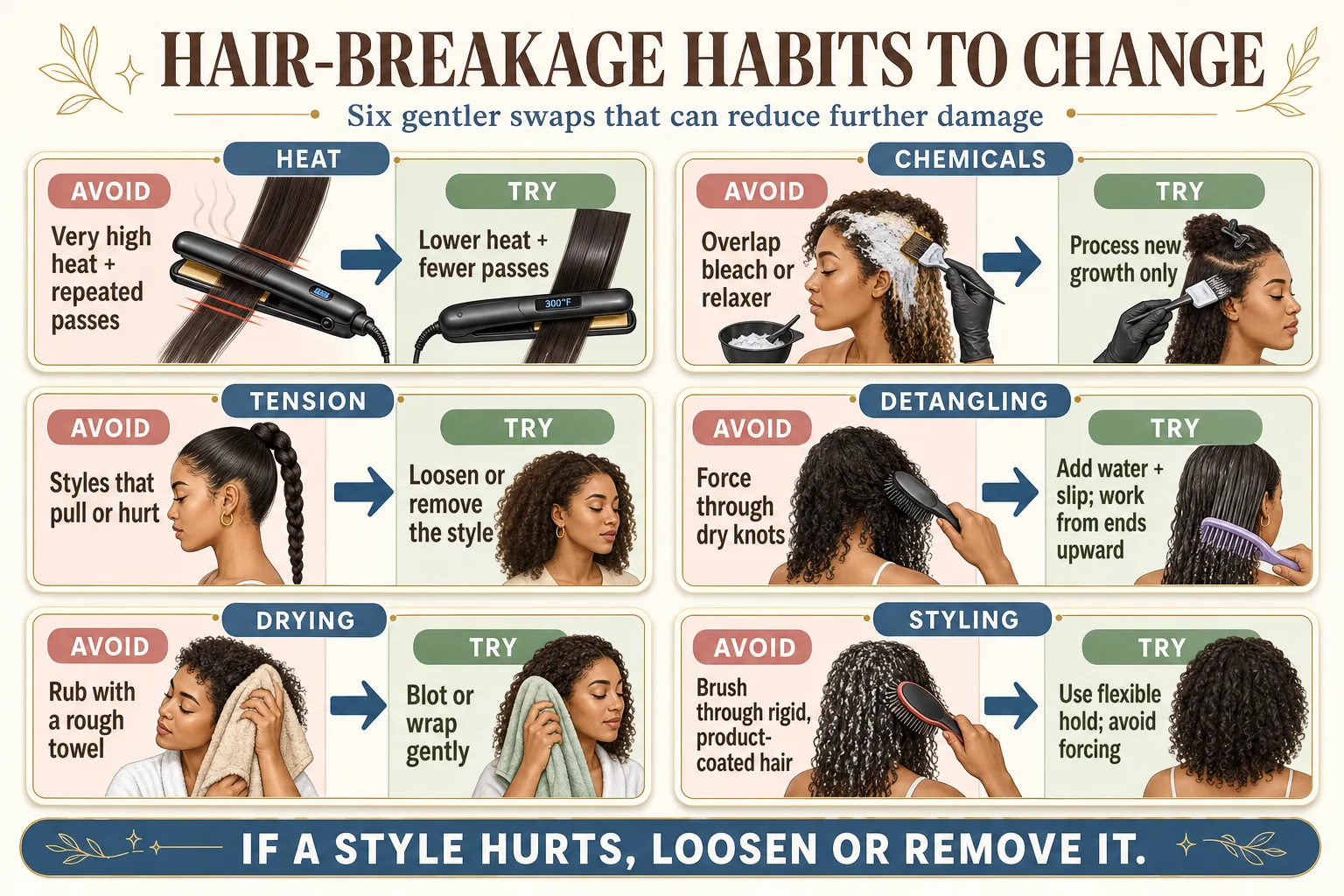
Excessive heat
Frequent use of straighteners, curling irons, hot combs and high-temperature blow-drying can weaken the hair shaft.
Damage becomes more likely when:
- tools are used at very high temperatures;
- the hair is not fully dry before ironing;
- the same section is passed through repeatedly;
- heat is used frequently; or
- the hair is already chemically processed.
Heat protectant can reduce some damage, but it cannot make unlimited heat harmless.
Chemical processing
Bleaching, permanent colouring, relaxing and perming alter the hair’s structure. Combining services or repeatedly overlapping chemicals onto previously processed hair increases the risk of weakness and breakage.
If your hair is breaking after a chemical service, focus on gentle handling and seek professional advice before applying another treatment.
Tension from hairstyles
Tight ponytails, slicked-back buns, cornrows, braids, weaves and extensions can place repeated tension on the hair and follicles.
Early warning signs include:
- pain or headaches from the style;
- bumps or tenderness around the hairline;
- broken hairs near the edges;
- thinning at the temples; and
- a style that feels tight when you move your face.
Persistent tension can contribute to traction alopecia, which may become permanent if it continues for long enough.
Rough detangling
Trying to force through knots without adequate water, slip or sectioning can snap vulnerable strands.
For curly and coily hair, use your fingers or a flexible detangling brush on damp, well-conditioned hair. Start at the ends and work upwards in manageable sections.
Although a wide-tooth comb is often promoted as a detangling tool for curls and coils, its rigid teeth may pull too firmly against complex knots. It can be more useful for gently separating roller-set curls or fluffing a blowout when the hair is already detangled.
See The Complete Wash-Day Routine for Curly and Coily Hair for a more detailed detangling routine.
Friction and rough drying
Rubbing wet hair vigorously with a towel, sleeping without protecting fragile lengths and repeatedly handling the same areas can contribute to weathering and breakage.
Use a soft microfibre towel or cotton T-shirt to blot or wrap the hair. At night, a satin or silk bonnet, scarf or pillowcase can reduce friction.
Brushing or styling too often
Hair does not need 100 brush strokes a day. The AAD’s guidance on preventing hair damage recommends keeping brushing to what is needed for styling and avoiding unnecessary pulling and tugging.
Long-lasting hold products can also make the hair rigid. Brushing or combing after the product has set may cause strands to snap.
Dryness, weathering and accumulated damage
The ends are the oldest part of your hair and have experienced the most washing, styling, sunlight and friction. They may become rough, split and prone to single-strand knots.
Conditioner, leave-in products and a small amount of oil or serum can improve lubrication and reduce friction, but products cannot permanently fuse badly split ends. Trimming may be necessary when the ends remain severely damaged.
Why Curly and Coily Hair May Show More Breakage
Curling creates bends along the hair shaft, and each bend can become a point of mechanical stress. Natural scalp oils also travel less easily along tightly curled strands, which can leave the lengths with less lubrication.
Shrinkage, tangling and single-strand knots add further opportunities for breakage during detangling.
This does not mean curly or coily hair is unhealthy. It means the routine should prioritise:
- adequate conditioning and slip;
- working in sections;
- low-tension styling;
- gentle, flexible tools;
- controlled heat;
- protecting the ends; and
- reducing unnecessary manipulation.
A Gentle Routine When You Suspect Breakage
1. Cleanse the scalp without roughing up the lengths
Massage shampoo into the scalp with your fingertips. Let the lather move through the lengths as you rinse instead of scrubbing the hair together.
Choose cleansing strength according to your scalp and product use. Persistent residue can make detangling more difficult, while overly harsh or frequent cleansing may leave fragile lengths feeling rough.
2. Condition after shampooing
Apply conditioner through the lengths and ends. Allow enough time for the product to soften the hair before beginning to detangle.
A deeper conditioner may help when the hair feels very rough, but heavier is not always better, especially for fine strands.
3. Detangle with water, slip and sectioning
Keep the hair damp and adequately coated with conditioner. Separate large knots with your fingers before using a flexible tool.
Work from the ends upwards and support the section above the knot to reduce pulling at the scalp.
4. Use a leave-in that suits your strand thickness
Fine hair may need a light spray or fluid. Coarser strands may tolerate a creamier leave-in.
Apply enough to improve flexibility and reduce friction without coating the hair so heavily that it becomes difficult to cleanse.
5. Reduce heat and tension
Lower the temperature, reduce repeated passes and give the hair breaks from high-tension styles.
A hairstyle should not hurt. Loosen or remove it if you feel persistent pulling, stinging or tenderness.
6. Protect the ends
Use a small amount of oil or serum on the ends when needed to improve lubrication and reduce friction. Protect the hair overnight and avoid leaving fragile ends rubbing against clothing continuously.
7. Trim damage that continues to split
Products may temporarily smooth split ends, but a split can continue travelling up the shaft. Removing severely damaged ends can make detangling easier and reduce further splitting.
What Products Can and Cannot Do
Hair products can help reduce friction, improve manageability and protect the shaft from additional damage. Useful categories include:
- a suitable shampoo;
- a conditioner with good slip;
- a leave-in conditioner;
- a heat protectant;
- a lightweight oil or serum; and
- an occasional strengthening or bond-support product.
However, a shampoo, oil or mask cannot treat every cause of excessive shedding or restore a damaged follicle.
Bond-building products may temporarily improve the strength and feel of damaged hair, but they are not treatments for telogen effluvium, pattern hair loss, alopecia areata, traction alopecia or scarring conditions.
When to Seek Medical Advice
Speak to a GP or dermatologist if:
- you are worried about the amount of hair you are losing;
- shedding is sudden, severe or continuing;
- your part is widening or your overall density is decreasing;
- you develop a receding hairline or smooth bald patches;
- your eyebrows, eyelashes or body hair are also changing;
- the scalp is painful, burning, intensely itchy, inflamed or persistently scaly;
- you have pustules, sores or discharge;
- breakage is concentrated at the crown or centre of the scalp;
- your hairline is thinning after tight hairstyles or extensions;
- hair changes accompany fatigue, unexplained weight changes, menstrual changes or other symptoms;
- the problem began after starting or changing medication; or
- gentler care is not improving suspected breakage.
Hair breakage at the crown, particularly when accompanied by tenderness, itching or progressive thinning can sometimes be an early sign of central centrifugal cicatricial alopecia. This condition is seen more often in Black women and requires medical assessment because scarring hair loss can become permanent.
The NHS advises seeing a GP if you are worried about hair loss and recommends getting an idea of the cause before approaching a commercial hair clinic.
Preparing for Your Appointment
It may help to record:
- when the change began;
- whether the loss is diffuse or concentrated;
- recent illness, fever, surgery or childbirth;
- substantial stress or weight changes;
- medicines and supplements;
- hair-colouring, bleaching, relaxing or perming;
- usual hairstyles and extension use;
- scalp symptoms; and
- photographs showing changes over time.
Do not feel that you need to count every shed hair. The pattern, timing, symptoms and effect on density are often more informative.
Your Hair-Fall Check at a Glance
- Look at the strands: Are they mainly full length or mixed shorter pieces?
- Check the ends: Do you see club-shaped ends, splitting or fraying?
- Look at the pattern: Is the change diffuse, patchy or concentrated around the hairline or crown?
- Review the timing: Was there an illness, birth, surgery, major stress, weight change or chemical service in the preceding months?
- Check the scalp: Is there pain, burning, itching, scaling or inflammation?
- Review your routine: Are heat, tension, friction or rough detangling likely contributors?
- Watch density not just the brush: Is your part widening or your hairline changing?
- Seek professional advice when concerned: Shedding, breakage and hair loss can overlap.
The Bottom Line
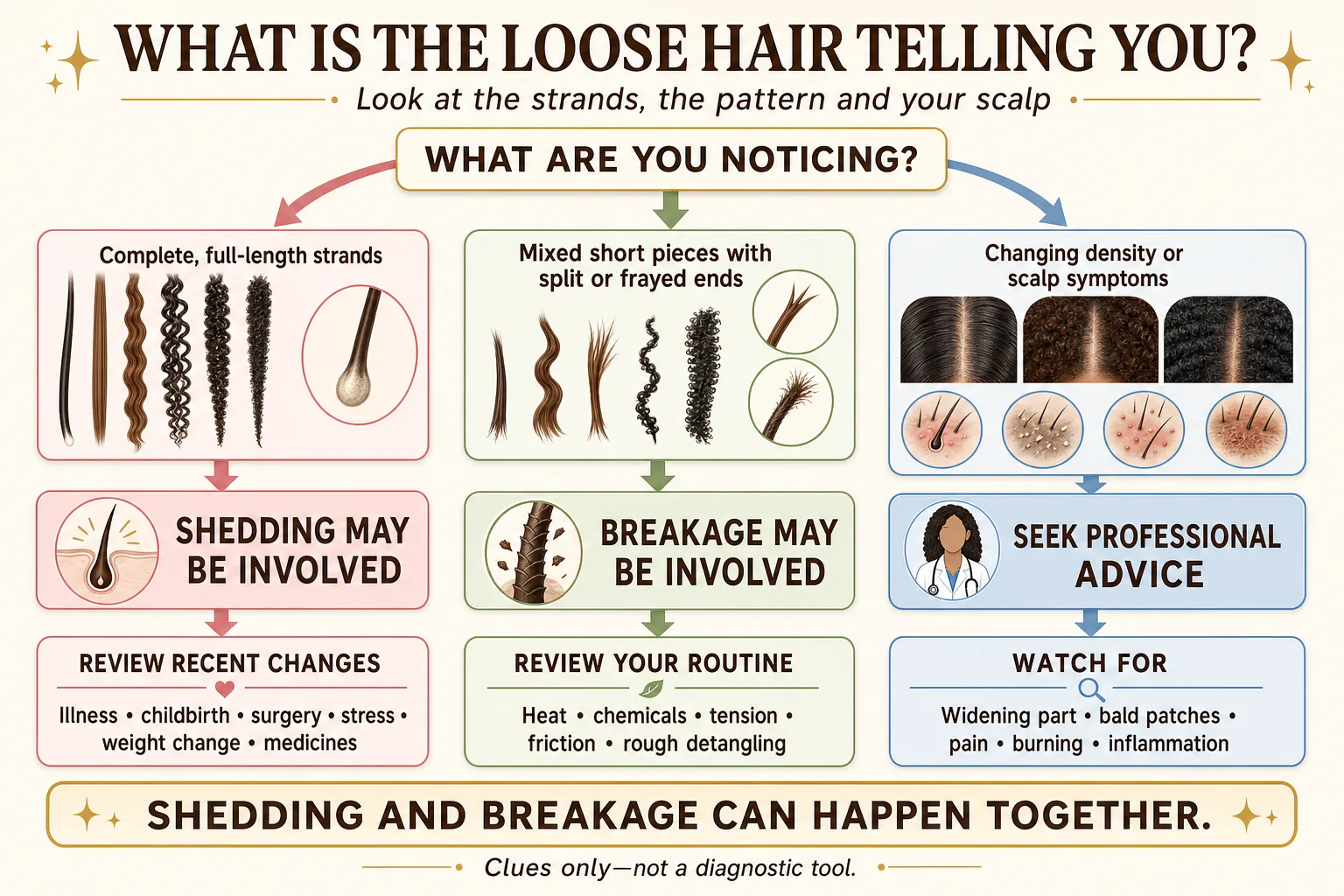
Shed hair usually leaves the scalp as a complete strand. Breakage occurs when a weakened strand snaps along its length. The hairs in your shower or brush can provide clues, but they cannot always identify the cause.
If you see mixed short pieces, split ends and uneven lengths, particularly after heat, chemicals, tight styling or rough detangling, breakage may be playing a significant role.
If you notice many complete hairs, diffuse loss or a delayed change after illness, childbirth, surgery, stress or weight loss, increased shedding may be involved.
A widening part, bald patches, scalp pain, inflammation or continued loss should be professionally assessed. The goal is not to guess at a treatment, it is to understand what is changing and respond early.
Build a routine around both your scalp and your strands with the Radiant Eden Hair Routine Quiz.
Sources
- American Academy of Dermatology: Do you have hair loss or hair shedding?
- American Academy of Dermatology: How to stop damaging your hair
- American Academy of Dermatology: Hair-loss signs and symptoms
- British Association of Dermatologists: Telogen effluvium
- NHS: Hair loss
- DermNet: Hair shedding
This article provides general information and cannot diagnose the cause of hair shedding, breakage or hair loss. Consult a GP or dermatologist for individual assessment.
Related products


Frequently asked
Does a white bulb mean the hair will not grow back?+
Can I experience shedding and breakage at the same time?+
Why does wash-day shedding look worse with curly or coily hair?+
Can a bond-repair treatment stop shedding?+
Should I take a hair supplement?+
Will cutting my hair stop breakage?+
How long does stress-related shedding last?+
Should I stop a medicine if I think it is causing hair loss?+
Find your perfect haircare routine
Answer a few questions and we'll tailor Radiant Eden's picks to you.
Build my haircare routineKeep reading

Dry Scalp, Dandruff or Product Build-Up? How to Tell the Difference
Learn how to tell dry scalp, dandruff and product build-up apart, which shampoo or scalp serum to use, and when to seek professional help.

The Complete Wash-Day Routine for Curly and Coily Hair
Build a curly or coily hair wash-day routine with the right order for cleansing, conditioning, detangling, leave-in, styling, drying and overnight protection.

How to Stop Frizzy Hair: A Routine for Every Hair Type and Climate
Learn what causes frizzy hair and build an anti-frizz routine for humid or dry weather, with practical advice for fine, thick, straight, wavy, curly and coily hair.

How to Build a Hair Care Routine for Your Hair Type
Build a hair care routine that suits your scalp, strand thickness, density, porosity and natural pattern, from straight and wavy to curly and coily.
Do You Need Bond Repair Products? A Dermatologist-Style Guide to How They Actually Work
Bond repair products promise stronger hair, but do they work, and do you need them? A clear guide to hair bonds, damage types, and when to use them.